
Gully Cricket Rules for Kids – Street Cricket Basics in India
Gully cricket is not a smaller version of cricket; it is a different game with its own constitution, passed orally from older kids to younger ones. The wicket might be a crate, a stack of bricks or chalk lines on a wall. The ball is a taped tennis ball. The boundary is the neighbour's gate. And the rules are wonderfully specific: "one tip one hand," "direct out if it hits the window," "last man batting allowed," "no LBW."
This page writes down the most common gully cricket rules so that children can agree on them quickly and play safely. It is meant for kids and families playing in lanes, terraces, society parking (when safe and allowed) and school courtyards. It also covers ball choice, field setup, team selection, scoring, fair dispute resolution and safety around traffic and windows.
History and cultural note — इतिहास और परंपरा
Cricket arrived in India during the colonial era and quickly became a national passion. As cities grew, children adapted it to small spaces, creating gully cricket. The tennis ball, sometimes wrapped in electrical tape for extra pace, became the standard, and local rules evolved for each lane's shape. Many famous Indian cricketers have spoken about learning the game in galis and maidans. Gully cricket remains one of the most democratic games in India: no kit, no fees, just a bat and a ball.
Players and age group — खिलाड़ी और उम्र
Four to fourteen players. Teams can be equal or "one batting, everyone fielding" (common when numbers are odd). Ages six and up, but mixed ages are typical. Older kids should bowl gently to younger batters.
Equipment you need — सामान
- A cricket bat (plastic or wooden) or a flat plank for young kids.
- A tennis ball or soft rubber ball; taped tennis ball for older kids.
- Wickets: stumps, a crate, bricks, or chalk lines on a wall.
- Chalk to mark the crease and boundaries.
Ground and setup — मैदान की तैयारी
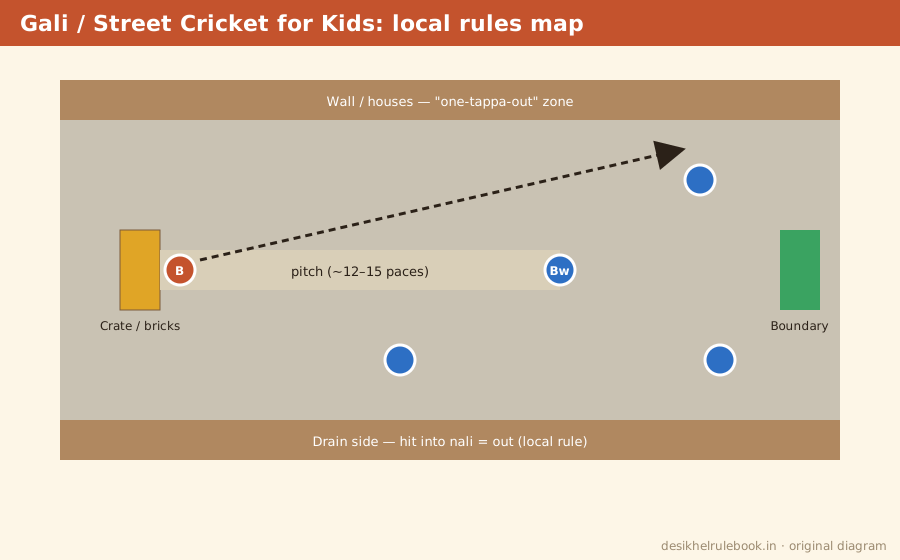
Choose a safe space: a lane with no traffic, a closed terrace with high walls, or a playground. Mark a pitch about 12–15 paces long for kids. Put the wicket at one end and a bowling crease at the other. Decide boundaries: e.g., ball hitting the wall on full = four, over the wall = out (to protect windows). Decide "out zones": drains, roofs or a neighbour's balcony.
Step-by-step rules — खेल के नियम
- Team selection: two captains pick players alternately, or use "toss and odd-even." Rotate captains each match so the same kids do not always pick.
Step 1 – Gully Cricket step 1: Team selection - Overs: agree on overs per innings (e.g., 3 or 5 overs).

Step 2 – Gully Cricket step 2: Overs - Bowling: underarm or slow overarm for young kids. No chucking hard at small batters.
Step 3 – Gully Cricket step 3: Bowling - Batting: batter must hit the ball and run if possible. In short lanes, runs are counted by hitting a wall or reaching a line.

Step 4 – Gully Cricket step 4: Batting - One tip one hand: if a fielder catches the ball with one hand after it bounces once (one tip), the batter is out.
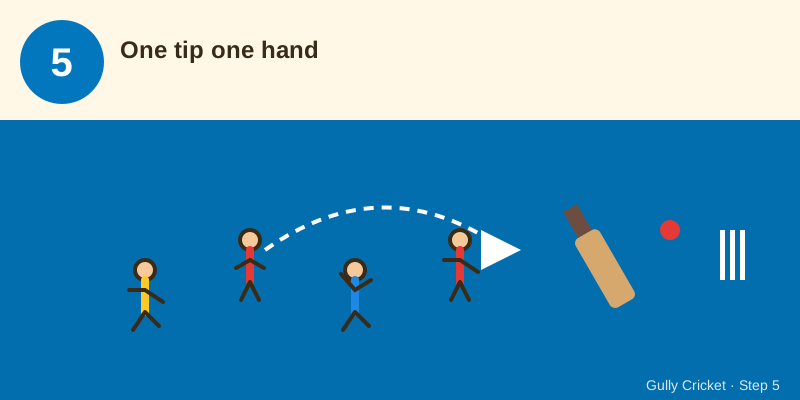
Step 5 – Gully Cricket step 5: One tip one hand - Direct catch: normal catch on the full is out.

Step 6 – Gully Cricket step 6: Direct catch - Wall rules: if the ball hits a particular wall on full, it is four; over the wall is out. Customise for your lane.
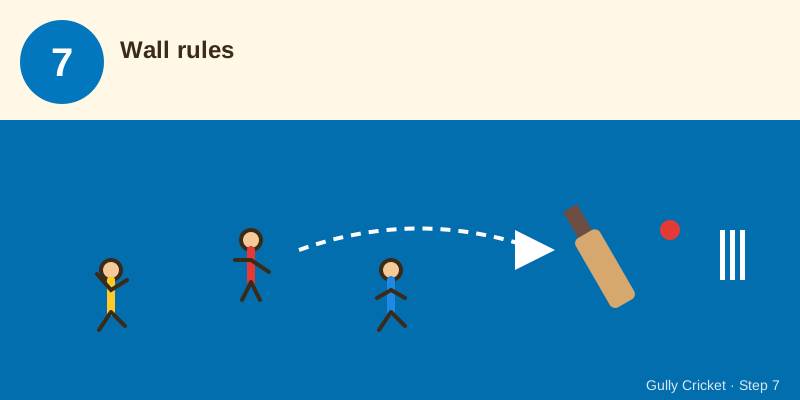
Step 7 – Gully Cricket step 7: Wall rules - No LBW: most gully games do not allow leg-before-wicket, because it causes fights.
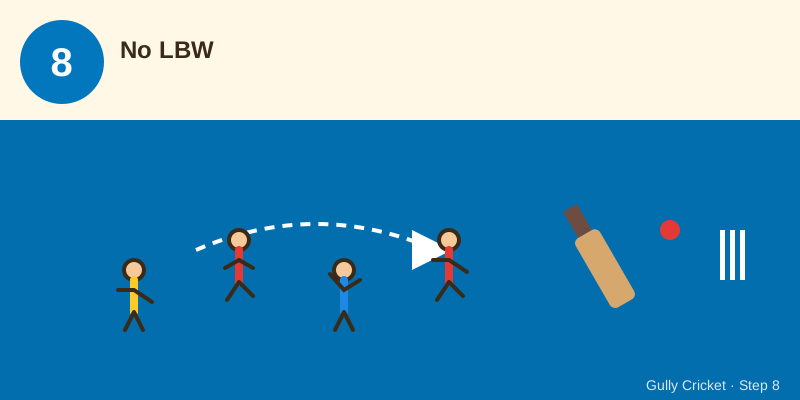
Step 8 – Gully Cricket step 8: No LBW - Last man batting: when only one batter is left, they may bat alone and run without a partner (agree beforehand).

Step 9 – Gully Cricket step 9: Last man batting - Trial ball: the first ball of the match is often a trial; no outs.
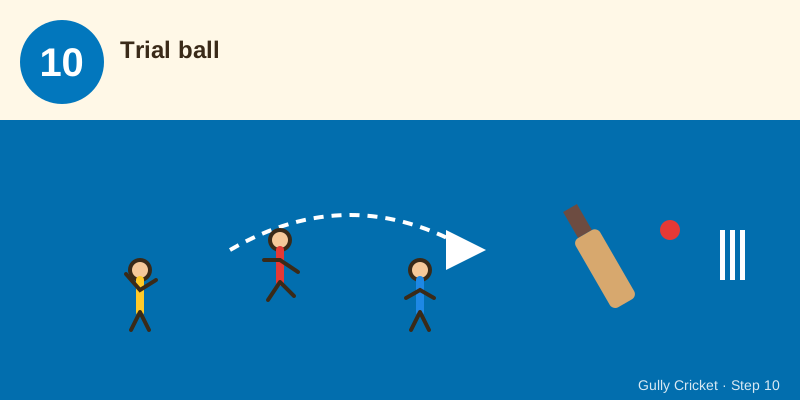
Step 10 – Gully Cricket step 10: Trial ball
Scoring and winning — अंक और जीत
Runs can be scored by running between the wickets (if space allows) or by fixed zones: e.g., one run for a hit past the bowler, two for hitting the side wall, four for the far wall on full. Wides and no-balls are usually one run and an extra ball. In small spaces, a "drop" (ball hitting a specific step) may count as a run.
Fouls and common disputes — फ़ाउल और झगड़े
- Hitting the ball into a neighbour's house or window — batter out and must apologise/collect the ball.
- Throwing the ball hard at batters — bowler warned.
- Fielders arguing endlessly — use the "captain decides" or "replay" rule.
- Running into traffic — immediate stop; game ends if repeated.
A sample round, explained — एक उदाहरण
In a society lane, Team A bats. Rohit hits the ball off the wall on full — four runs. Next ball, he taps it softly; it bounces once and a fielder catches it with one hand: "One tip one hand, out!" Rohit is out. Last man batting is allowed, so the final batter continues alone until the overs finish.
Regional names across India — अलग-अलग राज्यों में नाम
| Region / language | Name used |
|---|---|
| Across India | Gully cricket, Gali cricket, Street cricket |
| Mumbai | Box cricket (indoor/net courts) |
| Kolkata | Para cricket |
| Chennai | Street cricket, Tennis cricket |
| Delhi | Gali cricket, Tape-ball cricket |
Variations to try — खेल के रूप
Tape-ball cricket
Tennis ball wrapped in tape for faster bowling.
Box cricket
Played in a small enclosed court with net walls.
Single-wicket
One batter at a time; everyone else fields.
Plastic bat & ball
For very young children; slow and safe.
Writing your lane's "constitution"
Every gully has its own geography, so the best thing you can do is write a short "rules card" for your lane. List: the pitch length (in paces), what counts as four and six, which walls or areas are out, whether one tip one hand is allowed, whether last man batting is allowed, how many overs, and what happens with wides and no-balls. Stick it on a wall or keep it on a phone. When new kids join, they read the card first. This tiny step prevents most disputes and makes the game feel fair, especially when older and younger kids play together.
Good neighbour etiquette
Gully cricket only survives if neighbours tolerate it. Children should avoid playing during afternoon rest hours, keep noise reasonable, and collect balls politely. If a ball hits a car or window, the batter (and ideally the captain) should go and apologise. Many societies designate a "cricket zone" or timing slot to balance play with residents' peace. Teaching kids this etiquette is part of good citizenship and keeps the game welcome in the neighbourhood.
Picking teams without hurting feelings
Being picked last is a painful childhood memory for many. Rotate captains, use random methods like drawing names, or let captains pick in pairs. Another fair method is "odd-even" with hands: kids show one or two fingers, and the odds go to one team. Encourage older kids to include younger ones, and give everyone a chance to bat and bowl.
How to run it in a school or housing society — स्कूल और सोसाइटी में कैसे खिलाएँ
Gully cricket rules are useful in school courtyards where full cricket is impossible. Use soft balls and define zones clearly. For societies, schedule matches in safe areas and set rules about windows and parked cars. A notice board with "society cricket rules" can prevent disputes with residents.
Teaching tips for coaches and parents — सिखाने के टिप्स
Teach a straight bat and soft hands for catching. Encourage kids to bowl underarm accurately before trying overarm. Teach respect for space and neighbours.
A ready-made 45-minute session plan for Gully Cricket — 45 मिनट की योजना
Teachers, coaches and society volunteers often ask for a plan they can follow without preparation. Here is one built around Gully Cricket, suitable for 4–14 and a space of roughly lane, terrace or ground 20 m. Adjust the timings to your group, but try to keep the structure, because it moves children from understanding to playing without long lectures.
- 0–5 minutes: gather and explain. Sit everyone in a circle. Show the diagram on this page (print it or hold up a phone). Explain only the three most important rules; the rest can be taught while playing.
- 5–10 minutes: warm-up. Light jogging, arm circles, ankle rolls and a few stretches. For board or small-space games, use finger and wrist warm-ups and a quick memory game instead.
- 10–18 minutes: skill drill. Practise the one key skill of the game in pairs or small groups (the teaching tips above suggest which). Short repetitions with lots of praise work better than one long attempt.
- 18–38 minutes: play. Play the game in short rounds. After every round, pause for thirty seconds and ask one question: "What worked? What was unfair?" Let children suggest small rule tweaks and vote on them.
- 38–45 minutes: cool down and reflect. Slow walking or breathing, water, and a quick round where each child says one thing they learned or one person who played fairly.
A session like this fits neatly into a school games period, a summer-camp slot or a Sunday morning in the society garden. Repeat it across a few weeks and you will see children start organising Gully Cricket on their own, which is the real goal.
Making Gully Cricket inclusive — सबको शामिल करें
Traditional games were always played by mixed groups: older and younger siblings, cousins visiting for the holidays, neighbours of every background. Keep that spirit alive. Give younger or less confident children a "helper" role first (scorer, umpire, equipment-in-charge) and then a playing role once they have watched a round. Pair a strong player with a beginner rather than letting captains pick teams in front of everyone, which can hurt feelings. For a child who uses a wheelchair or has limited mobility, shorten distances, allow seated or standing play where possible, and give them roles that matter to the result, such as caller, measurer or final judge. For children who find noise overwhelming, a quieter corner version or a smaller group helps. Small changes like these rarely spoil the game, and they teach every child that play belongs to everyone.
A note for parents: bringing Gully Cricket home — माता-पिता के लिए
Many parents tell us the same story: their child spends hours on a phone game, but the moment a cousin or neighbour suggests Gully Cricket, the phone is forgotten. Traditional games work because they are social, physical and a little unpredictable, and because they belong to the child's own world rather than to a screen. You do not need to be an expert to bring this game home. Start by playing once yourself, even badly; children love seeing a parent learn. Tell them how you or their grandparents played it, and what it was called in your town. Then step back and let them run it.
Keep the equipment in a visible place, such as a basket near the door, so that it is easy to grab. Invite one or two neighbourhood children for a regular weekly slot, perhaps a Saturday evening, and the habit will grow on its own. When disagreements happen, ask questions instead of giving verdicts: "What rule did you agree? Is that fair for the smaller kids?" Over a few weeks you will notice the children negotiating, adapting and including others, which are exactly the skills a good school tries to teach. Finally, take a photo or a short video of them playing and share it with the grandparents. Few things make an Indian dadi or nana happier than seeing a grandchild play the game they once played in the same way.
Safety tips — सुरक्षा
- Never play on roads with traffic.
- Use soft balls in small spaces.
- Keep away from windows and parked cars.
- Batter and wicket-keeper should keep a safe distance.
- Supervise younger kids.
Skills and benefits for children — बच्चों को फ़ायदे
Gully cricket builds hand-eye coordination, teamwork, negotiation skills and respect for shared spaces. It is also accessible: anyone can play with minimal equipment.
हिंदी में सारांश
गली क्रिकेट में टेनिस बॉल, बल्ला और विकेट के लिए ईंटें या क्रेट काफ़ी होते हैं। हर गली के अपने नियम होते हैं: "वन टिप वन हैंड", "दीवार पर सीधा लगा तो चौका", "खिड़की में गेंद गई तो आउट"।
खेल से पहले नियम तय करें, सड़क पर न खेलें और छोटे बच्चों के लिए नरम गेंद रखें।
FAQ: Gully Cricket Rules for Kids – Street Cricket Basics in India — अक्सर पूछे जाने वाले सवाल
What is "one tip one hand"?
A catch with one hand after one bounce counts as out.
Is LBW allowed in gully cricket?
Usually not.
What ball is best?
A tennis ball or soft rubber ball.
What is last man batting?
When the last batter can continue alone.
How many overs?
Agree beforehand; 3–5 overs per side is common.
How do we prevent window damage?
Use soft balls and make "over the wall" an out.
What is tape-ball cricket?
A taped tennis ball for faster bowling.
How do we pick teams fairly?
Rotate captains and pick alternately.
Can girls play gully cricket?
Of course; mixed teams are common.
What if the ball goes into a neighbour's house?
Apologise and ask politely; the batter may be out by local rule.
Related games
Gilli-Danda Rules (गिल्ली डंडा) – How to Play, Scoring & Diagram
India's original bat-and-ball game: flick the gilli, strike it far, and count your score in danda-lengths.
Tug of War Rules – Safe Playground Rassa-Kashi
Two teams, one rope, one line — how to run a fair and safe rassa-kashi at school or society events.
Dog and the Bone Game Rules – Snatch the Hanky (Rumal Jhapatta)
Two teams, one "bone," a caller shouts a number — snatch it and race home before you are tagged.
Kabaddi Backyard Rules – Safe Playground Kabaddi for Kids
One breath, one raid: chant "kabaddi-kabaddi," touch a defender and race back — a safe backyard version for kids.