
Gilli-Danda Rules (गिल्ली डंडा) – How to Play, Scoring & Diagram
Gilli-danda is the game many Indian grandparents will tell you they played before cricket ever reached their village. All you need is two pieces of wood: a long stick called the danda and a short, double-pointed peg called the gilli. The striker taps one pointed end of the gilli so that it jumps into the air, then whacks it as far as possible while the other side tries to catch it. Distance is measured not in metres but in danda-lengths, which is why gilli-danda is also a quiet maths lesson in disguise.
This page gives you the playground rules as they are commonly played in North Indian galis, Maharashtrian wadas and South Indian villages, with notes where local customs differ. You will find the equipment sizes, how to dig the gucchi (the small slot in the ground), every stage of play from the first lift to the final count, the scoring system, common fouls, a worked example, regional names, variations and a detailed safety section. Gilli-danda is a wonderful game, but the gilli can fly fast, so please read the safety part before you hand a danda to a nine-year-old.
If you grew up in India you probably remember arguing whether a catch was clean or whether the gilli "touched the line." The rules below are written to settle exactly those arguments, so that a group of children (or a PE teacher with forty of them) can play fairly without an adult refereeing every hit.

History and cultural note — इतिहास और परंपरा
Gilli-danda is often described as one of the oldest stick-and-ball style games of the subcontinent. Folk tradition links it with the childhood games of village India for many centuries, and it appears again and again in Hindi and regional literature. Munshi Premchand's well-known short story "Gulli-Danda" uses the game to show how childhood friendship changes when one friend grows up and becomes an officer: as adults they play again, and the narrator realises his old friend is letting him win out of respect. Many school textbooks include that story, which is one reason the game is so firmly in the Indian imagination.
What makes gilli-danda culturally interesting is how local it is. There is no single rulebook. Every mohalla has its own words for the strokes, its own idea of how far the "home" line should be, and its own method of counting. In some villages the count is done in multiples of the danda; in others players count in hand-spans for short hits. Some areas allow the fielder to throw the gilli back at the danda lying across the gucchi; others ask him to throw it into a circle. This variety is not a weakness of the game but part of its charm, and it teaches children to negotiate rules before they start, which is a life skill in itself.
With cricket's popularity and the shrinking of open ground in cities, gilli-danda faded from many urban neighbourhoods, but it is still common in rural India and is enjoying a small revival in schools, heritage festivals and "traditional games" days organised by housing societies and NGOs.
Players and age group — खिलाड़ी और उम्र
You can play gilli-danda one-on-one, but it is most fun with two teams of three to five players each. One team strikes (the batting side) and the other fields. Each striker continues until he or she is out, and then the next teammate takes over. When all strikers of a team are out, the teams swap roles.
For age, children aged eight and above usually have enough hand-eye coordination to lift and hit the gilli. Younger children (five to seven years) can play a gentle version using a foam or rolled-newspaper gilli and a plastic stick, with the fielders standing further back. Teenagers and adults enjoy the full game; adults in particular often surprise themselves with how far a well-timed hit travels. Mixed-age groups work well if you keep the fielders at a safe distance and let younger children field near the boundary where catches are slower.
Equipment you need — सामान
- Danda: a straight, smooth stick about 45–60 cm long and 2.5–4 cm thick. Bamboo, neem or babool wood works well. Sand off any splinters.
- Gilli: a peg about 8–15 cm long and 2.5–3 cm thick, with both ends tapered to a blunt point (like a pencil sharpened at both ends, but not sharp).
- Gucchi / ghuchi: a small oval slot dug in the ground, about 8–10 cm long, 2–3 cm wide and a few centimetres deep. On concrete, use two bricks placed close together instead.
- Chalk or a stick to mark the striking spot and an optional circle around it.
- A measuring helper: the danda itself is the measuring tape.
Do not make the gilli tips sharp. A rounded point still lifts well when tapped and is far safer if it hits someone. Many families make a fresh gilli every season from a branch, which is part of the fun. For schools, a carpenter can turn a dozen sets from one length of bamboo or a broomstick, and the cost is tiny.
Ground and setup — मैदान की तैयारी
Choose a long, open space with no windows, parked cars or toddlers in the strike direction. A playground, a harvested field or an empty end of a society lawn is ideal. The striker stands at one end with the gucchi in front of his feet; the open field stretches out ahead.
Dig the gucchi so that it runs in the direction of play. If the ground is too hard, place two bricks a gilli-width apart. Draw a circle of about 1–1.5 metres radius around the gucchi; some versions use this circle for the "throw-back" stage described below. Fielders spread out in front, at least 10 metres away to start. Agree on a boundary, too: if the gilli lands outside it, decide whether it counts or is a "dead" hit.
Before playing, agree out loud on three things: how many lives each striker gets (usually one, sometimes three for small children), whether a one-handed catch counts, and what the target score is for the game. These three agreements prevent most quarrels.
Step-by-step rules — खेल के नियम
- Toss: decide which team strikes first by a coin toss or by a "longest first hit" contest.
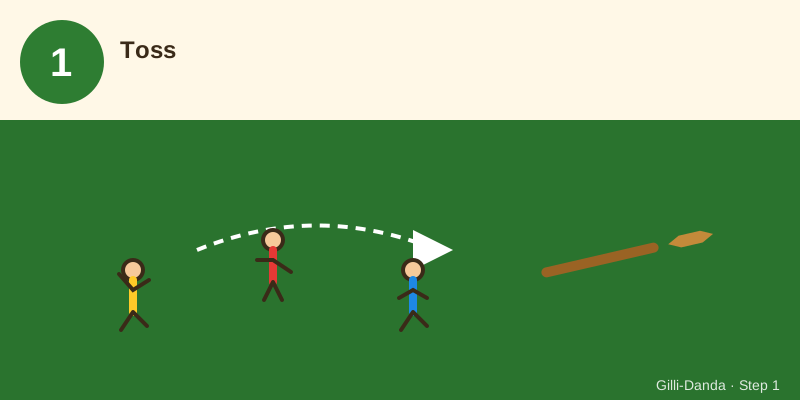
Step 1 – Gilli-Danda step 1: Toss - The opening lift (uchhal / pidhi): the striker places the gilli across the gucchi. Putting the danda under it, he flicks the gilli forward into the field as far as possible.
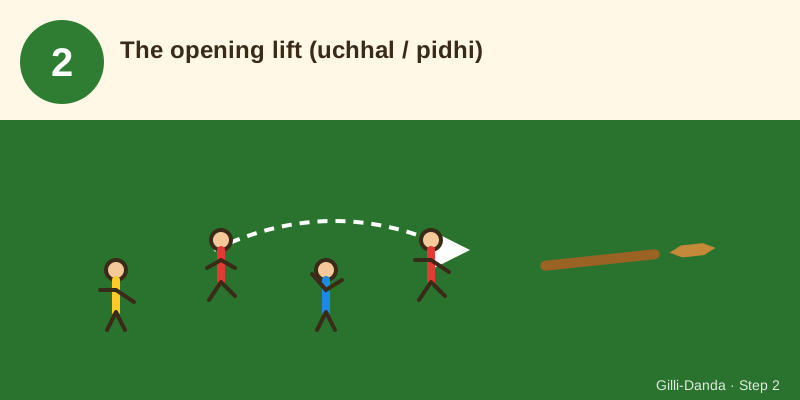
Step 2 – Gilli-Danda step 2: The opening lift (uchhal / pidhi) - Catch on the lift: if any fielder catches the gilli in the air before it touches the ground, the striker is out.
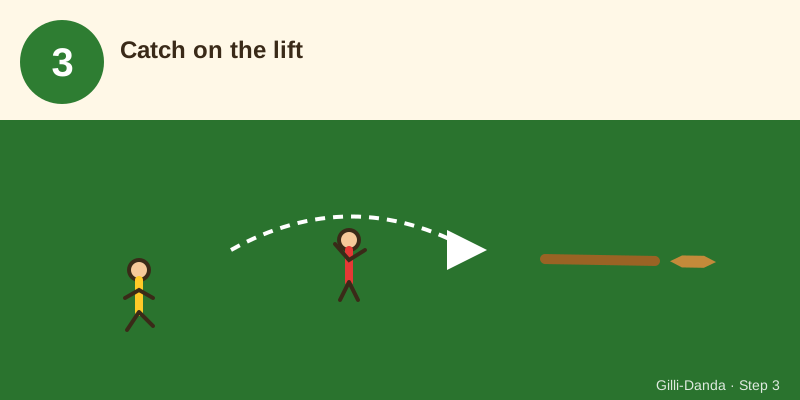
Step 3 – Gilli-Danda step 3: Catch on the lift - Danda on the gucchi: if not caught, the striker lays the danda across the gucchi. The fielder nearest to where the gilli landed throws it back, aiming to hit the danda. If he hits it, the striker is out. (Some areas instead ask the fielder to throw the gilli into the circle; if it lands inside, the striker is out.)
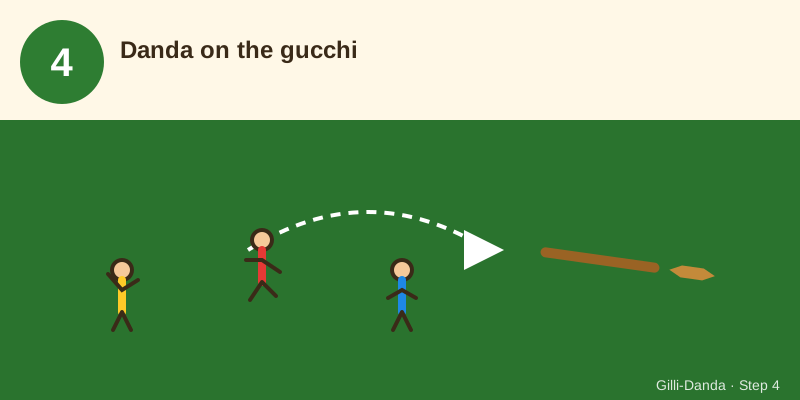
Step 4 – Gilli-Danda step 4: Danda on the gucchi - The strikes: if the striker survives, he places the gilli on the ground, taps one pointed end with the danda so that it jumps up, and then hits it in mid-air as far as he can. Usually the striker gets up to three attempts to make the gilli rise; if he misses all three, he is out.
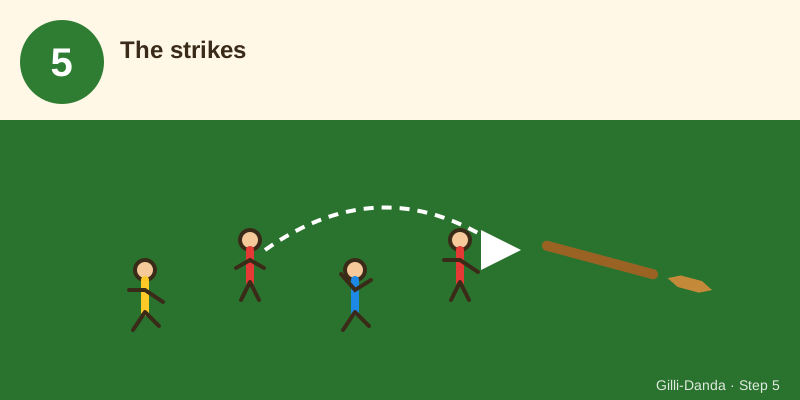
Step 5 – Gilli-Danda step 5: The strikes - Successive hits: in many versions the striker may hit the gilli more than once while it is in the air, or may make up to three hits in a turn, each starting from where the gilli last landed.
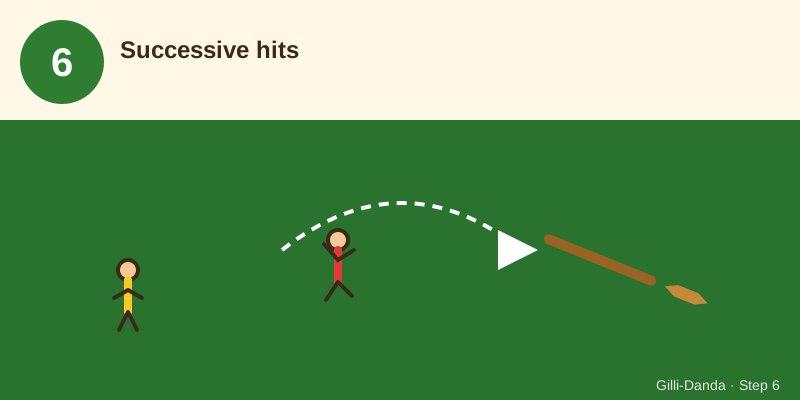
Step 6 – Gilli-Danda step 6: Successive hits - Catch on a strike: a clean catch by any fielder at any stage gets the striker out.
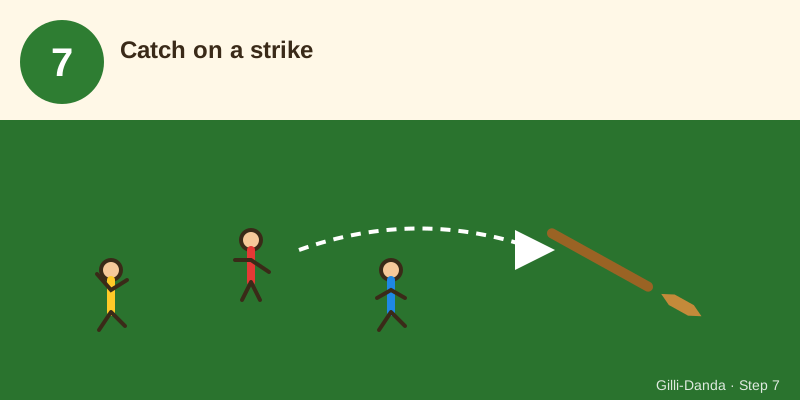
Step 7 – Gilli-Danda step 7: Catch on a strike - Counting: after the final hit, the striker measures the distance from where the gilli lies back to the gucchi using the danda. Each danda-length is one point.
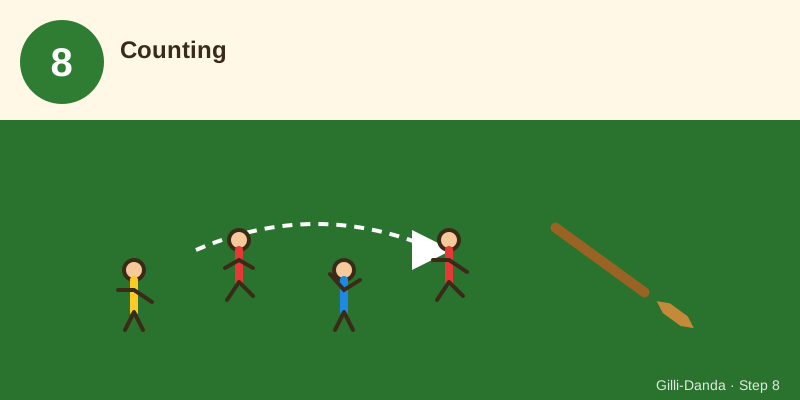
Step 8 – Gilli-Danda step 8: Counting - Next striker: when the striker is out, a teammate takes over. When all members are out, teams swap.
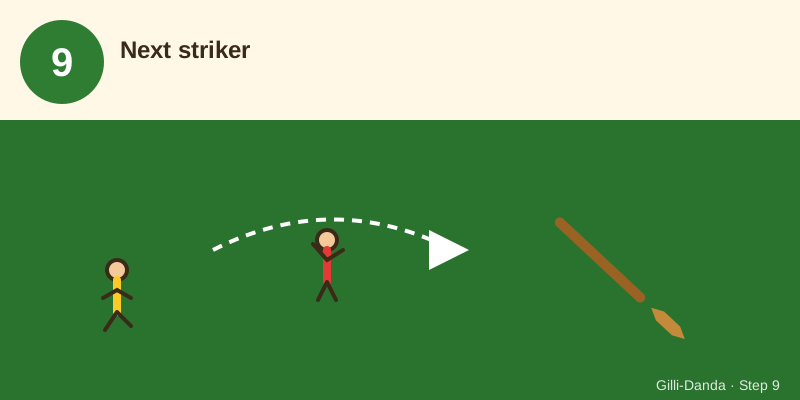
Step 9 – Gilli-Danda step 9: Next striker - End of game: play an agreed number of innings or first to an agreed target (for example 100 danda-lengths).
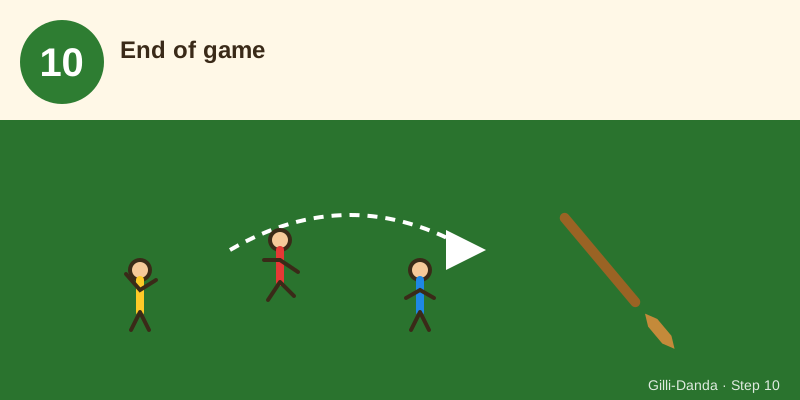
Step 10 – Gilli-Danda step 10: End of game
A key skill is the tap-and-hit. The tap must hit the very tip of the gilli so it pops up at an angle; tapping the middle only rolls it. Beginners should practise just the pop-up ten times before trying to hit. Once the gilli rises to knee height, the striker swings sideways like a short forehand, not overhead.
Scoring and winning — अंक और जीत
The standard way of scoring is in danda-lengths: the striker or a neutral player lays the danda end to end from the gucchi to where the gilli finally rests. Each full length is one point. Part lengths are ignored or, in friendly games, rounded.
Many neighbourhoods add bonuses. If the striker hits the gilli twice in the air before it lands, the distance is doubled. Three air touches may triple it. Some groups let the fielding team challenge a huge claimed distance; then the striker must measure it in front of everyone, and if he overestimates by more than a few lengths, he loses that score.
For quicker games with younger children, score one point for any hit that crosses a chalk line 10 metres out and three points for one beyond 20 metres. This avoids long measuring breaks and keeps attention high. Team score is the sum of all strikers' points, and the team with the higher total after equal innings wins.
Fouls and common disputes — फ़ाउल और झगड़े
- Lifting or hitting the gilli with a hand instead of the danda — the striker is out.
- Taking more than the agreed number of tries to pop the gilli up — out.
- Fielder running into the striking circle before the hit — the strike is replayed, or the striker gets bonus lengths.
- Moving the gilli after it lands before measurement — the measured score is cancelled.
- Swinging the danda wildly near other players or throwing the danda — immediate stop and a warning; a second time means the player sits out a turn.
- Disputed catches: if the gilli touches the ground first, even lightly, it is not a catch. When in doubt, the striker is given the benefit of the doubt (or replay the hit).
A sample round, explained — एक उदाहरण
Imagine Riya's team (three players) strikes first against Kabir's team. Riya lifts the gilli from the gucchi; it lands about 12 metres away and nobody catches it. She places the danda across the gucchi. Kabir, the nearest fielder, throws the gilli back, but it misses the danda by a hand-span, so Riya survives.
Now Riya taps the gilli. On her first try it only rolls. On the second it pops up to knee height and she hits it cleanly, sending it 18 metres. She is allowed three strikes in total, so she walks to where it landed and hits it again, adding another 9 metres. On the third, she mistimes the swing and the gilli flies straight up; Kabir's teammate Sana takes an easy catch. Riya is out, but her earlier hits still count: from the final resting place of the gilli before the catch, the team measures back to the gucchi and counts 41 danda-lengths. That is Riya's score.
Her teammate Arjun now steps in. This is where tactics come in: Kabir's team moves fielders deeper because Arjun hits hard, which leaves the short area open. Arjun deliberately plays a soft strike that drops just in front of the fielders, then a big hit over them. The lesson children quickly learn is that both power and placement matter, just like in cricket.
Regional names across India — अलग-अलग राज्यों में नाम
| Region / language | Name used |
|---|---|
| Hindi belt (UP, Bihar, MP, Rajasthan) | Gilli-danda, Gulli-danda |
| Punjab | Gulli-dandaa, Gulli-dandi |
| Maharashtra | Viti-dandu (विटी-दांडू) |
| Gujarat | Gedi-dandiyo / Moi-dandiyo |
| Bengal | Dang-guli (ডাংগুলি) |
| Odisha | Guli-danda |
| Karnataka | Chinni-dandu / Chinni-kolu |
| Tamil Nadu | Kitti-pullu / Gilli |
| Andhra Pradesh & Telangana | Gooti-billa / Bilam-godu |
| Kerala | Kutti-yum kolum |
| Nepal (neighbouring) | Dandi-biyo |
Variations to try — खेल के रूप
Circle throw-back version
Instead of hitting the danda, the fielder must throw the gilli into a 1 m circle around the gucchi. This is easier for younger fielders and reduces the chance of a hard throw at a striker standing nearby.
Three-strike rule
Every striker gets exactly three hits per turn, and only the final distance is counted. It speeds up the game and is good for school periods.
Points by zones
Chalk lines at 10, 20 and 30 metres score 1, 2 and 3 points. No measuring needed, ideal for large classes.
Partner gilli-danda
Pairs share one danda and alternate hits; if either partner is caught both are out. This builds teamwork and is great for mixed-age pairs (older child with younger).
Indoor-safe version
Use a rolled-up newspaper gilli and a plastic ruler or rolled magazine as danda in a corridor or hall. Count distance in floor tiles.
How to run it in a school or housing society — स्कूल और सोसाइटी में कैसे खिलाएँ
In a school, gilli-danda works best as a station game rather than a whole-class game. Set up four to six "gucchi stations" along one side of the ground, each with a set of equipment and a group of six to eight students. Fielders stand in a marked zone at least 10 metres in front. Students rotate roles every three strikes: striker, two fielders near, two fielders deep, a measurer and a scorer. That way everyone stays busy and nobody stands in the strike line idly.
For housing societies, plan gilli-danda for the evening slot on a sports day or a Sunday morning. Block off one end of the lawn with chairs or cones, keep a volunteer at each station, and announce the rules on a printed sheet (you can print this page). Parents enjoy a "parents vs children" match; just make adults hit with their non-dominant hand to keep it fair and safe. Keep a first-aid box and an ice pack nearby. Finally, give small prizes for "longest hit," "best catch" and "fairest player" — the last one encourages children to call their own outs honestly.
Teaching tips for coaches and parents — सिखाने के टिप्स
Teach in three stages. Stage one is the pop-up: children practise tapping the tip of the gilli so it rises, without hitting it. Stage two is the hit: one child pops and another gently tosses back if it fails, so each child gets twenty swings in five minutes. Stage three is the full game. Skipping stages one and two leads to frustration and wild swings.
Model the swing yourself: feet apart, side-on to the field, eyes on the gilli, swing level and follow through low. Remind children that a smooth swing travels further than a hard, jerky one. Use the counting phase to involve the quieter children as measurers; they love being the official judge. If a child is consistently missing, let them use a slightly thicker danda or a bigger gilli, then reduce the size later.
A ready-made 45-minute session plan for Gilli-Danda — 45 मिनट की योजना
Teachers, coaches and society volunteers often ask for a plan they can follow without preparation. Here is one built around Gilli-Danda, suitable for 2 or more (best 4–10 in two teams) and a space of roughly open ground 30–50 m long. Adjust the timings to your group, but try to keep the structure, because it moves children from understanding to playing without long lectures.
- 0–5 minutes: gather and explain. Sit everyone in a circle. Show the diagram on this page (print it or hold up a phone). Explain only the three most important rules; the rest can be taught while playing.
- 5–10 minutes: warm-up. Light jogging, arm circles, ankle rolls and a few stretches. For board or small-space games, use finger and wrist warm-ups and a quick memory game instead.
- 10–18 minutes: skill drill. Practise the one key skill of the game in pairs or small groups (the teaching tips above suggest which). Short repetitions with lots of praise work better than one long attempt.
- 18–38 minutes: play. Play the game in short rounds. After every round, pause for thirty seconds and ask one question: "What worked? What was unfair?" Let children suggest small rule tweaks and vote on them.
- 38–45 minutes: cool down and reflect. Slow walking or breathing, water, and a quick round where each child says one thing they learned or one person who played fairly.
A session like this fits neatly into a school games period, a summer-camp slot or a Sunday morning in the society garden. Repeat it across a few weeks and you will see children start organising Gilli-Danda on their own, which is the real goal.
Making Gilli-Danda inclusive — सबको शामिल करें
Traditional games were always played by mixed groups: older and younger siblings, cousins visiting for the holidays, neighbours of every background. Keep that spirit alive. Give younger or less confident children a "helper" role first (scorer, umpire, equipment-in-charge) and then a playing role once they have watched a round. Pair a strong player with a beginner rather than letting captains pick teams in front of everyone, which can hurt feelings. For a child who uses a wheelchair or has limited mobility, shorten distances, allow seated or standing play where possible, and give them roles that matter to the result, such as caller, measurer or final judge. For children who find noise overwhelming, a quieter corner version or a smaller group helps. Small changes like these rarely spoil the game, and they teach every child that play belongs to everyone.
A note for parents: bringing Gilli-Danda home — माता-पिता के लिए
Many parents tell us the same story: their child spends hours on a phone game, but the moment a cousin or neighbour suggests Gilli-Danda, the phone is forgotten. Traditional games work because they are social, physical and a little unpredictable, and because they belong to the child's own world rather than to a screen. You do not need to be an expert to bring this game home. Start by playing once yourself, even badly; children love seeing a parent learn. Tell them how you or their grandparents played it, and what it was called in your town. Then step back and let them run it.
Keep the equipment in a visible place, such as a basket near the door, so that it is easy to grab. Invite one or two neighbourhood children for a regular weekly slot, perhaps a Saturday evening, and the habit will grow on its own. When disagreements happen, ask questions instead of giving verdicts: "What rule did you agree? Is that fair for the smaller kids?" Over a few weeks you will notice the children negotiating, adapting and including others, which are exactly the skills a good school tries to teach. Finally, take a photo or a short video of them playing and share it with the grandparents. Few things make an Indian dadi or nana happier than seeing a grandchild play the game they once played in the same way.
Safety tips — सुरक्षा
- Keep everyone except the striker at least 10 metres in front and never behind or beside the striker. The danda swing can hit someone standing close.
- Never play towards roads, windows, parked vehicles or areas where small children walk.
- Round off the gilli tips; never sharpen them to a point.
- Fielders should catch with two hands in front of the body, not at face height, and should call "mine" to avoid collisions.
- Younger children can use foam or newspaper gillis. Safety glasses are a sensible addition for school matches.
- Stop play immediately if someone walks into the field.
- Check the danda for cracks and splinters before every game.
Skills and benefits for children — बच्चों को फ़ायदे
Gilli-danda trains hand-eye coordination, timing and depth perception far more than most mobile games. Measuring in danda-lengths sharpens estimation and counting. Fielding builds reaction speed and the courage to catch. Most of all, because there is no fixed rulebook, children practise agreeing on rules, accepting decisions and resolving disputes, which teachers will tell you is just as valuable as the exercise.
हिंदी में सारांश
गिल्ली डंडा भारत का बहुत पुराना खेल है। इसमें एक लंबी लकड़ी (डंडा) और छोटी, दोनों तरफ़ से नुकीली लकड़ी (गिल्ली) होती है। ज़मीन में एक छोटी गुच्ची बनाई जाती है। खिलाड़ी गिल्ली को डंडे से उछालता है और फिर हवा में मारकर दूर भेजता है।
अगर सामने वाली टीम गिल्ली को हवा में ही पकड़ ले, तो खिलाड़ी आउट हो जाता है। दूरी डंडे की लंबाई से नापी जाती है — हर डंडा एक अंक। सुरक्षा के लिए फ़ील्डर कम से कम 10 मीटर दूर रहें, गिल्ली की नोक धारदार न हो और सड़क या खिड़कियों की तरफ़ कभी न खेलें।
FAQ: Gilli-Danda Rules (गिल्ली डंडा) – How to Play, Scoring & Diagram — अक्सर पूछे जाने वाले सवाल
What is the difference between gilli-danda and cricket?
Gilli-danda uses a short wooden peg instead of a ball and has no bowler. The striker launches the gilli himself, and runs are replaced by distance measured in danda-lengths.
How long should the danda and gilli be?
A danda of about 45–60 cm and a gilli of 8–15 cm work well. For children under ten, use the shorter end of both ranges.
Is gilli-danda dangerous?
It can be if fielders stand too close or the gilli is sharp. With blunt tips, a 10 m safety gap and no one behind the striker, it is as safe as most bat games.
How many players are needed?
Two can play, but 4–10 players in two teams is ideal.
What is a gucchi?
A small oval slot dug in the ground where the gilli is placed for the opening lift. On hard floors, two bricks can be used instead.
How is a striker out?
By a clean catch, by the fielder hitting the danda laid across the gucchi on the throw-back, or by failing to pop up the gilli within the agreed tries.
Can girls and boys play together?
Absolutely. Gilli-danda is about timing more than strength, and mixed teams are common in schools.
What is gilli-danda called in Marathi and Bengali?
Viti-dandu in Marathi and Dang-guli in Bengali.
Can gilli-danda be played indoors?
Only a soft version: a rolled-paper gilli and a plastic stick in a cleared hall, with fielders standing well back.
Who wrote the story Gulli-Danda?
Munshi Premchand wrote the famous Hindi short story "Gulli-Danda" about childhood friendship and the game.
Related games

Gully Cricket Rules for Kids – Street Cricket Basics in India
One tip one hand, no LBW, last man batting — the unwritten rules of Indian gully cricket, written down.

Lattu (Spinning Top) Games – How to Spin & Play Surr/Bambaram
Wind the string, throw down and pull — then knock rival lattus out of the ring.
Lagori / Pittu / Satoliya Rules – Seven Stones Game of India
Knock down the stack of seven stones, then rebuild it before the other team tags you out with the ball.

Kancha (Marbles) Rules – Indian Marble Games Explained
Flick the shooter, knock marbles out of the ring and learn the famous Indian "gucchi" pit version.