
Kancha (Marbles) Rules – Indian Marble Games Explained

For generations of Indian children, a pocket that jingled with glass kanchas was a sign of wealth. Kancha, also called goli, golli or gotiya, is played everywhere from Lucknow gullies to Chennai school compounds. It needs a handful of marbles, a flat patch of mud and a good finger flick. The skill is in the aim, and the drama is in the "winning" (in some areas children play for keeps, which we discuss below).
There is no single kancha game; there are several. This page explains the three most common Indian versions: the circle game (knocking marbles out of a ring), the pit or gucchi game (getting marbles into a small hole), and hit-the-target (chasing an opponent's marble). You will learn the flick grip, setup, rules, scoring, fouls and fair-play suggestions.
History and cultural note — इतिहास और परंपरा
Marbles of clay and stone are among the oldest toys found by archaeologists in many civilisations, and children in India have played with clay and stone balls for a very long time. Glass marbles became cheap and common in the twentieth century, and the green-tinged "bottle" glass marble (from the stoppers of old soda bottles, called "banta" bottles in North India) became part of childhood lore. Even today, lemon soda bottles with a marble stopper are sold in some cities and called banta or goli soda.
Kancha culture is rich with slang. A big shooter marble is called a "dhapper", "dabbu" or "lakhota"; a perfectly clean hit is a "fatka"; and declaring rules before a game is "pakka" or "kachha" depending on whether marbles are kept. These words vary by city, and part of the fun is learning the local vocabulary.
Players and age group — खिलाड़ी और उम्र
Two to six players, each with their own marbles. Most games are individual, but you can play doubles where partners share a turn order. Ages six and up; under-threes should never be near marbles because they are a choking hazard. Kancha suits quiet children who may not enjoy running games, and it is an excellent way to build finger strength and concentration.
Equipment you need — सामान
- 10–20 glass marbles (kanchas) per player, about 1.5 cm wide.
- One slightly larger shooter marble (dhapper) per player, optional.
- A stick or chalk to draw the ring and lines.
- For the pit game: a small hole (gucchi) about 6–8 cm wide and 3–4 cm deep, dug with a heel or spoon.
Ground and setup — मैदान की तैयारी
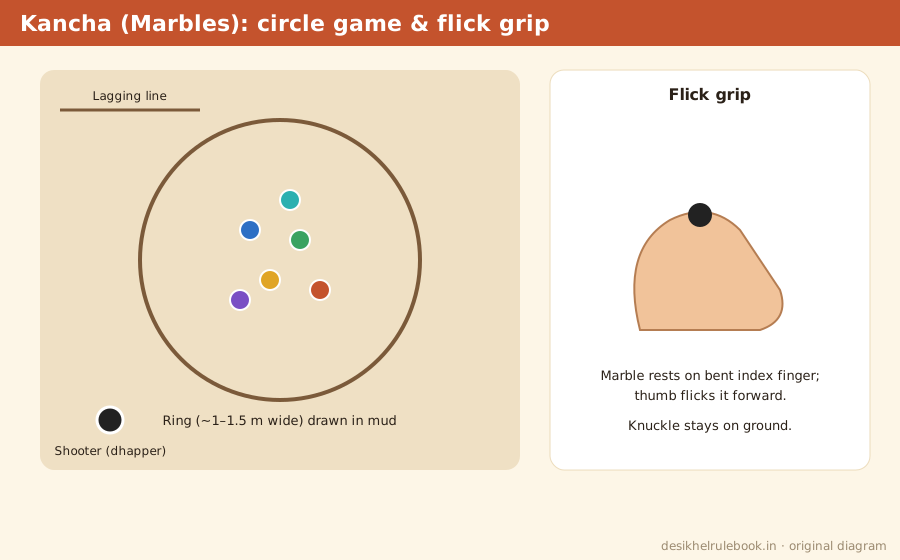
Find flat, smooth mud or a cement floor. For the circle game, draw a ring about 1–1.5 m in diameter. Each player puts an agreed number of marbles (for example three) in a cluster or cross shape in the middle. Draw a "lagging line" about two metres from the ring.
For the pit game, dig a gucchi and draw a starting line 2–3 metres away. For the target game, you only need a starting line.
Before starting, decide "for fun" or "for keeps." We strongly recommend "for fun" (all marbles go back to their owners at the end), especially in schools and societies, to avoid quarrels and tears.
Step-by-step rules — खेल के नियम
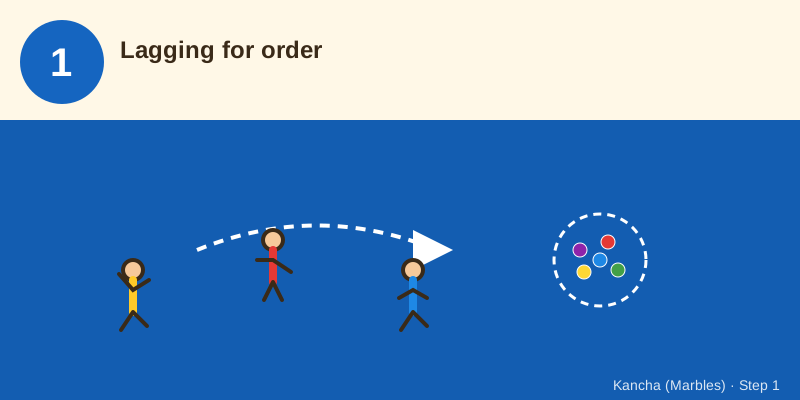
- Lagging for order: each player flicks or rolls a marble from the ring towards the lagging line. The one closest to the line plays first, next closest second, and so on.
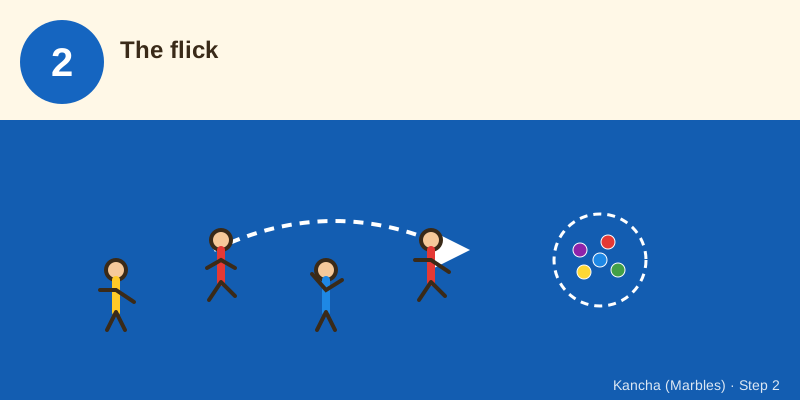
Step 1 – Kancha (Marbles) step 1: Lagging for order - The flick: place the shooter on the bent tip of your index finger (or between index and middle finger), with your thumb behind it. Keep one knuckle touching the ground (called "knuckling down") and flick the shooter with your thumb or pull the index finger back like a catapult.
Step 2 – Kancha (Marbles) step 2: The flick - Circle game: from outside the ring, flick your shooter at the marbles. Any marble knocked out of the ring is yours for the game. If you knock one out and your shooter stays inside the ring, shoot again from where it rests.
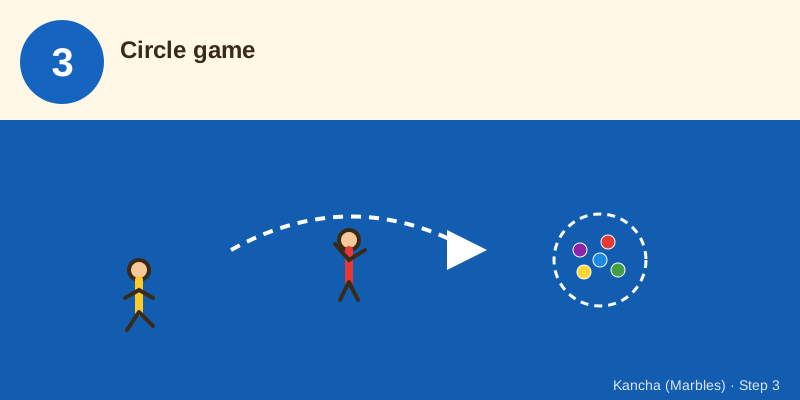
Step 3 – Kancha (Marbles) step 3: Circle game - Your turn ends when you fail to knock a marble out, or your shooter leaves the ring without knocking any out.
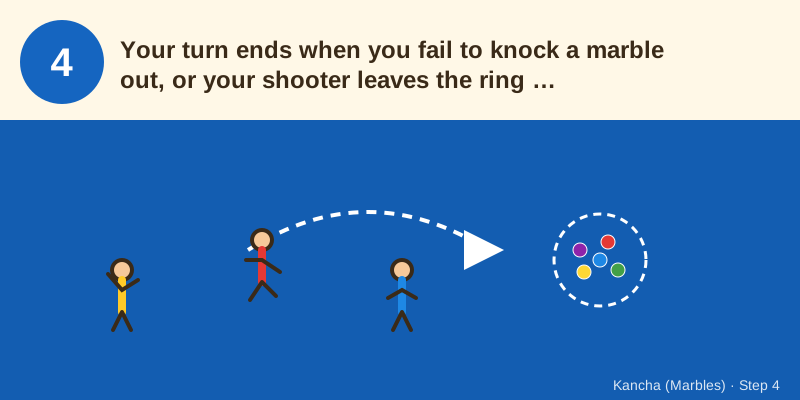
Step 4 – Kancha (Marbles) step 4: Your turn ends when you fail to knock a marble out, or your shooter leaves the ring … - Pit (gucchi) game: players take turns flicking marbles into the pit from the line. The first to get a marble in may then aim at opponents' marbles; hitting one "captures" it. Some versions require hitting the other marble and then going into the pit again.
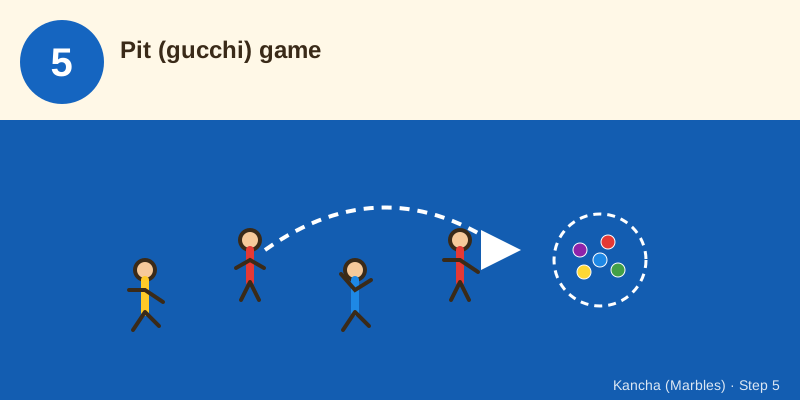
Step 5 – Kancha (Marbles) step 5: Pit (gucchi) game - Target game (chasing): one player rolls a marble forward. The next player tries to hit it with a flick. A hit scores a point; if missed, the first player now aims at the second player's marble. Continue in turns.
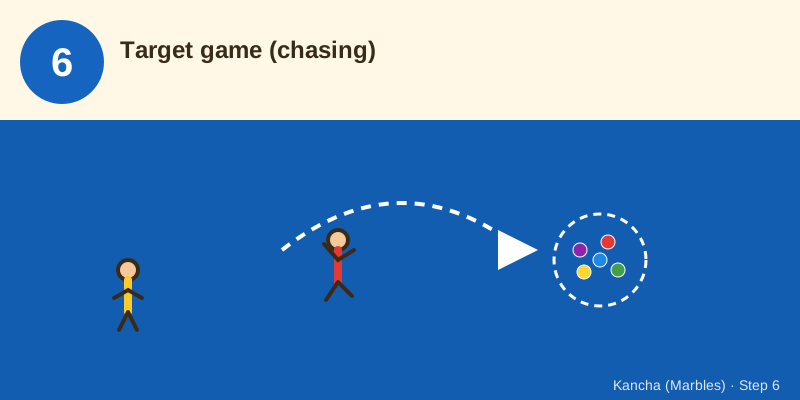
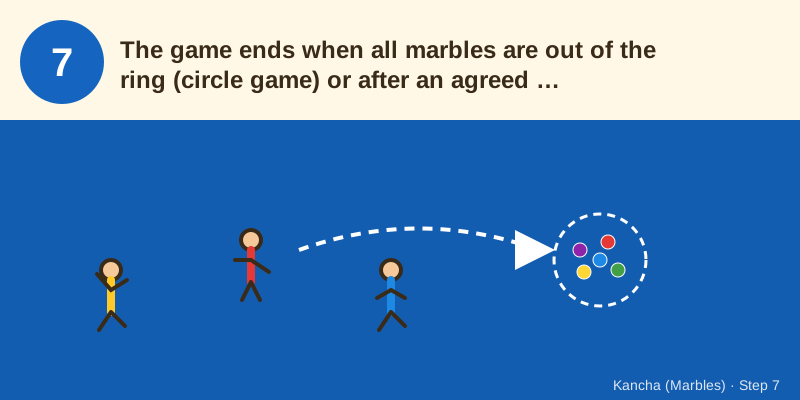
Step 6 – Kancha (Marbles) step 6: Target game (chasing) - The game ends when all marbles are out of the ring (circle game) or after an agreed number of rounds.
Step 7 – Kancha (Marbles) step 7: The game ends when all marbles are out of the ring (circle game) or after an agreed …
Scoring and winning — अंक और जीत
In the circle game, each marble knocked out counts as one point. Some groups give the centre "king" marble two points. At the end, players count their captured marbles; the player with the most wins. In "for fun" games, return all marbles afterwards.
In the pit game, one point for each marble sunk and two points for each hit on an opponent's marble followed by a sink. In the target game, play to ten points.
Fouls and common disputes — फ़ाउल और झगड़े
- "Fudging" — moving your hand forward over the line while shooting. The shot is replayed from behind the line, or the turn is lost.
- Lifting the knuckle off the ground in a "knuckle down" game.
- Touching other marbles with the hand. Any marble accidentally moved goes back.
- Shooting out of turn — turn lost.
- Changing the rule from "for fun" to "for keeps" mid-game — not allowed! Settle it first.
A sample round, explained — एक उदाहरण
Three players, Aman, Fatima and Zoya, each put three marbles in the ring. In lagging, Zoya's marble stops closest to the line, so she starts. She knuckles down at the ring edge and flicks; her shooter hits the cluster and one blue marble rolls out. Her shooter stops inside the ring, so she shoots again from there, knocking out a green one. On her third shot she misses, so her turn ends with two marbles.
Aman is next. Zoya's shooter is still inside the ring; in many neighbourhood rules, Aman may hit it, and if he knocks it out, Zoya must give him one of her captured marbles. He tries, misses, and his own shooter rolls out. His turn ends. The game continues until the ring is empty. Fatima finishes with four, Zoya with three and Aman with two. Fatima wins, and everyone collects their own marbles back because it was a "for fun" game.
Regional names across India — अलग-अलग राज्यों में नाम
| Region / language | Name used |
|---|---|
| Hindi belt | Kancha, Kanche, Goli |
| Punjab | Bante, Kanche |
| Maharashtra | Goti, Gotya |
| Gujarat | Lakhoti |
| Bengal | Marble, Guli |
| Tamil Nadu | Goli, Golikundu |
| Karnataka | Gooli |
| Kerala | Goli, Kotti |
| Andhra & Telangana | Golilu, Goti |
Variations to try — खेल के रूप
Teen-Goti (three-hole)
Three pits in a line; you must sink in each in order, then come back. First to complete the circuit wins.
Line-out
Marbles placed on a straight line instead of a ring; knock them past a second line to capture.
Shooting through the arch
Make an arch from a bent cardboard; get the marble through for points. Great indoors.
Rich man, poor man
Players who have no marbles left can borrow one "life" marble from the leader, to keep younger kids in the game longer.
Fair-play rules every kancha group should agree on
Kancha arguments are legendary, and nearly all of them come from rules nobody agreed on before the first shot. Before you begin, settle these five points out loud. First, is it "kachha" (for fun, marbles go back) or "pakka" (captured marbles are kept)? For children, choose kachha every time. Second, may a player hit another player's shooter, and what happens if they do? Third, does a shooter that stops on the ring line count as inside or outside? Most groups say "line is out." Fourth, how many marbles does each player stake? Equal stakes keep it fair. Fifth, who is the judge if two players disagree? A neutral friend, or a quick replay of the shot.
Writing these five points on a slate or a phone note sounds silly, but it saves time and friendships. Older children can also be given the role of "kancha referee" for younger groups, which builds responsibility. If you are a parent watching, resist the urge to settle every argument yourself; instead, ask the children "what did you agree before the game?" and let them work it out. That small habit is one of the hidden lessons of traditional games.
Choosing and caring for marbles
Standard Indian kanchas are about 1.5–1.6 cm across. Avoid very cheap marbles with bubbles or rough seams because they chip easily and roll unpredictably. A slightly heavier shooter helps beginners, but in fair games everyone should use a similar size. Keep marbles in a cloth pouch or a steel dabba, wash them in soapy water after mud games, and dry them on a towel so they do not leave stains. Count your set before and after each game, especially in school, so that none are left behind on the floor where a toddler could find them.
How to run it in a school or housing society — स्कूल और सोसाइटी में कैसे खिलाएँ
Kancha is perfect for a small corner of the school ground or a covered corridor on rainy days. Mark six rings with chalk, put four children at each, and give each child five marbles from a class set. Use a "for fun" rule and collect marbles back at the end. Supervision is needed to keep marbles away from younger siblings and to stop them rolling onto stairs.
In societies, a "kancha corner" during festivals or summer camps keeps kids engaged for hours. Use a bed sheet with a printed or painted ring on it for indoor play; it can be packed away easily.
Teaching tips for coaches and parents — सिखाने के टिप्स
The flick is the hardest part. Practise with a single marble and a target (like a matchbox) placed 50 cm away. Gradually move the target further. Children with small hands can use the "pinch-and-push" style (thumb and index pushing forward) until their flick gets stronger.
Teach "knuckling down" early; it makes shots more accurate and avoids fudging fights later. Encourage quieter children to keep score; kancha is a numbers game, and they may enjoy calculating.
A ready-made 45-minute session plan for Kancha — 45 मिनट की योजना
Teachers, coaches and society volunteers often ask for a plan they can follow without preparation. Here is one built around Kancha, suitable for 2–6 and a space of roughly 2 × 3 m of flat mud or floor. Adjust the timings to your group, but try to keep the structure, because it moves children from understanding to playing without long lectures.
- 0–5 minutes: gather and explain. Sit everyone in a circle. Show the diagram on this page (print it or hold up a phone). Explain only the three most important rules; the rest can be taught while playing.
- 5–10 minutes: warm-up. Light jogging, arm circles, ankle rolls and a few stretches. For board or small-space games, use finger and wrist warm-ups and a quick memory game instead.
- 10–18 minutes: skill drill. Practise the one key skill of the game in pairs or small groups (the teaching tips above suggest which). Short repetitions with lots of praise work better than one long attempt.
- 18–38 minutes: play. Play the game in short rounds. After every round, pause for thirty seconds and ask one question: "What worked? What was unfair?" Let children suggest small rule tweaks and vote on them.
- 38–45 minutes: cool down and reflect. Slow walking or breathing, water, and a quick round where each child says one thing they learned or one person who played fairly.
A session like this fits neatly into a school games period, a summer-camp slot or a Sunday morning in the society garden. Repeat it across a few weeks and you will see children start organising Kancha on their own, which is the real goal.
Making Kancha inclusive — सबको शामिल करें
Traditional games were always played by mixed groups: older and younger siblings, cousins visiting for the holidays, neighbours of every background. Keep that spirit alive. Give younger or less confident children a "helper" role first (scorer, umpire, equipment-in-charge) and then a playing role once they have watched a round. Pair a strong player with a beginner rather than letting captains pick teams in front of everyone, which can hurt feelings. For a child who uses a wheelchair or has limited mobility, shorten distances, allow seated or standing play where possible, and give them roles that matter to the result, such as caller, measurer or final judge. For children who find noise overwhelming, a quieter corner version or a smaller group helps. Small changes like these rarely spoil the game, and they teach every child that play belongs to everyone.
A note for parents: bringing Kancha home — माता-पिता के लिए
Many parents tell us the same story: their child spends hours on a phone game, but the moment a cousin or neighbour suggests Kancha, the phone is forgotten. Traditional games work because they are social, physical and a little unpredictable, and because they belong to the child's own world rather than to a screen. You do not need to be an expert to bring this game home. Start by playing once yourself, even badly; children love seeing a parent learn. Tell them how you or their grandparents played it, and what it was called in your town. Then step back and let them run it.
Keep the equipment in a visible place, such as a basket near the door, so that it is easy to grab. Invite one or two neighbourhood children for a regular weekly slot, perhaps a Saturday evening, and the habit will grow on its own. When disagreements happen, ask questions instead of giving verdicts: "What rule did you agree? Is that fair for the smaller kids?" Over a few weeks you will notice the children negotiating, adapting and including others, which are exactly the skills a good school tries to teach. Finally, take a photo or a short video of them playing and share it with the grandparents. Few things make an Indian dadi or nana happier than seeing a grandchild play the game they once played in the same way.
Safety tips — सुरक्षा
- Keep marbles away from children under three and pets; they can be swallowed.
- Never throw marbles at people; they are glass and hard.
- Avoid playing near stairs and walkways where marbles can roll and cause falls.
- Check for cracked marbles; discard them.
- Wash hands after playing in mud.
Skills and benefits for children — बच्चों को फ़ायदे
Kancha builds fine motor control, concentration and geometry intuition (angles of rebound). It is a calm, low-space game, ideal for children who prefer focus over running. Counting and trading build number sense.
हिंदी में सारांश
कंचे (गोली) का खेल ज़मीन पर गोला बनाकर खेला जाता है। हर खिलाड़ी कुछ कंचे बीच में रखता है और अपने बड़े कंचे (डपर) को उंगली से झटककर दूसरों को गोले से बाहर निकालता है। एक और तरीका है गुच्ची (छोटा गड्ढा) में कंचा डालना।
खेल से पहले तय करें कि "पक्का" (कंचे जीतना) या "कच्चा" (सिर्फ़ मज़े के लिए) खेलेंगे। बच्चों के लिए "कच्चा" बेहतर है। छोटे बच्चों से कंचे दूर रखें।
FAQ: Kancha (Marbles) Rules – Indian Marble Games Explained — अक्सर पूछे जाने वाले सवाल
What is kancha?
It is the Indian name for marbles, also called goli or gotiya.
How many marbles do I need?
About 10–20 per player, plus one shooter.
What is knuckling down?
Keeping one knuckle on the ground while shooting for accuracy and fairness.
Is it OK to play for keeps?
We recommend "for fun" games where marbles are returned, especially in schools.
What is a gucchi in kancha?
A small pit in the ground; players try to get marbles into it.
Can kancha be played indoors?
Yes, on a carpet or bed sheet with a ring drawn on it.
Is kancha safe for toddlers?
No, marbles are a choking hazard for children under three.
What is a dhapper?
A larger shooter marble used to hit others.
How do I improve my flick?
Practise short shots at a target, then increase distance; keep your wrist still.
What is a banta bottle?
A soda bottle with a marble stopper, popular in India and linked to kancha culture.
Related games

Lattu (Spinning Top) Games – How to Spin & Play Surr/Bambaram
Wind the string, throw down and pull — then knock rival lattus out of the ring.
Gilli-Danda Rules (गिल्ली डंडा) – How to Play, Scoring & Diagram
India's original bat-and-ball game: flick the gilli, strike it far, and count your score in danda-lengths.
Carrom Rules (Home Rules) – Points, Queen Cover & Fouls
Flick the striker, pocket your coins, cover the queen — family carrom rules made clear.

Seven Stones Game Rules – School Version for PE Classes
A tidy, referee-friendly version of the stone-stack game designed for school periods and sports days.