
Seven Stones Game Rules – School Version for PE Classes
 Seven Stones is the English name most schools use for the stone-stack game that India knows as lagori, pittu or satoliya. We have a full page on the many regional versions at Lagori / Pittu / Satoliya. This page is different: it gives one tidy, school-friendly version with fixed measurements, timed halves and simple umpire signals, so that a PE teacher can run fair matches for several classes and an inter-house tournament without long arguments over local rules.
Why a separate standard? Because when children from different neighbourhoods meet in a school ground, everyone brings their own rules: "we can run with the ball," "we can't," "three throws," "one throw." A common sheet saves the first ten minutes of every period. Below you will find the field, equipment, rules, an umpire guide, a sample scoring sheet, and ways to adapt the game for different age groups.

History and cultural note — इतिहास और परंपरा
The idea of knocking down and rebuilding a pile of stones is one of the oldest forms of Indian play, mentioned in the folk memories of many states. As schools adopted traditional games in physical education and on sports days, many simplified it into a "seven stones" format that fits a period. In recent years, school sports festivals and traditional games competitions have helped popularise structured versions. The version below is a practical blend, not an official code.
Players and age group — खिलाड़ी और उम्र
Two teams of five to seven on the field, with up to three substitutes each. One team is the breaking team (throws at the stack and rebuilds it) and the other is the fielding team (retrieves the ball and tags). Ages seven to sixteen. For mixed classes, insist on at least two girls and two boys per team if numbers allow.
Equipment you need — सामान
- Seven wooden or plastic discs, diameters from 15 cm down to 6 cm, about 2 cm thick (or seven flat stones).
- One tennis ball (ages 11+) or foam ball (ages 7–10).
- Chalk or cones for markings; a whistle; a stopwatch; a score sheet.
Ground and setup — मैदान की तैयारी
Mark a circle of 1 m diameter in the centre of a 20 × 15 m field. Stack the discs inside the circle, largest at the bottom. Mark a throwing line 6 m from the circle for ages 11+ and 4.5 m for ages 7–10. Mark the outer boundary with cones. The fielding team stands anywhere outside the circle but not between the throwing line and the stack until the throw is made.
Step-by-step rules — खेल के नियम
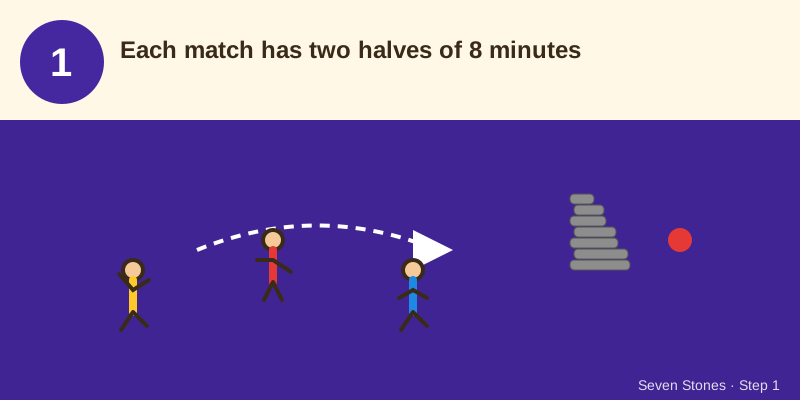
- Each match has two halves of 8 minutes. In each half, each team gets alternating innings as the breaking team. An innings ends when the stack is rebuilt, or when all breakers are tagged out.
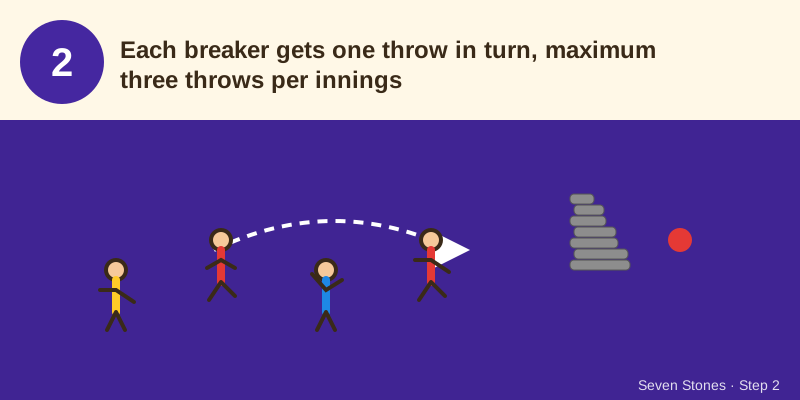
Step 1 – Seven Stones step 1: Each match has two halves of 8 minutes - Each breaker gets one throw in turn, maximum three throws per innings. If none of the three throws topples a disc, the innings passes to the other team with no points.
Step 2 – Seven Stones step 2: Each breaker gets one throw in turn, maximum three throws per innings - If a fielder catches the thrown ball on the full, that thrower is out for the innings (the innings continues if throws remain).
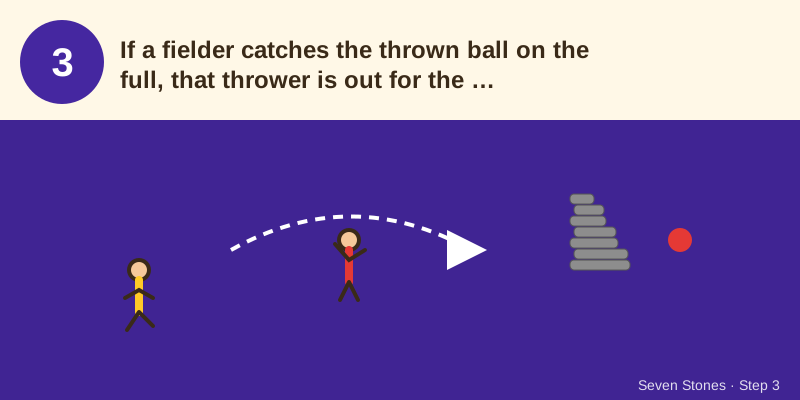
Step 3 – Seven Stones step 3: If a fielder catches the thrown ball on the full, that thrower is out for the … - Once at least one disc falls, the umpire blows the whistle once: rebuilding is on.
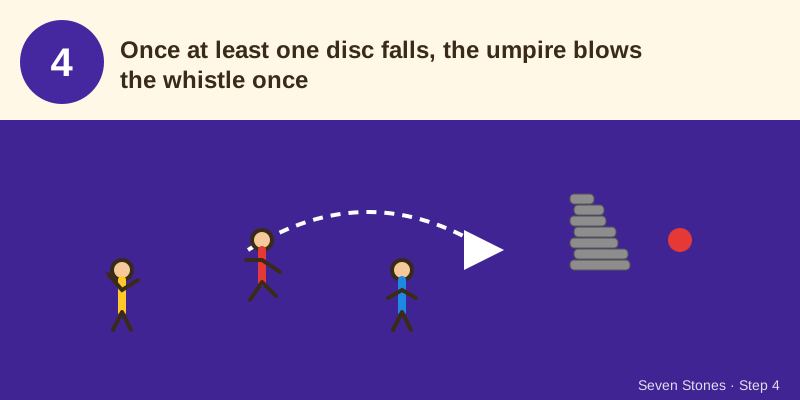
Step 4 – Seven Stones step 4: Once at least one disc falls, the umpire blows the whistle once - Fielders may not take more than two steps while holding the ball. They must pass or throw.
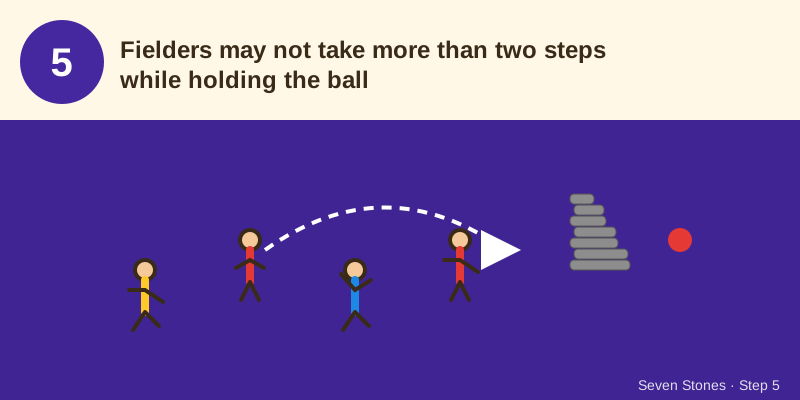
Step 5 – Seven Stones step 5: Fielders may not take more than two steps while holding the ball - Fielders tag a breaker by hitting them below the shoulder with the ball (a direct throw) or touching them with the ball held in hand.
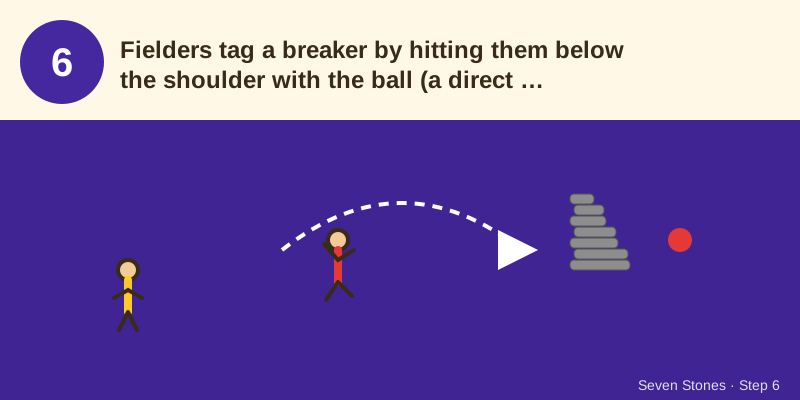
Step 6 – Seven Stones step 6: Fielders tag a breaker by hitting them below the shoulder with the ball (a direct … - Tagged breakers leave the field and sit at the side.
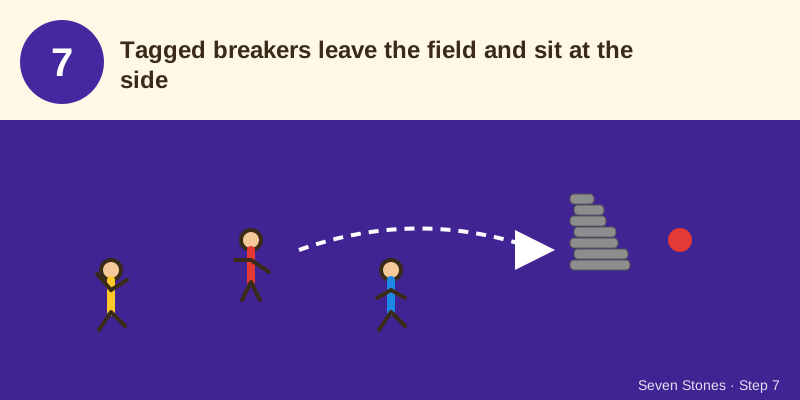
Step 7 – Seven Stones step 7: Tagged breakers leave the field and sit at the side - Breakers rebuild the stack in correct size order. When the seventh disc is placed, the breaker calls "Seven Stones!" and the umpire blows two whistles.
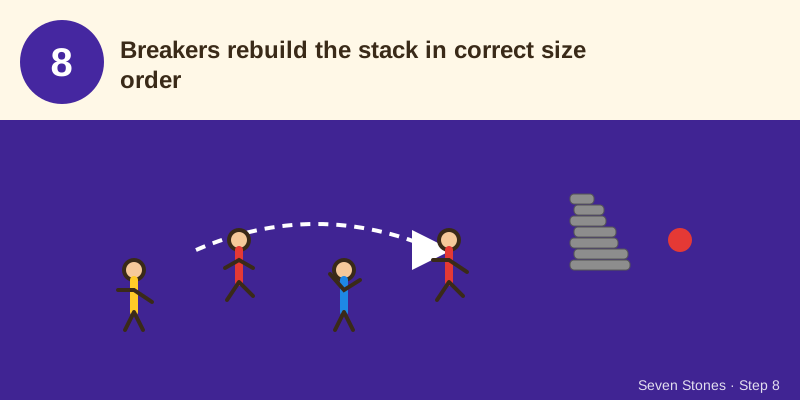
Step 8 – Seven Stones step 8: Breakers rebuild the stack in correct size order - Breakers may not touch the ball deliberately with hands or feet; doing so gets them out.
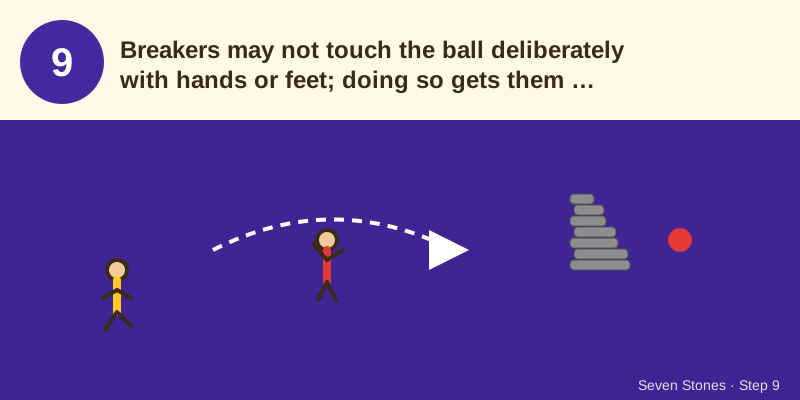
Step 9 – Seven Stones step 9: Breakers may not touch the ball deliberately with hands or feet; doing so gets them … - At the end of the innings, teams swap roles.
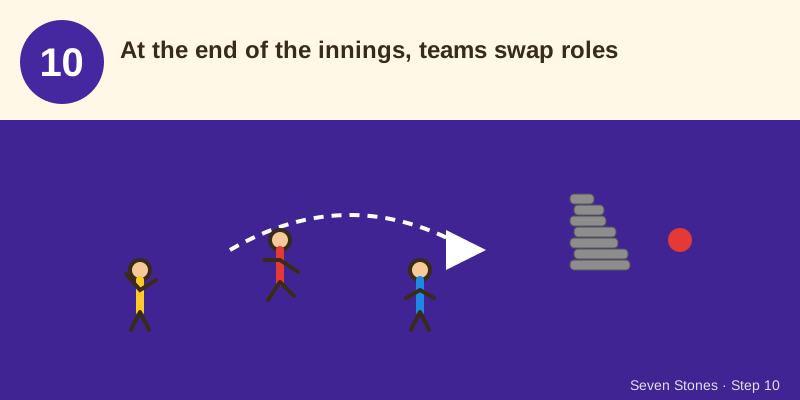
Step 10 – Seven Stones step 10: At the end of the innings, teams swap roles
Scoring and winning — अंक और जीत
Breaking team: 3 points for a completed rebuild, plus 1 bonus point if no breaker was tagged. Fielding team: 1 point for each breaker tagged, and 2 points if they tag all breakers before the stack is completed. The team with most points after two halves wins. In a tie, each team gets one "sudden" innings; fastest rebuild wins.
Simple score sheet columns: Innings number · Team breaking · Discs toppled? (Y/N) · Rebuild complete? · Breakers tagged · Points breaking · Points fielding.
Fouls and common disputes — फ़ाउल और झगड़े
- Head hit: the tag does not count; thrower gets a yellow warning; second warning = out for the innings.
- Fielder taking more than two steps with the ball: tag cancelled.
- Breaker touching ball: out.
- Fielder inside the circle: rebuilding team gets one free disc placed by the umpire.
- Wrong order of discs: the stack does not count until corrected.
A sample round, explained — एक उदाहरण
In the inter-house final, Blue breaks first. Their first throw misses; the second topples four discs. Whistle. Blue breakers fan out. Red fielders pass quickly: two passes and a throw at a breaker's legs — tagged. Meanwhile a Blue breaker rebuilds three discs. Red tags another. With two discs left, the last Blue breaker dives in, places both and calls "Seven Stones!" Two whistles. Blue: 3 points. Red: 2 points for two tags. Then Red breaks.
Regional names across India — अलग-अलग राज्यों में नाम
| Region / language | Name used |
|---|---|
| Pan-India (schools) | Seven Stones |
| Karnataka, Maharashtra | Lagori |
| North India | Pittu, Pittho |
| Rajasthan, Gujarat | Satoliya |
| Tamil Nadu, Kerala | Ezhu Kallu |
Variations to try — खेल के रूप
Junior rules (7–10)
Foam ball, 4.5 m line, fielders may only tag by touching with ball in hand, no throws.
Speed round
Each team gets only 60 seconds to rebuild; if not complete, no points.
Double stack
Two stacks of seven at either end for 10-a-side matches.
Umpire signals and duties
Every field needs one umpire, and a student umpire can do the job well with a few simple signals. One short whistle means "rebuild is on" (at least one disc has fallen). Two short whistles mean "stack complete, innings over." One long whistle means "stop play" for an injury, a ball out of the ground, or a dispute. A raised open hand means "tag counts." Crossed arms in front of the chest mean "tag cancelled" (for a head hit or a fielder taking too many steps). A finger pointed at a player followed by a hand moving to the side means "you are out, please leave the field."
The umpire stands about three metres from the circle, on the side away from the throwing line, so that they can see the stack, the rebuild and most tags. They should count the fielders' steps aloud ("one, two") when a fielder holds the ball, which instantly cuts down on running with the ball. At the end of each innings, the umpire tells the scorer the points. With these routines, even a twelve-year-old umpire can run a fair match, and children learn to respect decisions because the signals are clear and consistent.
Adapting by age group
For ages seven to nine, shorten the field to 15 × 10 m, use the 4.5 m line, allow five throws per innings and do not allow throwing at breakers at all, only touching with the ball in hand. For ages ten to twelve, use the standard rules with a foam ball. For thirteen and up, use a tennis ball, allow direct throws below the shoulder, and introduce the bonus point for a rebuild with no tags. These steps keep the game exciting while matching children's strength and control.
How to run it in a school or housing society — स्कूल और सोसाइटी में कैसे खिलाएँ
For a tournament, run a round-robin of four houses on two fields with student umpires. Keep a printed rules sheet and score sheet for each field. Before the tournament, run a 10-minute umpire training for senior students: the whistle signals, the head-hit rule and the two-step rule. In societies, use the same rules for a quick inter-wing event.
Teaching tips for coaches and parents — सिखाने के टिप्स
Teach in three drills: disc stacking race; fielders' passing triangle; and throwing at a target (a cone) for accuracy. Then play. After each innings, ask the breaking team how they split roles (builder vs decoy) and the fielders how they could pass faster.
A ready-made 45-minute session plan for Seven Stones — 45 मिनट की योजना
Teachers, coaches and society volunteers often ask for a plan they can follow without preparation. Here is one built around Seven Stones, suitable for 2 teams of 5–7 and a space of roughly 20 × 15 m. Adjust the timings to your group, but try to keep the structure, because it moves children from understanding to playing without long lectures.
- 0–5 minutes: gather and explain. Sit everyone in a circle. Show the diagram on this page (print it or hold up a phone). Explain only the three most important rules; the rest can be taught while playing.
- 5–10 minutes: warm-up. Light jogging, arm circles, ankle rolls and a few stretches. For board or small-space games, use finger and wrist warm-ups and a quick memory game instead.
- 10–18 minutes: skill drill. Practise the one key skill of the game in pairs or small groups (the teaching tips above suggest which). Short repetitions with lots of praise work better than one long attempt.
- 18–38 minutes: play. Play the game in short rounds. After every round, pause for thirty seconds and ask one question: "What worked? What was unfair?" Let children suggest small rule tweaks and vote on them.
- 38–45 minutes: cool down and reflect. Slow walking or breathing, water, and a quick round where each child says one thing they learned or one person who played fairly.
A session like this fits neatly into a school games period, a summer-camp slot or a Sunday morning in the society garden. Repeat it across a few weeks and you will see children start organising Seven Stones on their own, which is the real goal.
Making Seven Stones inclusive — सबको शामिल करें
Traditional games were always played by mixed groups: older and younger siblings, cousins visiting for the holidays, neighbours of every background. Keep that spirit alive. Give younger or less confident children a "helper" role first (scorer, umpire, equipment-in-charge) and then a playing role once they have watched a round. Pair a strong player with a beginner rather than letting captains pick teams in front of everyone, which can hurt feelings. For a child who uses a wheelchair or has limited mobility, shorten distances, allow seated or standing play where possible, and give them roles that matter to the result, such as caller, measurer or final judge. For children who find noise overwhelming, a quieter corner version or a smaller group helps. Small changes like these rarely spoil the game, and they teach every child that play belongs to everyone.
A note for parents: bringing Seven Stones home — माता-पिता के लिए
Many parents tell us the same story: their child spends hours on a phone game, but the moment a cousin or neighbour suggests Seven Stones, the phone is forgotten. Traditional games work because they are social, physical and a little unpredictable, and because they belong to the child's own world rather than to a screen. You do not need to be an expert to bring this game home. Start by playing once yourself, even badly; children love seeing a parent learn. Tell them how you or their grandparents played it, and what it was called in your town. Then step back and let them run it.
Keep the equipment in a visible place, such as a basket near the door, so that it is easy to grab. Invite one or two neighbourhood children for a regular weekly slot, perhaps a Saturday evening, and the habit will grow on its own. When disagreements happen, ask questions instead of giving verdicts: "What rule did you agree? Is that fair for the smaller kids?" Over a few weeks you will notice the children negotiating, adapting and including others, which are exactly the skills a good school tries to teach. Finally, take a photo or a short video of them playing and share it with the grandparents. Few things make an Indian dadi or nana happier than seeing a grandchild play the game they once played in the same way.
Safety tips — सुरक्षा
- Foam balls for under-11s.
- Head hits penalised strictly.
- No diving on concrete.
- Clear fields of stones and glass.
- Water and shade between innings.
Skills and benefits for children — बच्चों को फ़ायदे
Seven Stones builds throwing accuracy, teamwork, fast decision-making and fine motor control. The structured version teaches respect for umpires and rules.
हिंदी में सारांश
सात पत्थर (सेवन स्टोन्स) स्कूलों में खेला जाने वाला पिट्ठू/लगोरी का नियमबद्ध रूप है। एक टीम गेंद से सात पत्थरों का ढेर गिराती है और फिर उसे जोड़ती है, दूसरी टीम गेंद से उन्हें आउट करती है।
हर पारी में तीन फेंक, फ़ील्डर गेंद लेकर दो कदम से ज़्यादा नहीं चल सकते, और सिर पर मारना मना है। पूरा ढेर बनाने पर 3 अंक मिलते हैं।
FAQ: Seven Stones Game Rules – School Version for PE Classes — अक्सर पूछे जाने वाले सवाल
Is Seven Stones the same as Lagori?
Yes, it is the same game; this page gives a standard school version.
How many throws does a team get?
Three per innings in this version.
Can fielders run with the ball?
Only two steps.
What ball should we use?
Foam for 7–10, tennis ball for 11+.
How is a breaker out?
Hit below the shoulder by the ball, touched with ball in hand, or caught throw.
How long is a match?
Two halves of 8 minutes.
What if a disc is placed in wrong order?
The stack does not count until corrected.
Do we need wooden discs?
No, flat stones or plastic coasters work.
How many players per side?
Five to seven on field.
Is it suitable for sports day?
Yes, it is perfect for inter-house events.
Related games

Lagori / Pittu / Satoliya Rules – Seven Stones Game of India
Knock down the stack of seven stones, then rebuild it before the other team tags you out with the ball.
Dog and the Bone Game Rules – Snatch the Hanky (Rumal Jhapatta)
Two teams, one "bone," a caller shouts a number — snatch it and race home before you are tagged.
Tug of War Rules – Safe Playground Rassa-Kashi
Two teams, one rope, one line — how to run a fair and safe rassa-kashi at school or society events.

Four Corners Game Rules – Chaar Kone Indoor & Outdoor Fun
Run to a corner, wait for the call, hope your corner survives — a quick, no-equipment classroom favourite.