
Dog and the Bone Game Rules – Snatch the Hanky (Rumal Jhapatta)
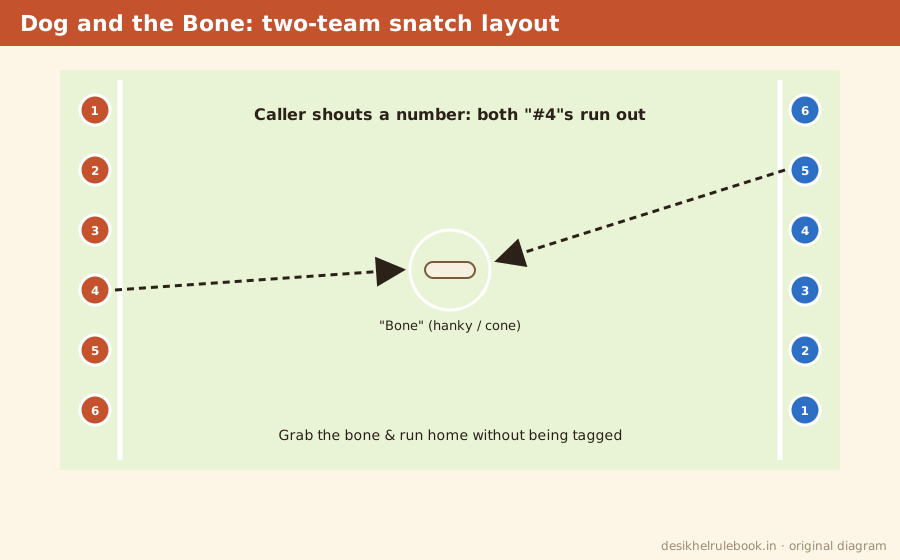
 Dog and the Bone is a PE-period favourite across Indian schools. Two teams line up facing each other, every player gets a number, and an object called the "bone" (usually a handkerchief, a duster or a small cone) sits in the middle. The teacher shouts a number, and both players with that number dash to the centre. Whoever grabs the bone must get back to their own line without being tagged by the other. It is quick, noisy, tactical and fair, because every child gets the same chance.
In Hindi-speaking schools it is often called Rumal Jhapatta (snatch the hanky) or Rumal Chor, though Rumal Chor sometimes also refers to a circle game where a hanky is dropped behind someone. This page covers the line version in detail, with tips on calling, feints and fair tagging, and notes on the circle cousin.
History and cultural note — इतिहास और परंपरा
Snatch-the-object games are common worldwide, and the English name "Dog and the Bone" came into Indian schools through PE syllabi. But the Indian versions quickly developed their own flavour: the rumal, the loud calling of numbers in Hindi or regional languages, and creative calls like "sab ke sab!" (everyone!). The game is a staple of school sports days and summer camps because it needs nothing but a hanky.
Players and age group — खिलाड़ी और उम्र
Two equal teams of 5 to 15 players. Number each team 1 to N, so that each number exists on both teams. A caller (teacher or child) stands to the side. Ages six and up. It is a good game to mix age groups because the calling ensures fair matchups (you can deliberately call numbers so similar-sized children meet).
Equipment you need — सामान
- One "bone": handkerchief, small beanbag, duster or cone.
- Chalk or cones to mark two home lines and a centre circle.
- Optional: whistle.
Ground and setup — मैदान की तैयारी
Mark two parallel home lines 15–20 m apart. Teams stand behind their lines, facing each other. Number the players on each team, but not in the same order (so number 1 on one team may face number 5 on the other). Draw a small circle of about 1 m in the middle and place the bone in it.
Step-by-step rules — खेल के नियम
- The caller shouts a number, for example "Four!"
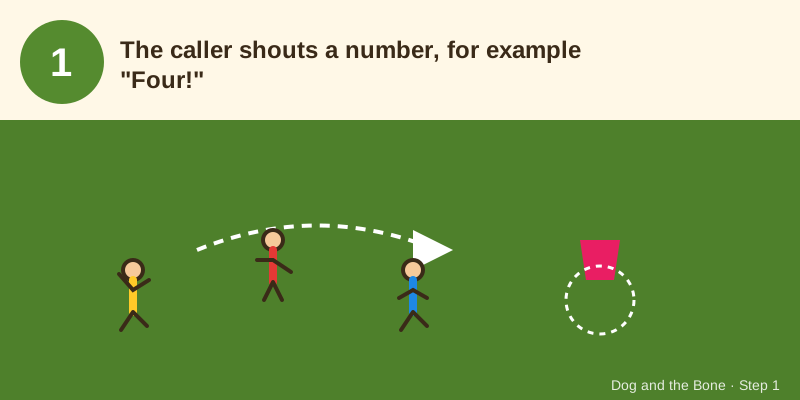
Step 1 – Dog and the Bone step 1: The caller shouts a number, for example "Four!" - Both players numbered four run to the centre.
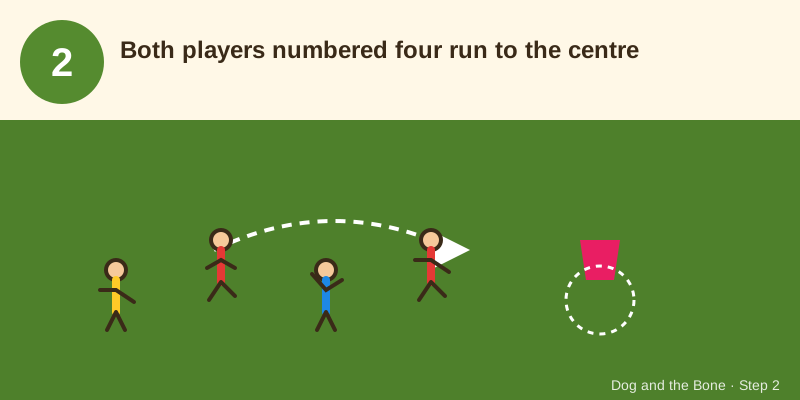
Step 2 – Dog and the Bone step 2: Both players numbered four run to the centre - Each player tries to snatch the bone and run back to their own line.
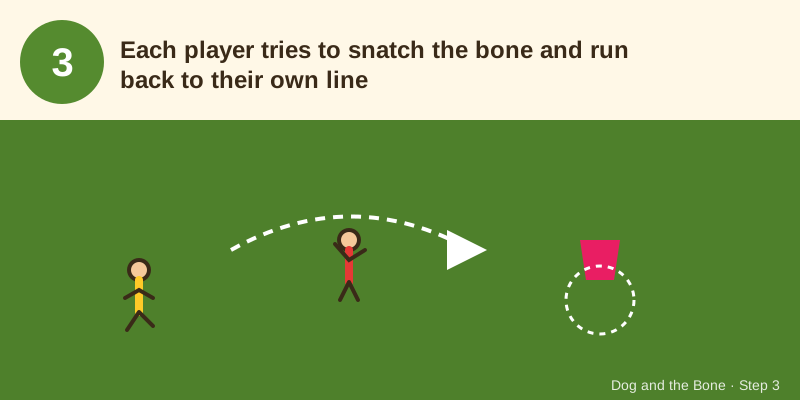
Step 3 – Dog and the Bone step 3: Each player tries to snatch the bone and run back to their own line - If a player snatches the bone and returns home without being tagged, their team scores.
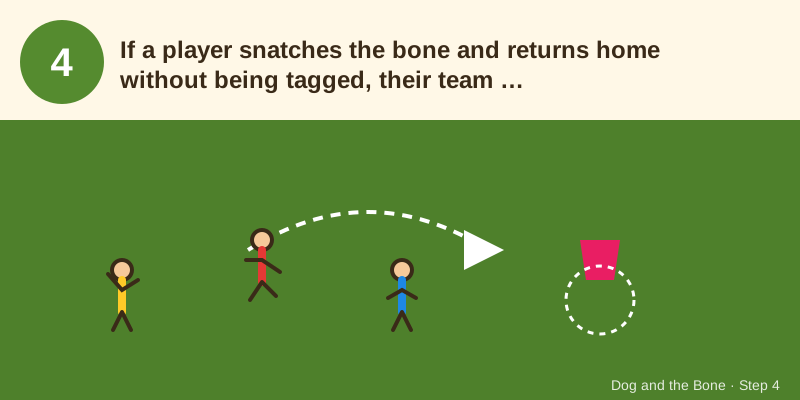
Step 4 – Dog and the Bone step 4: If a player snatches the bone and returns home without being tagged, their team … - If the other player tags the snatcher before they reach home, the tagger's team scores.
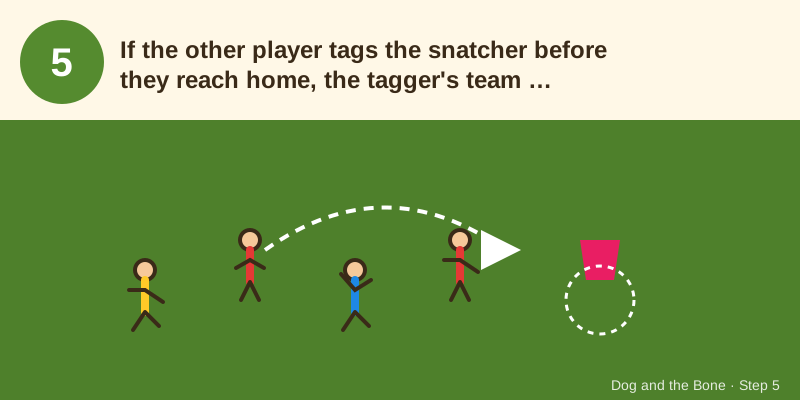
Step 5 – Dog and the Bone step 5: If the other player tags the snatcher before they reach home, the tagger's team … - If neither player picks up the bone for a long time (five seconds or so), the caller may shout another number to add pressure, or call "both back."
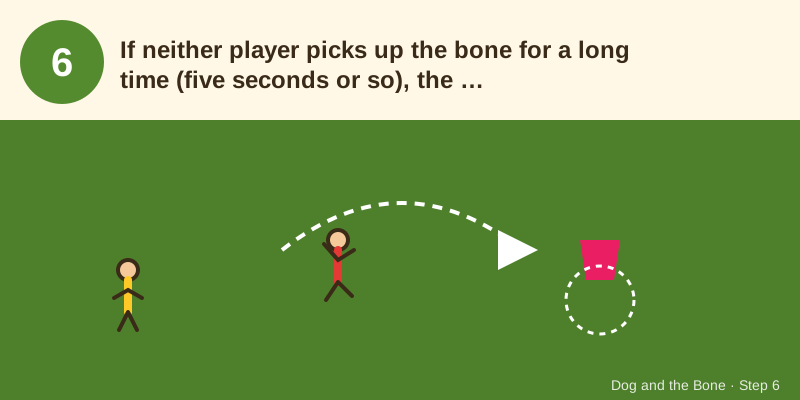
Step 6 – Dog and the Bone step 6: If neither player picks up the bone for a long time (five seconds or so), the … - Once the bone is picked up, it cannot be dropped deliberately; dropping it gives the point to the opponent (in many versions).
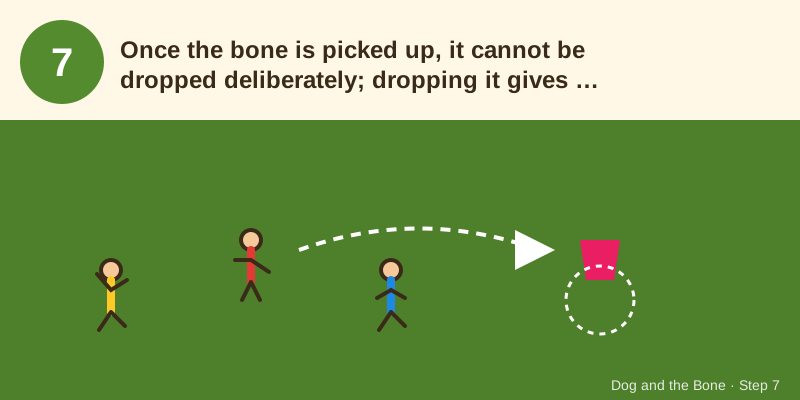
Step 7 – Dog and the Bone step 7: Once the bone is picked up, it cannot be dropped deliberately; dropping it gives … - After each point, the bone is returned to the centre and players return to their lines.
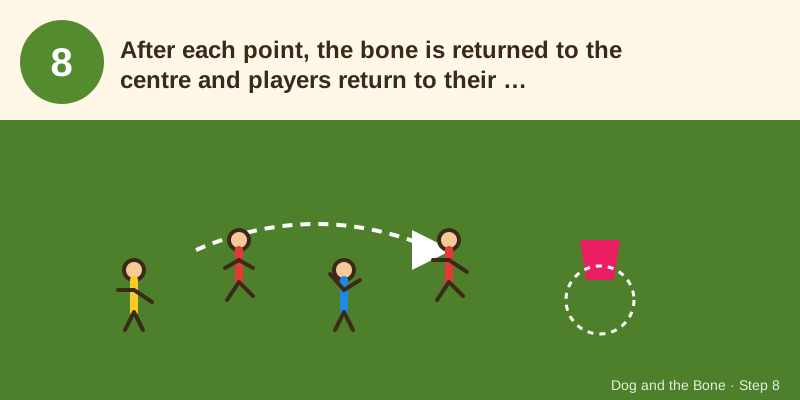
Step 8 – Dog and the Bone step 8: After each point, the bone is returned to the centre and players return to their … - The caller may call two or three numbers at once, creating a team challenge.
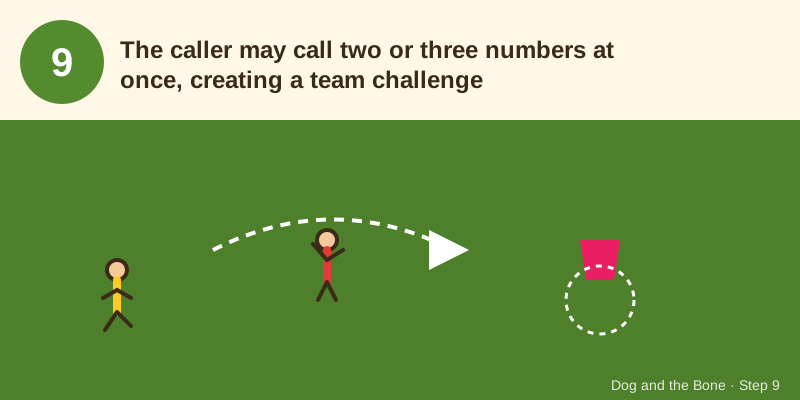
Step 9 – Dog and the Bone step 9: The caller may call two or three numbers at once, creating a team challenge - Game ends after an agreed time or score (for example first to 10 points).
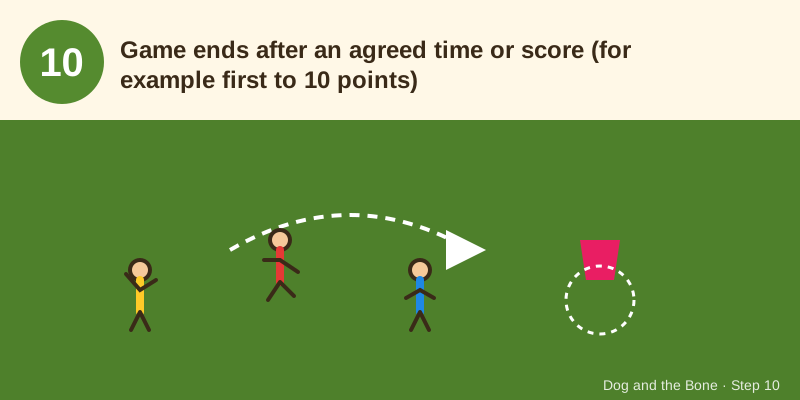
Step 10 – Dog and the Bone step 10: Game ends after an agreed time or score (for example first to 10 points)
Scoring and winning — अंक और जीत
One point for a successful snatch-and-return. One point for a successful tag. If the snatcher steps out of the side boundary, the opponent scores. If both players touch the bone at the same time, the caller declares a re-run.
Fouls and common disputes — फ़ाउल और झगड़े
- Pushing or pulling the opponent — point to the other team.
- Tagging before the bone is picked up — does not count.
- Leaving the line before the number is called — false start, point to opponent.
- Hitting instead of tagging — warning, then point to opponent.
A sample round, explained — एक उदाहरण
The caller shouts "Seven!" Neha and Kunal rush to the centre and circle the bone. Kunal feints a grab; Neha steps back. Neha suddenly grabs the hanky and turns, but Kunal is close and tags her shoulder. Point to Kunal's team. Next call: "Two and nine!" Now two players from each side compete; one team distracts while the other grabs. The game becomes a mini strategy battle.
Regional names across India — अलग-अलग राज्यों में नाम
| Region / language | Name used |
|---|---|
| Hindi belt | Rumal Jhapatta, Rumal Chor |
| Maharashtra | Rumal Jhapat |
| Gujarat | Rumal Jhapat |
| Bengal | Rumal Chor |
| Tamil Nadu | Kaikuttai Pidi (hanky snatch) |
| English schools | Dog and the Bone, Steal the Bacon |
Variations to try — खेल के रूप
Multiple numbers
Call two or three numbers at once; players may pass the bone among teammates.
Maths calls
Call "3+4!" and the number sevens run. Great for primary maths practice.
Rumal Chor (circle version)
Players sit in a circle; one walks around and drops a hanky behind someone, who must chase the dropper around the circle.
Two bones
Two hankies; players must grab both, or one each.
The art of calling
The caller makes or breaks this game. A good caller keeps everyone alert by changing the rhythm: sometimes a quick call right after the bone is replaced, sometimes a long pause that makes everyone lean forward. They also balance the match by calling numbers so that every child gets roughly the same number of runs, and by matching children of similar speed when possible. A useful trick is to keep a small notebook or tick-list of numbers called. Calls in Hindi, English and the local language keep children listening hard ("Paanch!", "Five!", "Aidu!"). For a big finish, call "Everyone!" and let the whole team compete, with a rule that the bone can be passed between teammates — absolute chaos, absolute fun, but keep a close eye on safety.
Common strategy mistakes
Children new to the game make three common mistakes. First, rushing to grab immediately, which gives the opponent an easy tag because the grabber is still facing the wrong way. Second, standing too far from the bone, so the opponent can grab safely. Third, chasing too long after a lost bone instead of cutting off the return path. Teach them the "circle" tactic: circle the bone at arm's length, watch the opponent, and grab only when they look away or step back. Defensive players should stay between the opponent and the opponent's home line. These small ideas turn a running game into a thinking game.
How to run it in a school or housing society — स्कूल और सोसाइटी में कैसे खिलाएँ
Dog and the Bone works brilliantly for big PE classes. Make sure numbers are shuffled so that different children meet. Use maths or language calls to integrate learning ("Call the number of letters in 'Bharat'!"). In societies, call numbers in local languages to make it fun for families.
Teaching tips for coaches and parents — सिखाने के टिप्स
Teach feints: step forward and back, pretend to grab, watch the opponent's eyes. Teach a safe tag: open-hand touch on the shoulder or back. Encourage quick decisions — the longer you wait, the more likely the other player will snatch.
A ready-made 45-minute session plan for Dog & the Bone — 45 मिनट की योजना
Teachers, coaches and society volunteers often ask for a plan they can follow without preparation. Here is one built around Dog & the Bone, suitable for 2 teams of 5–15 and a space of roughly 20 × 10 m. Adjust the timings to your group, but try to keep the structure, because it moves children from understanding to playing without long lectures.
- 0–5 minutes: gather and explain. Sit everyone in a circle. Show the diagram on this page (print it or hold up a phone). Explain only the three most important rules; the rest can be taught while playing.
- 5–10 minutes: warm-up. Light jogging, arm circles, ankle rolls and a few stretches. For board or small-space games, use finger and wrist warm-ups and a quick memory game instead.
- 10–18 minutes: skill drill. Practise the one key skill of the game in pairs or small groups (the teaching tips above suggest which). Short repetitions with lots of praise work better than one long attempt.
- 18–38 minutes: play. Play the game in short rounds. After every round, pause for thirty seconds and ask one question: "What worked? What was unfair?" Let children suggest small rule tweaks and vote on them.
- 38–45 minutes: cool down and reflect. Slow walking or breathing, water, and a quick round where each child says one thing they learned or one person who played fairly.
A session like this fits neatly into a school games period, a summer-camp slot or a Sunday morning in the society garden. Repeat it across a few weeks and you will see children start organising Dog & the Bone on their own, which is the real goal.
Making Dog & the Bone inclusive — सबको शामिल करें
Traditional games were always played by mixed groups: older and younger siblings, cousins visiting for the holidays, neighbours of every background. Keep that spirit alive. Give younger or less confident children a "helper" role first (scorer, umpire, equipment-in-charge) and then a playing role once they have watched a round. Pair a strong player with a beginner rather than letting captains pick teams in front of everyone, which can hurt feelings. For a child who uses a wheelchair or has limited mobility, shorten distances, allow seated or standing play where possible, and give them roles that matter to the result, such as caller, measurer or final judge. For children who find noise overwhelming, a quieter corner version or a smaller group helps. Small changes like these rarely spoil the game, and they teach every child that play belongs to everyone.
A note for parents: bringing Dog & the Bone home — माता-पिता के लिए
Many parents tell us the same story: their child spends hours on a phone game, but the moment a cousin or neighbour suggests Dog & the Bone, the phone is forgotten. Traditional games work because they are social, physical and a little unpredictable, and because they belong to the child's own world rather than to a screen. You do not need to be an expert to bring this game home. Start by playing once yourself, even badly; children love seeing a parent learn. Tell them how you or their grandparents played it, and what it was called in your town. Then step back and let them run it.
Keep the equipment in a visible place, such as a basket near the door, so that it is easy to grab. Invite one or two neighbourhood children for a regular weekly slot, perhaps a Saturday evening, and the habit will grow on its own. When disagreements happen, ask questions instead of giving verdicts: "What rule did you agree? Is that fair for the smaller kids?" Over a few weeks you will notice the children negotiating, adapting and including others, which are exactly the skills a good school tries to teach. Finally, take a photo or a short video of them playing and share it with the grandparents. Few things make an Indian dadi or nana happier than seeing a grandchild play the game they once played in the same way.
Safety tips — सुरक्षा
- Use soft objects for the bone.
- Clear the space of obstacles.
- Stress open-hand tags only.
- Avoid head-on collisions: one player must not lunge into another.
- Short breaks and water in hot weather.
Skills and benefits for children — बच्चों को फ़ायदे
Builds reaction time, speed, agility and tactical thinking. Also encourages listening and focus (waiting for your number).
हिंदी में सारांश
रुमाल झपट्टा (डॉग एंड द बोन) में दो टीमें आमने-सामने खड़ी होती हैं और हर खिलाड़ी को एक नंबर मिलता है। बीच में रुमाल रखा होता है। नंबर बुलाने पर दोनों टीमों के वही नंबर वाले खिलाड़ी दौड़ते हैं; जो रुमाल लेकर बिना छुए वापस पहुँचे, उसकी टीम को अंक मिलता है।
धक्का देना मना है, सिर्फ़ खुले हाथ से छूना।
FAQ: Dog and the Bone Game Rules – Snatch the Hanky (Rumal Jhapatta) — अक्सर पूछे जाने वाले सवाल
What is Dog and the Bone?
A team game where two players race to snatch an object and return home without being tagged.
What can I use as the bone?
A hanky, beanbag, cone or duster.
How many players are needed?
Ten or more in two teams.
What happens if both grab at once?
The caller declares a re-run.
Can I tag before the bone is picked up?
No, the tag only counts after the bone is picked up.
Is it the same as Rumal Chor?
Rumal Chor is often a circle variation; the line version is Dog and the Bone.
What age is it for?
Six and above.
How do I make it more challenging?
Call multiple numbers or use maths calls.
How do you score?
One point for a successful return or a successful tag.
Is it good for PE classes?
Yes, it is a common PE game.
Related games
Lagori / Pittu / Satoliya Rules – Seven Stones Game of India
Knock down the stack of seven stones, then rebuild it before the other team tags you out with the ball.
Kho-Kho Playground Rules – Simple Guide for Kids & Schools
Sit, chase, shout "Kho!" — the fast relay-chase game every Indian school knows, explained for the playground.

Four Corners Game Rules – Chaar Kone Indoor & Outdoor Fun
Run to a corner, wait for the call, hope your corner survives — a quick, no-equipment classroom favourite.
Tug of War Rules – Safe Playground Rassa-Kashi
Two teams, one rope, one line — how to run a fair and safe rassa-kashi at school or society events.