
Tug of War Rules – Safe Playground Rassa-Kashi
This page explains how to set up a safe playground tug of war: rope choice, marking, balancing teams, pulling technique, a judge's guide, fouls and safety rules. With these simple precautions, you can run tug of war for children and adults alike without injuries.
History and cultural note — इतिहास और परंपरा
Rope-pulling contests are ancient and found in many cultures, often connected to festivals and rituals. Tug of war was part of the early modern Olympic Games in the early twentieth century. In India, rassa-kashi is a beloved part of school sports days, village fairs and corporate events, often accompanied by drums and chants like "Jor laga ke haisha!"
Players and age group — खिलाड़ी और उम्र
Two teams of five to ten players each. For children, keep teams small (5–6). Balance teams by size and weight. Ages eight and up for full pulling; younger children can play a gentle version with a short rope.
Equipment you need — सामान
- A thick, natural fibre or synthetic rope (3–4 cm diameter), at least 15–20 m long.
- A centre ribbon or cloth tied to the rope.
- Chalk or cones to mark the centre line and two win lines.
- Optional gloves for adults; children can pull bare-handed if the rope is smooth.
Ground and setup — मैदान की तैयारी
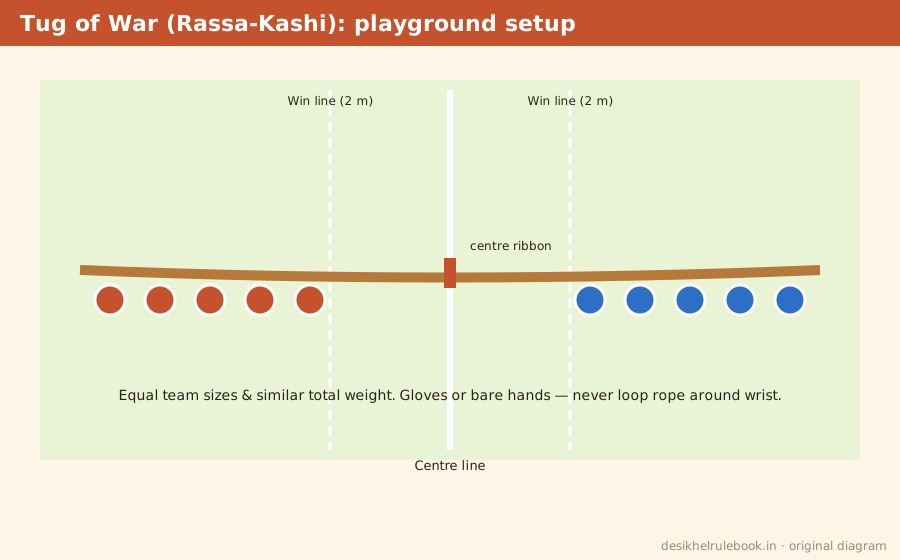
Mark a centre line on the ground. Mark two win lines 2 m on either side of the centre (1.5 m for kids). Place the rope so the centre ribbon is directly above the centre line. Teams line up on either side, holding the rope with both hands. The first puller should stand at least 1 m behind the win line.
Step-by-step rules — खेल के नियम
- Teams take position and hold the rope at waist height.
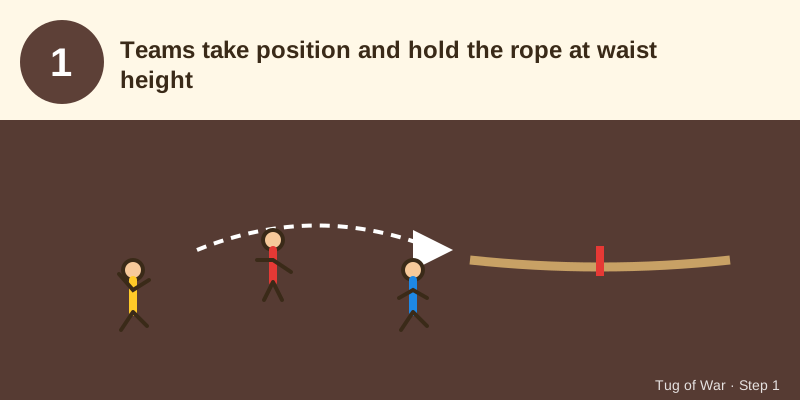
Step 1 – Tug of War step 1: Teams take position and hold the rope at waist height - The judge says "Take the strain" — teams pull gently to straighten the rope.
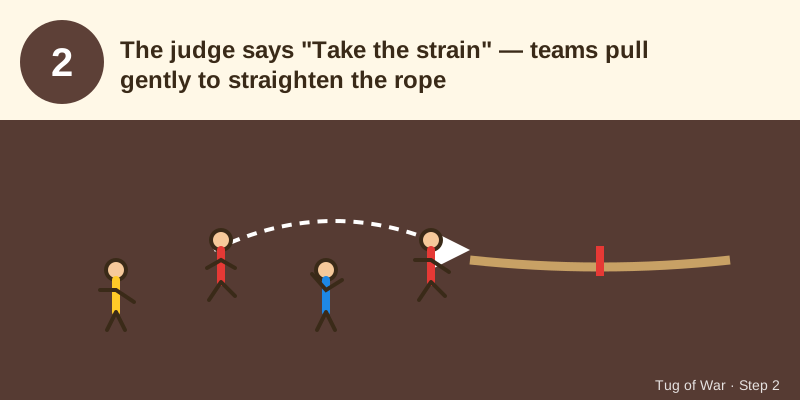
Step 2 – Tug of War step 2: The judge says "Take the strain" — teams pull gently to straighten the rope - When the ribbon is centred, the judge signals "Pull!" (or blows a whistle).
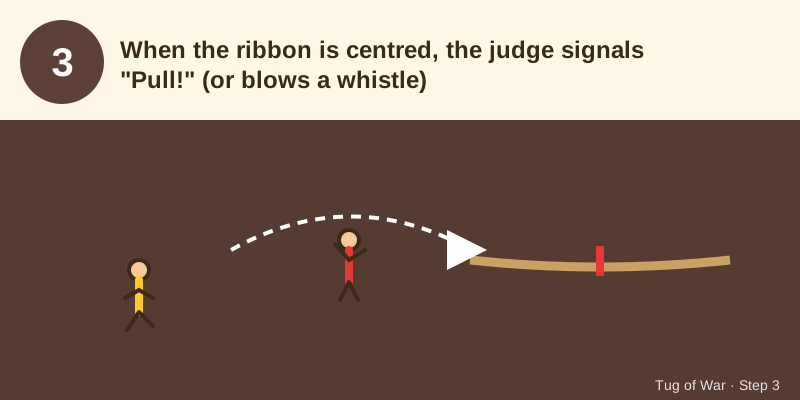
Step 3 – Tug of War step 3: When the ribbon is centred, the judge signals "Pull!" (or blows a whistle) - Teams pull backwards, keeping feet in front of knees and rope under the arm.
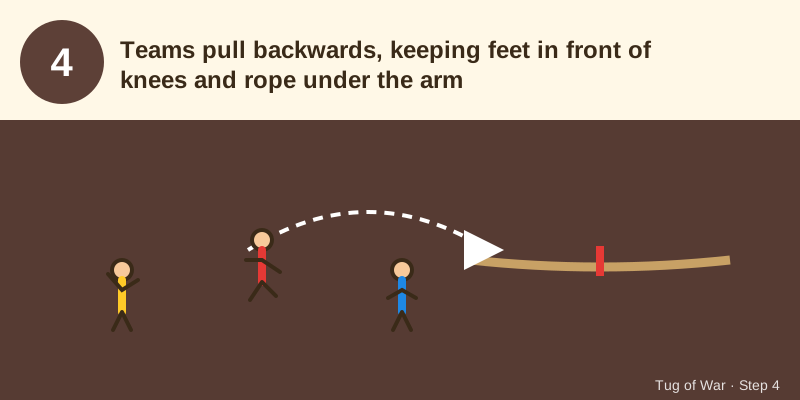
Step 4 – Tug of War step 4: Teams pull backwards, keeping feet in front of knees and rope under the arm - The team that pulls the ribbon over their win line wins the bout.
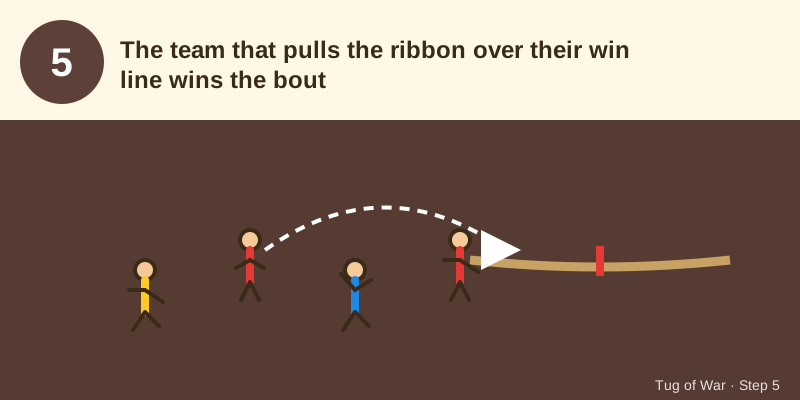
Step 5 – Tug of War step 5: The team that pulls the ribbon over their win line wins the bout - Matches are best of three bouts; teams switch sides after each bout.
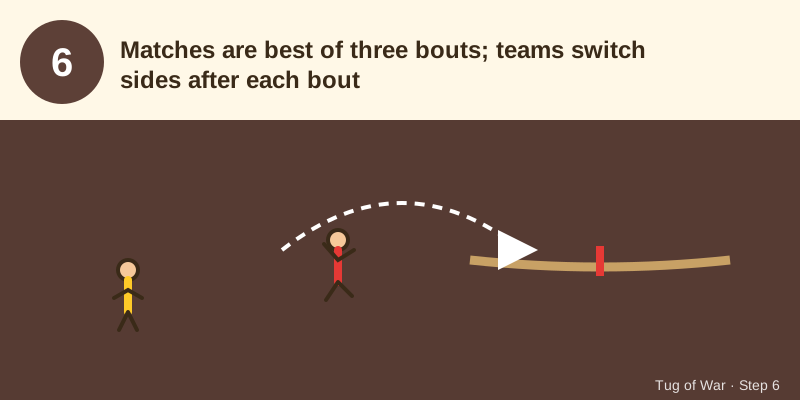
Step 6 – Tug of War step 6: Matches are best of three bouts; teams switch sides after each bout - No wrapping the rope around hands, wrists or body.
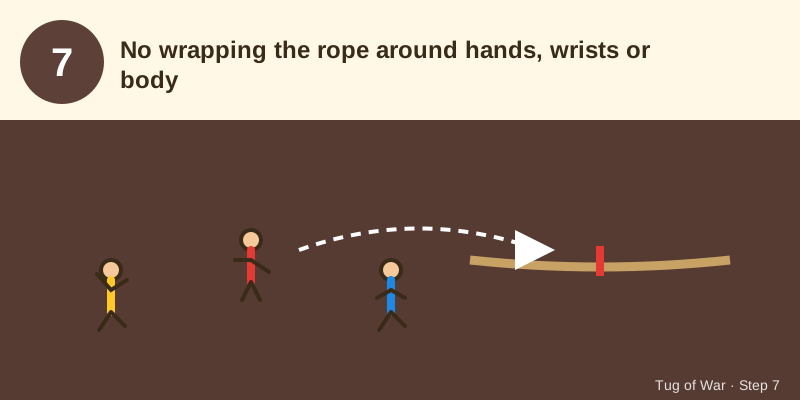
Step 7 – Tug of War step 7: No wrapping the rope around hands, wrists or body - No sitting on the ground while pulling (except momentary slips).
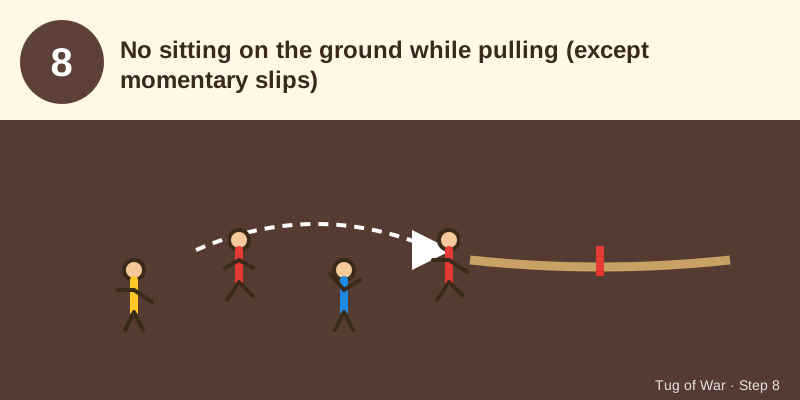
Step 8 – Tug of War step 8: No sitting on the ground while pulling (except momentary slips)
Scoring and winning — अंक और जीत
Each bout won = one point. Best of three wins the match. For tournaments, use a knockout or round-robin format with rest breaks between matches.
Fouls and common disputes — फ़ाउल और झगड़े
- Wrapping rope around hands, wrists or waist — foul; first warning, second disqualification.
- Sitting or lying down to pull — foul.
- Starting before the signal — re-start; repeated false starts = bout lost.
- Unsafe footwear (slippers) — players must change.
A sample round, explained — एक उदाहरण
At a society sports day, Team A (six adults) faces Team B (six adults). The judge centres the ribbon and calls "Take the strain… Pull!" Team A digs in and pulls steadily, chanting "Haisha!" in rhythm. Team B pulls hard but out of sync. The ribbon crosses Team A's win line. Team A wins bout one. They switch sides and repeat.
Regional names across India — अलग-अलग राज्यों में नाम
| Region / language | Name used |
|---|---|
| Across India | Rassa-Kashi, Rassi Khench, Tug of War |
| Punjab | Rassa Kashi |
| Bengal | Dori Tana |
| Tamil Nadu | Kayiru Izhuthal |
| Kerala | Vadamvali |
Variations to try — खेल के रूप
Kids' mini tug
Short rope and smaller teams; pull for 30 seconds max.
Mixed teams
Equal numbers of adults and children on each team.
Four-way tug
Four ropes tied in the centre; each team pulls towards a target.
Seated tug
Players sit and pull hand-over-hand; safer for very young kids.
Technique: why rhythm beats raw strength
The strongest team does not always win tug of war. Teams win when they pull together. A good team leans back at about 45 degrees, keeps arms straight, and uses their legs to push, like walking backwards up a slope. The rope stays close to the body, tucked under the arm, and feet are planted with heels digging in. The team then pulls in rhythm: a short, coordinated heave on the chant ("haisha!") followed by a quick reset. If each person pulls at a different moment, the force is wasted. Practise in a sequence: everyone leans back, a leader calls the beat, and the team takes a small step back on each heave. Kids love this because it feels like a group dance.
Running a fair tournament
For a fair tournament, group teams by size and age. In schools, match classes of similar strength. In societies, create mixed teams so that each team has a mix of adults and kids. Use a simple bracket on a chart paper and update it after each bout. Give teams at least two minutes of rest between bouts. Keep a judge and a backup judge, and a first-aid volunteer. End with a "friendly" pull where everyone joins the rope, which often becomes a laughing tangle — a perfect sports day finale.
Rope care and checks
Before every event, inspect the rope. Look for frayed sections, cuts or loose fibres. If you see damage, do not use it. Store the rope dry, coiled loosely, and away from sunlight to prevent weakening. A good rope can last many years if cared for.
Quick checklist before you start
Before the first round, run through a short checklist with the group. Is the space clear and safe for everyone, including younger children? Does everyone know the main rules, and have the house rules been agreed out loud? Is there a neutral person to settle disputes, such as an older child, a teacher or a parent? Is there water nearby, and does anyone need a break? Does every player have a role, even if it is scorer or judge for the first round? Taking one minute for this checklist saves many minutes of arguments later, and it teaches children to plan before they play — a small habit that helps them in every team activity they will ever join.
How to run it in a school or housing society — स्कूल और सोसाइटी में कैसे खिलाएँ
Tug of war is perfect for sports day finales. Group students by class and size. Use a strong rope and soft ground. Keep a teacher at each end and a judge in the centre. Limit pulls to 30–60 seconds for kids.
Teaching tips for coaches and parents — सिखाने के टिप्स
Teach the "lean back" posture and footwork. Practise rhythmic pulling with a chant. Explain how teamwork beats raw strength.
A ready-made 45-minute session plan for Tug of War — 45 मिनट की योजना
Teachers, coaches and society volunteers often ask for a plan they can follow without preparation. Here is one built around Tug of War, suitable for 2 teams of 5–10 and a space of roughly 20 × 6 m. Adjust the timings to your group, but try to keep the structure, because it moves children from understanding to playing without long lectures.
- 0–5 minutes: gather and explain. Sit everyone in a circle. Show the diagram on this page (print it or hold up a phone). Explain only the three most important rules; the rest can be taught while playing.
- 5–10 minutes: warm-up. Light jogging, arm circles, ankle rolls and a few stretches. For board or small-space games, use finger and wrist warm-ups and a quick memory game instead.
- 10–18 minutes: skill drill. Practise the one key skill of the game in pairs or small groups (the teaching tips above suggest which). Short repetitions with lots of praise work better than one long attempt.
- 18–38 minutes: play. Play the game in short rounds. After every round, pause for thirty seconds and ask one question: "What worked? What was unfair?" Let children suggest small rule tweaks and vote on them.
- 38–45 minutes: cool down and reflect. Slow walking or breathing, water, and a quick round where each child says one thing they learned or one person who played fairly.
A session like this fits neatly into a school games period, a summer-camp slot or a Sunday morning in the society garden. Repeat it across a few weeks and you will see children start organising Tug of War on their own, which is the real goal.
Making Tug of War inclusive — सबको शामिल करें
Traditional games were always played by mixed groups: older and younger siblings, cousins visiting for the holidays, neighbours of every background. Keep that spirit alive. Give younger or less confident children a "helper" role first (scorer, umpire, equipment-in-charge) and then a playing role once they have watched a round. Pair a strong player with a beginner rather than letting captains pick teams in front of everyone, which can hurt feelings. For a child who uses a wheelchair or has limited mobility, shorten distances, allow seated or standing play where possible, and give them roles that matter to the result, such as caller, measurer or final judge. For children who find noise overwhelming, a quieter corner version or a smaller group helps. Small changes like these rarely spoil the game, and they teach every child that play belongs to everyone.
A note for parents: bringing Tug of War home — माता-पिता के लिए
Many parents tell us the same story: their child spends hours on a phone game, but the moment a cousin or neighbour suggests Tug of War, the phone is forgotten. Traditional games work because they are social, physical and a little unpredictable, and because they belong to the child's own world rather than to a screen. You do not need to be an expert to bring this game home. Start by playing once yourself, even badly; children love seeing a parent learn. Tell them how you or their grandparents played it, and what it was called in your town. Then step back and let them run it.
Keep the equipment in a visible place, such as a basket near the door, so that it is easy to grab. Invite one or two neighbourhood children for a regular weekly slot, perhaps a Saturday evening, and the habit will grow on its own. When disagreements happen, ask questions instead of giving verdicts: "What rule did you agree? Is that fair for the smaller kids?" Over a few weeks you will notice the children negotiating, adapting and including others, which are exactly the skills a good school tries to teach. Finally, take a photo or a short video of them playing and share it with the grandparents. Few things make an Indian dadi or nana happier than seeing a grandchild play the game they once played in the same way.
Safety tips — सुरक्षा
- Never wrap the rope around any body part.
- Use a rope without frays or knots.
- Play on grass or soft ground.
- Stop immediately if someone falls.
- Balance team size and weight.
- Have first aid ready.
Skills and benefits for children — बच्चों को फ़ायदे
Builds strength, teamwork, coordination and team spirit. Great for community bonding.
हिंदी में सारांश
रस्साकशी में दो टीमें रस्सी के दोनों ओर खींचती हैं। बीच में रिबन होता है और दोनों तरफ़ 2 मीटर पर जीत की लाइन। जो टीम रिबन अपनी लाइन तक खींच लेती है, वह जीतती है।
रस्सी कभी हाथ या कमर पर न लपेटें, नरम ज़मीन पर खेलें, और बच्चों के लिए छोटे राउंड रखें।
FAQ: Tug of War Rules – Safe Playground Rassa-Kashi — अक्सर पूछे जाने वाले सवाल
How long should the rope be?
At least 15–20 m for teams of 5–8.
How far are the win lines?
Usually 2 m from the centre line.
Can kids play tug of war?
Yes, with shorter rounds and smaller teams.
Is it safe?
Yes if you follow rope and posture safety rules.
What is "take the strain"?
Gentle pulling to straighten the rope before the start.
Why not wrap the rope?
It can cause serious injuries if pulled suddenly.
How many bouts in a match?
Usually best of three.
What footwear is best?
Sports shoes; no slippers.
Is it an official sport?
Yes, but these are playground rules.
What chant is common in India?
"Jor laga ke haisha!"
Related games

Sack Race & Lemon-Spoon Race Rules – Sports Day Classics Pack
Hop in a bori, balance a nimbu — the two classic sports day races with fair rules and judging tips.
Kabaddi Backyard Rules – Safe Playground Kabaddi for Kids
One breath, one raid: chant "kabaddi-kabaddi," touch a defender and race back — a safe backyard version for kids.
Dog and the Bone Game Rules – Snatch the Hanky (Rumal Jhapatta)
Two teams, one "bone," a caller shouts a number — snatch it and race home before you are tagged.
Kho-Kho Playground Rules – Simple Guide for Kids & Schools
Sit, chase, shout "Kho!" — the fast relay-chase game every Indian school knows, explained for the playground.