
Sack Race & Lemon-Spoon Race Rules – Sports Day Classics Pack

No Indian sports day is complete without the sack race (bori daud) and the lemon-spoon race (nimbu-chammach daud). Children hop in jute sacks, stumble, giggle and leap across the finish line; others walk with laser focus, a lemon balanced on a spoon. These races are simple to run, safe for young children and endlessly entertaining for parents.
This page gives clear rules for both races, a standard lane setup, judging tips, fair start methods and safety guidance. It also includes age-wise distances and alternative versions like potato races or marble-spoon races.

History and cultural note — इतिहास और परंपरा
Novelty races have long been part of school sports days and village fairs. In India, sack races and lemon-spoon races became staples of school annual sports and community events. They focus on balance and fun rather than speed, making them inclusive for all ages.
Players and age group — खिलाड़ी और उम्र
4–8 children per heat, depending on the width of your ground. Ages four and up for lemon-spoon; five and up for sack race. Adults can join for parents' races.
Equipment you need — सामान
- Jute sacks (bori) large enough for a child to stand in, reaching hip or waist height.
- Spoons (steel or plastic) and lemons (or small plastic balls).
- Cones, chalk or rope for lanes.
- Whistle, stopwatch and finish tape.
Ground and setup — मैदान की तैयारी
Mark straight lanes about 1.2–1.5 m wide. Distances: 15 m for ages 4–6, 20 m for 7–9, 25–30 m for 10+. Place a start line and finish line. Keep a soft surface (grass or sand) for sack races. For lemon-spoon, ensure the ground is even.
Step-by-step rules — खेल के नियम
- Sack race: children stand in the sack holding it at the waist.
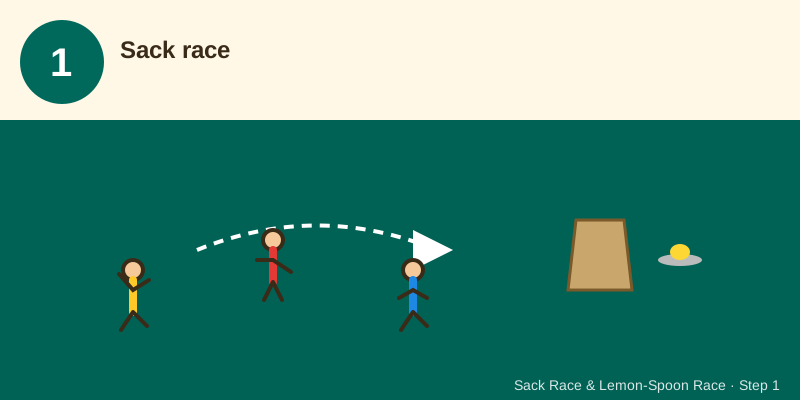
Step 1 – Sack Race & Lemon-Spoon Race step 1: Sack race - At "Ready, steady, go!" they hop or jump to the finish line.
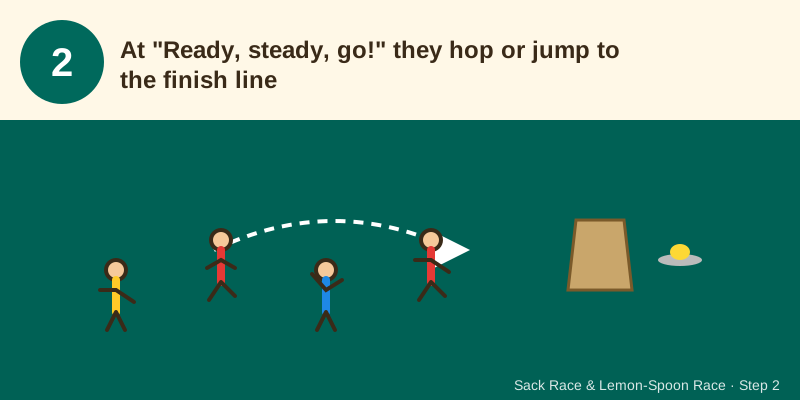
Step 2 – Sack Race & Lemon-Spoon Race step 2: At "Ready, steady, go!" they hop or jump to the finish line - They must keep both feet inside the sack. If they fall, they can get up and continue.
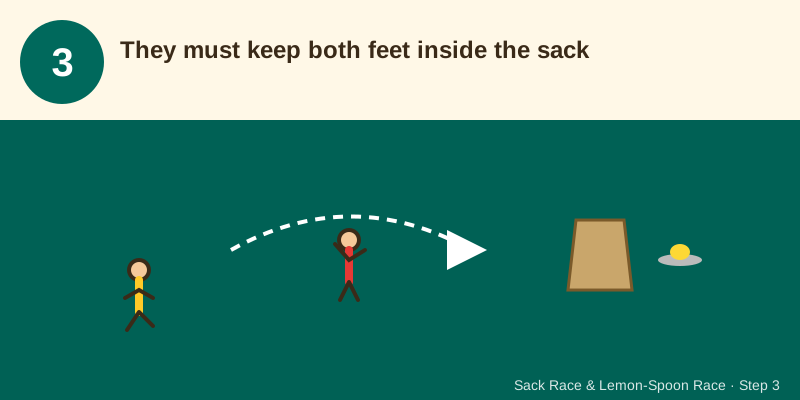
Step 3 – Sack Race & Lemon-Spoon Race step 3: They must keep both feet inside the sack - Running inside the sack is not allowed; it must be hopping or jumping.
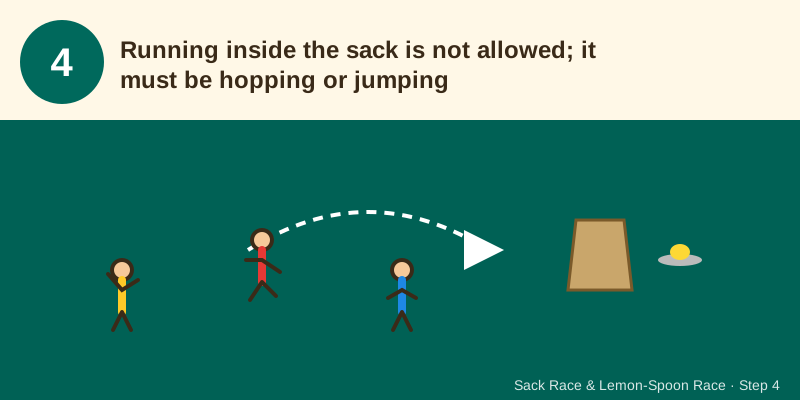
Step 4 – Sack Race & Lemon-Spoon Race step 4: Running inside the sack is not allowed; it must be hopping or jumping - The first child to cross the finish line with both feet in the sack wins.
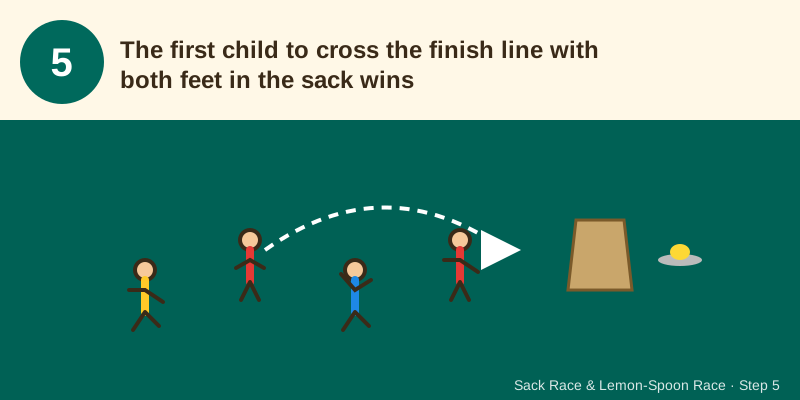
Step 5 – Sack Race & Lemon-Spoon Race step 5: The first child to cross the finish line with both feet in the sack wins - Lemon-spoon race: children hold the spoon by the handle and place the lemon on the spoon.
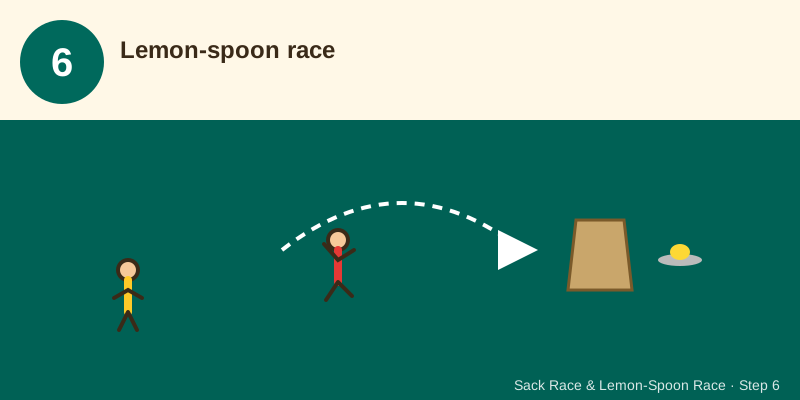
Step 6 – Sack Race & Lemon-Spoon Race step 6: Lemon-spoon race - At the start signal, they walk or run to the finish line without touching the lemon.
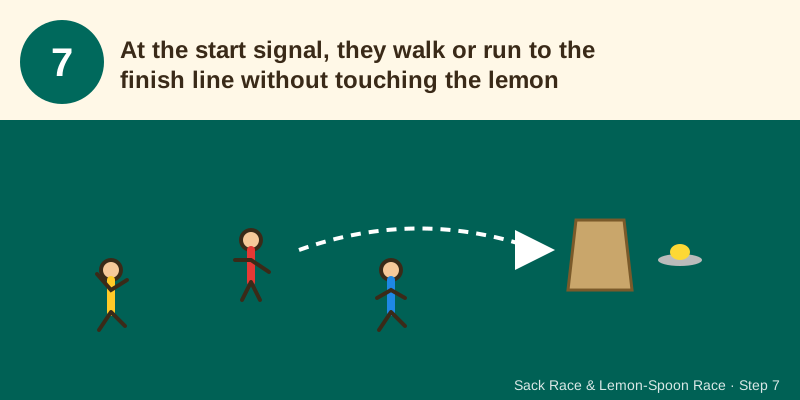
Step 7 – Sack Race & Lemon-Spoon Race step 7: At the start signal, they walk or run to the finish line without touching the lemon - If the lemon falls, they must stop, pick it up, put it back and continue from where it fell.
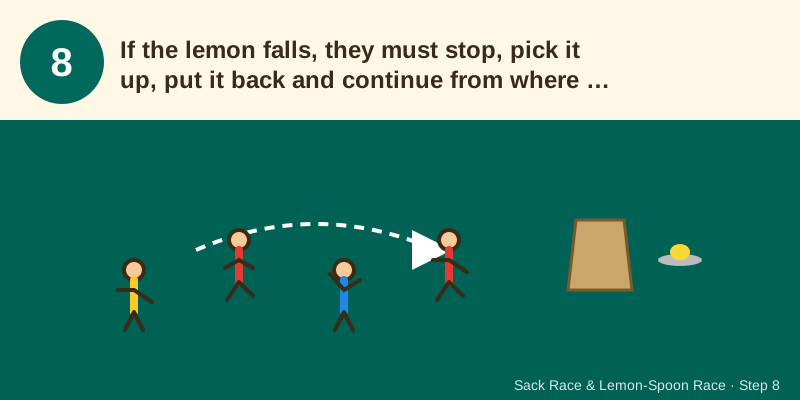
Step 8 – Sack Race & Lemon-Spoon Race step 8: If the lemon falls, they must stop, pick it up, put it back and continue from where … - Holding the lemon with a finger or thumb is a foul.
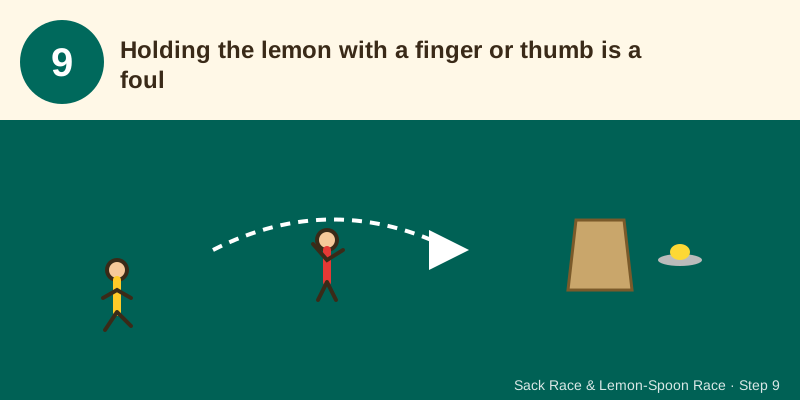
Step 9 – Sack Race & Lemon-Spoon Race step 9: Holding the lemon with a finger or thumb is a foul - The first child to cross the finish line with the lemon on the spoon wins.
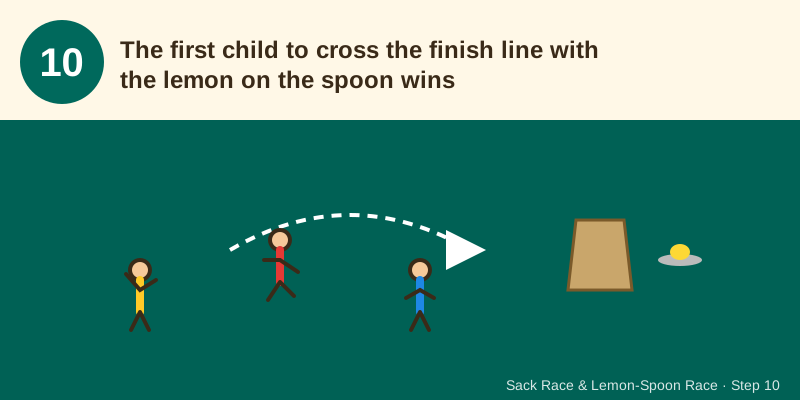
Step 10 – Sack Race & Lemon-Spoon Race step 10: The first child to cross the finish line with the lemon on the spoon wins
Scoring and winning — अंक और जीत
Winner of each heat advances to the final, or award 1st, 2nd and 3rd per heat. For class competitions, give points (3-2-1) to houses or teams.
Fouls and common disputes — फ़ाउल और झगड़े
- Sack race: stepping out of the sack — return to the point of exit or disqualify (agree).
- Sack race: running in the sack — warning, then disqualification.
- Lemon-spoon: holding the lemon — disqualification.
- Lemon-spoon: putting the spoon in the mouth (if hand version) — disqualification.
- False start — warning; second false start disqualifies.
A sample round, explained — एक उदाहरण
In the Class 2 sack race, six children line up. On "Go!" Rahul jumps too far and falls, laughs and gets up. Aanya hops steadily and wins. In the lemon-spoon race, Kabir walks slowly, eyes on the lemon. Meera speeds up and drops it, picks it up and continues. Kabir wins by steady balance.
Regional names across India — अलग-अलग राज्यों में नाम
| Region / language | Name used |
|---|---|
| Hindi belt | Bori Daud, Nimbu-Chammach Daud |
| Maharashtra | Pote Sharyat, Limbu-Chamcha |
| Tamil Nadu | Saakku Ottam, Elumichai Spoon |
| Bengal | Bosta Dour, Lebu-Chamuch |
Variations to try — खेल के रूप
Spoon in mouth
Older children hold the spoon in their mouth; increases difficulty.
Marble-spoon race
Use a marble instead of lemon for advanced kids.
Potato race
Collect potatoes one by one and place them in a bucket.
Three-legged race
Partners tie one leg together and run.
A complete sports day "novelty race" plan
If you are organising a sports day, combine these races into a sequence. Start with lemon-spoon races for younger classes (Nursery–Class 2), then sack races for Classes 3–5, followed by three-legged races and potato races. Keep each heat short and keep the next heat ready at the start line to avoid long waits. Use a public announcement or a teacher with a loudspeaker to call names. Give certificates or ribbons to winners and participation badges to all. Parents enjoy these races, so schedule a "parents' sack race" just before tug of war. This creates a joyful, inclusive event without complex equipment.
Judging and recording results
Assign two judges at the finish line: one watching for 1st place, the other for 2nd and 3rd. Use a finish tape or a rope held loosely. Record results on a clipboard with columns for heat, lane, name and position. For house points, update a chart board immediately after each race so children can see progress. Clear judging prevents disputes and keeps the event moving.
Making races inclusive
For children with limited mobility, allow assisted lemon-spoon walking or seated relay versions. For very young children, shorten distances and allow lemons to be replaced with larger soft balls. Encourage cheering for all participants, not just winners. The goal is participation and fun, not only speed.
Preparing equipment on a budget
You do not need to buy special equipment. Ask the local kirana store or a rice/grain trader for used jute sacks; many will give them away or sell them cheaply. Shake them out, check for holes and wash them if dusty, then dry in the sun. Cut sacks that are too tall for small children so the top reaches their waist. For lemon-spoon, steel tablespoons from the school canteen or home kitchens work well; mark each spoon with coloured tape for lanes. Lemons can be replaced with ping-pong balls or small potatoes, which roll differently and add fun. Keep a box with spares, a few safety pins (to fix torn sacks) and a towel for sweaty hands. With a little planning, the whole kit for a class of forty costs less than a single cricket ball, and it can be reused year after year.
How to run it in a school or housing society — स्कूल और सोसाइटी में कैसे खिलाएँ
Run heats by age group. Use house points to encourage teamwork. Assign teachers to start, judge and record results. Keep spare sacks and lemons ready. For societies, add parent races to boost participation.
Teaching tips for coaches and parents — सिखाने के टिप्स
For sack race, practise small jumps and landing softly. For lemon-spoon, practise walking with the spoon steady, eyes on the lemon, arm close to the body.
A ready-made 45-minute session plan for Sack & Lemon-Spoon — 45 मिनट की योजना
Teachers, coaches and society volunteers often ask for a plan they can follow without preparation. Here is one built around Sack & Lemon-Spoon, suitable for 4–8 per heat and a space of roughly 20–30 m straight track. Adjust the timings to your group, but try to keep the structure, because it moves children from understanding to playing without long lectures.
- 0–5 minutes: gather and explain. Sit everyone in a circle. Show the diagram on this page (print it or hold up a phone). Explain only the three most important rules; the rest can be taught while playing.
- 5–10 minutes: warm-up. Light jogging, arm circles, ankle rolls and a few stretches. For board or small-space games, use finger and wrist warm-ups and a quick memory game instead.
- 10–18 minutes: skill drill. Practise the one key skill of the game in pairs or small groups (the teaching tips above suggest which). Short repetitions with lots of praise work better than one long attempt.
- 18–38 minutes: play. Play the game in short rounds. After every round, pause for thirty seconds and ask one question: "What worked? What was unfair?" Let children suggest small rule tweaks and vote on them.
- 38–45 minutes: cool down and reflect. Slow walking or breathing, water, and a quick round where each child says one thing they learned or one person who played fairly.
A session like this fits neatly into a school games period, a summer-camp slot or a Sunday morning in the society garden. Repeat it across a few weeks and you will see children start organising Sack & Lemon-Spoon on their own, which is the real goal.
Making Sack & Lemon-Spoon inclusive — सबको शामिल करें
Traditional games were always played by mixed groups: older and younger siblings, cousins visiting for the holidays, neighbours of every background. Keep that spirit alive. Give younger or less confident children a "helper" role first (scorer, umpire, equipment-in-charge) and then a playing role once they have watched a round. Pair a strong player with a beginner rather than letting captains pick teams in front of everyone, which can hurt feelings. For a child who uses a wheelchair or has limited mobility, shorten distances, allow seated or standing play where possible, and give them roles that matter to the result, such as caller, measurer or final judge. For children who find noise overwhelming, a quieter corner version or a smaller group helps. Small changes like these rarely spoil the game, and they teach every child that play belongs to everyone.
A note for parents: bringing Sack & Lemon-Spoon home — माता-पिता के लिए
Many parents tell us the same story: their child spends hours on a phone game, but the moment a cousin or neighbour suggests Sack & Lemon-Spoon, the phone is forgotten. Traditional games work because they are social, physical and a little unpredictable, and because they belong to the child's own world rather than to a screen. You do not need to be an expert to bring this game home. Start by playing once yourself, even badly; children love seeing a parent learn. Tell them how you or their grandparents played it, and what it was called in your town. Then step back and let them run it.
Keep the equipment in a visible place, such as a basket near the door, so that it is easy to grab. Invite one or two neighbourhood children for a regular weekly slot, perhaps a Saturday evening, and the habit will grow on its own. When disagreements happen, ask questions instead of giving verdicts: "What rule did you agree? Is that fair for the smaller kids?" Over a few weeks you will notice the children negotiating, adapting and including others, which are exactly the skills a good school tries to teach. Finally, take a photo or a short video of them playing and share it with the grandparents. Few things make an Indian dadi or nana happier than seeing a grandchild play the game they once played in the same way.
Safety tips — सुरक्षा
- Use grass or sand for sack races.
- Check sacks for holes and sharp threads.
- Keep lanes wide to prevent collisions.
- Lemons can be replaced with soft balls for younger kids.
- Warm up ankles and knees.
Skills and benefits for children — बच्चों को फ़ायदे
Balance, coordination, focus and resilience (getting up after a fall). Inclusive and joyful for all ages.
हिंदी में सारांश
बोरी दौड़ में बच्चे बोरी के अंदर खड़े होकर कूदते हुए फिनिश लाइन तक पहुँचते हैं। नींबू-चम्मच दौड़ में चम्मच पर नींबू रखकर उसे गिराए बिना चलना होता है।
नींबू को उंगली से पकड़ना फ़ाउल है। बोरी दौड़ के लिए नरम घास या रेत पर लेन बनाएँ।
FAQ: Sack Race & Lemon-Spoon Race Rules – Sports Day Classics Pack — अक्सर पूछे जाने वाले सवाल
How long should a sack race be?
15–30 m depending on age.
Can children run inside the sack?
No, they must hop or jump.
What if the lemon falls?
Stop, pick it up and continue from that spot.
Can we use plastic balls?
Yes, especially for younger kids.
Is spoon in mouth allowed?
Only in advanced variants.
How many kids per heat?
4–8 depending on lane width.
What surface is best?
Grass or sand.
How do we judge fairly?
Use a finish tape and two judges.
Can adults participate?
Yes, parent races are popular.
Why are these races popular?
They are fun, inclusive and easy to organise.
Related games

Tug of War Rules – Safe Playground Rassa-Kashi
Two teams, one rope, one line — how to run a fair and safe rassa-kashi at school or society events.

Four Corners Game Rules – Chaar Kone Indoor & Outdoor Fun
Run to a corner, wait for the call, hope your corner survives — a quick, no-equipment classroom favourite.

Dog and the Bone Game Rules – Snatch the Hanky (Rumal Jhapatta)
Two teams, one "bone," a caller shouts a number — snatch it and race home before you are tagged.

Kho-Kho Playground Rules – Simple Guide for Kids & Schools
Sit, chase, shout "Kho!" — the fast relay-chase game every Indian school knows, explained for the playground.