
Kabaddi Backyard Rules – Safe Playground Kabaddi for Kids
Kabaddi is a test of courage and breath. A single player, the raider, crosses into the opponents' half while chanting "kabaddi, kabaddi, kabaddi" without breaking breath, tries to touch one or more defenders, and then dashes back across the midline. The defenders try to stop him. It is thrilling to watch and even more thrilling to play.
Because kabaddi involves contact, the backyard version on this page is adapted for safety: we use a "touch-and-tag" approach, limit tackling, and add a few rules for younger players. You will learn court markings, the raid, how points are scored, how players are revived, fouls, and how teachers can run kabaddi safely.
History and cultural note — इतिहास और परंपरा
Kabaddi has roots in rural India, where it was played in village fields with no equipment at all. It is known in many forms and names, and it has spread across South Asia. It became an organised sport in the twentieth century, was showcased in the 1936 Berlin Olympics demonstration of Indian games, and later became part of the Asian Games. In the last decade, professional kabaddi leagues have made it hugely popular on television. Yet the heart of kabaddi remains the village ground: a line in the dust, two teams, and a brave raider holding his breath.
Players and age group — खिलाड़ी और उम्र
Two teams of five to seven players each. Extra players wait at the side and enter when players are out or revived. Children nine and up can play the touch version; younger children can play a "no-tackle" version where defenders only tag the raider. Mixed teams are fine if contact is limited.
Equipment you need — सामान
- Chalk or rope to mark the court.
- A whistle and timer.
- Soft ground: grass, mud or mats. Avoid concrete.
Ground and setup — मैदान की तैयारी
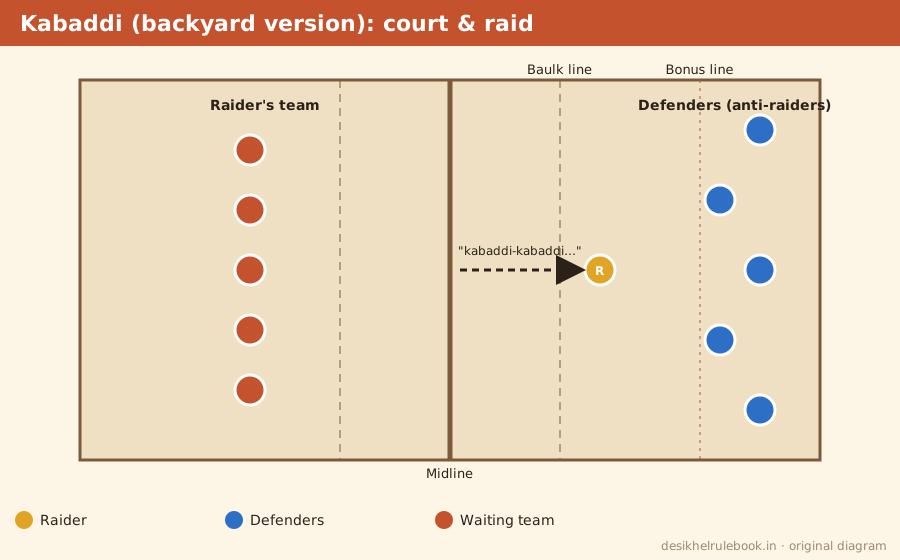
Mark a rectangle about 12 m by 8 m (smaller for kids). Draw a midline across the middle. Mark a "baulk line" about 2.5–3 m from the midline in each half; the raider must cross it for a raid to count. Optionally mark a "bonus line" closer to the end line for older players. Teams take their halves; the waiting team sits outside the court.
Step-by-step rules — खेल के नियम
- Teams toss for first raid.
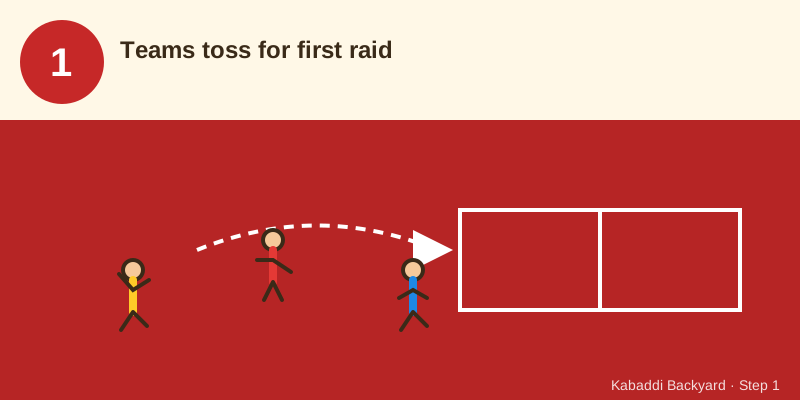
Step 1 – Kabaddi Backyard step 1: Teams toss for first raid - The raider must start chanting "kabaddi" before crossing the midline and continue without taking a breath until he returns.
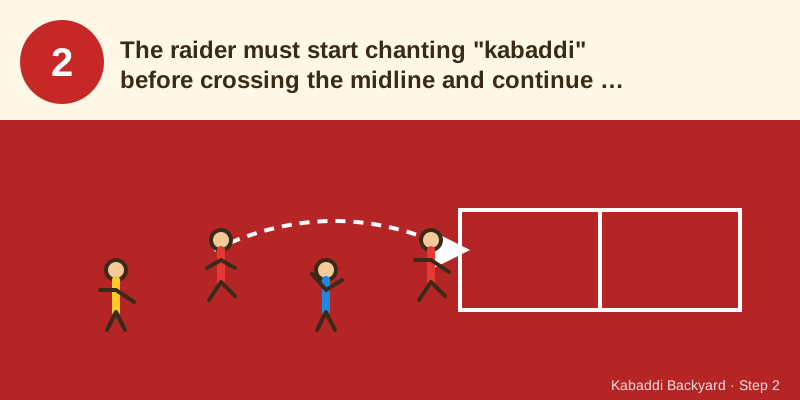
Step 2 – Kabaddi Backyard step 2: The raider must start chanting "kabaddi" before crossing the midline and continue … - The raider must cross the baulk line in the opponent's half for the raid to be valid.
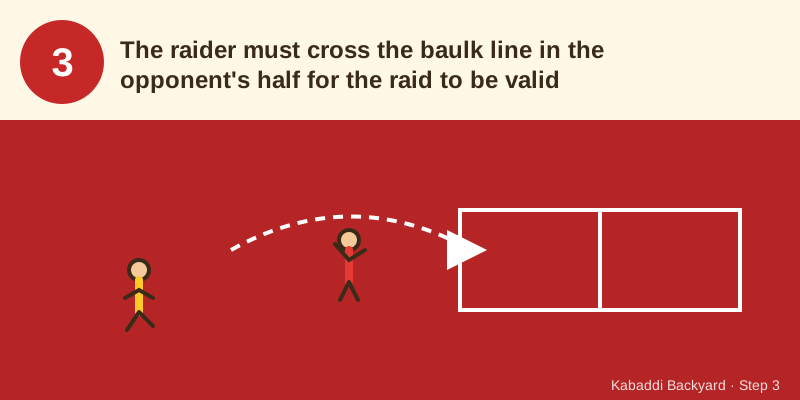
Step 3 – Kabaddi Backyard step 3: The raider must cross the baulk line in the opponent's half for the raid to be valid - The raider tries to touch any defender with hand or foot, then return to his own half.

Step 4 – Kabaddi Backyard step 4: The raider tries to touch any defender with hand or foot, then return to his own … - If the raider returns safely, each defender he touched is out.
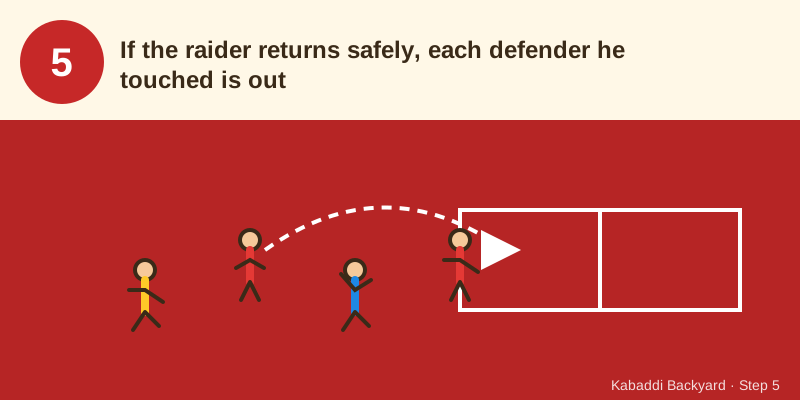
Step 5 – Kabaddi Backyard step 5: If the raider returns safely, each defender he touched is out - Defenders try to stop the raider from returning. In the backyard version, defenders "tag" the raider by holding him gently or by two defenders touching him at once (agree before playing). If stopped, the raider is out.
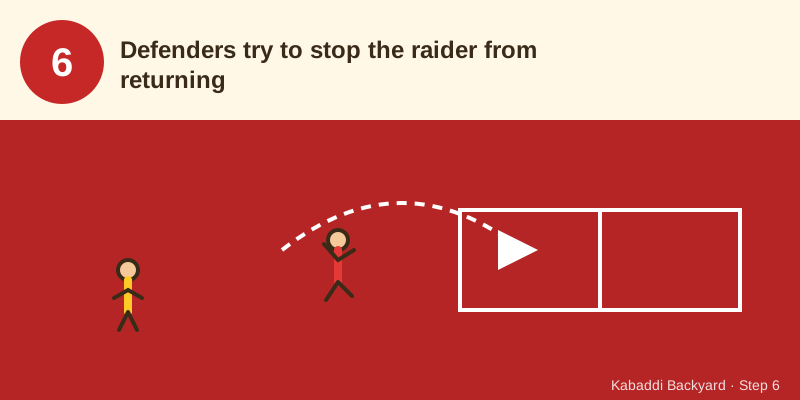
Step 6 – Kabaddi Backyard step 6: Defenders try to stop the raider from returning - If the raider breaks the chant (takes a breath) in the opponent's half, he is out.
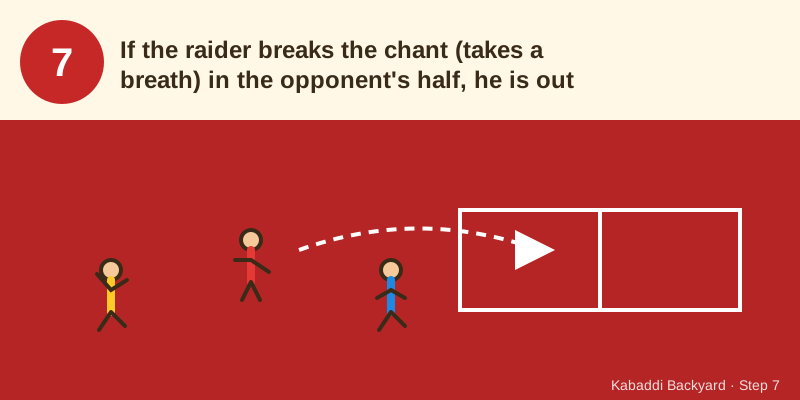
Step 7 – Kabaddi Backyard step 7: If the raider breaks the chant (takes a breath) in the opponent's half, he is out - Teams alternate raids.
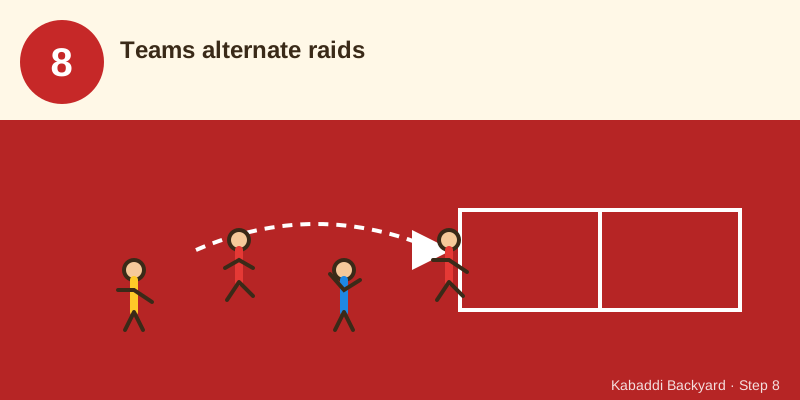
Step 8 – Kabaddi Backyard step 8: Teams alternate raids - Revival: when a team gets an opponent out, one of their own out players returns to the court (in order).
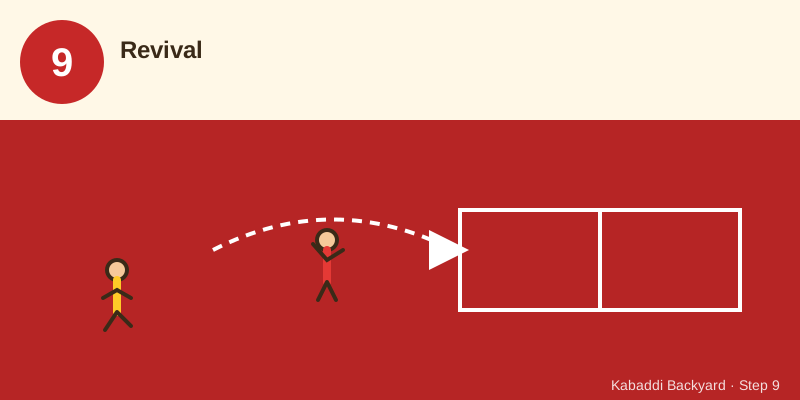
Step 9 – Kabaddi Backyard step 9: Revival - The game is played in two halves of 10 minutes each (or shorter for kids).

Step 10 – Kabaddi Backyard step 10: The game is played in two halves of 10 minutes each (or shorter for kids)
Scoring and winning — अंक और जीत
One point for each opponent put out. If the raider touches two defenders and returns, his team gets two points. If defenders stop the raider, the defending team gets one point. If all players of one team are out (an "all out"), the other team gets two bonus points and the out team is fully revived. The team with the higher score at the end wins.
Fouls and common disputes — फ़ाउल और झगड़े
- Breaking the chant — raider out.
- Defenders grabbing the raider by the neck, hair or clothes — foul; raider safe and gets a point.
- Rough tackling or diving — not allowed in the backyard version.
- Stepping out of the boundary — out (except during a struggle, if your group allows).
- Raider not crossing the baulk line — raid invalid.
A sample round, explained — एक उदाहरण
Team Tiger raids first. Raider Kiran crosses the midline chanting. She steps past the baulk line, touches defender Ali on the shoulder and quickly turns back. Ali and Meena try to stop her, but Kiran slips past and crosses the midline still chanting. Ali is out; Tiger gets one point.
Next, Team Lion's raider Vivek enters. He tries to touch two defenders, but Tiger's defenders form a chain and gently block him. Two defenders touch him at once, which in their backyard rule means he is stopped. Vivek is out, Tiger gets one point and Ali is revived.
Regional names across India — अलग-अलग राज्यों में नाम
| Region / language | Name used |
|---|---|
| North India | Kabaddi, Kaudi, Hu-tu-tu |
| Maharashtra | Hututu |
| Tamil Nadu | Sadugudu, Chadugudu |
| Bengal | Ha-du-du |
| Kerala | Vandi-kali (some areas) |
| Punjab | Kabaddi, Circle Kabaddi |
Variations to try — खेल के रूप
Touch kabaddi
Defenders can only touch, not hold. A raider is stopped if three defenders touch him.
Circle kabaddi (Punjab style)
Played in a circle with a single raider and single stopper; older players only.
Hu-tu-tu chant
Use "hu-tu-tu" instead of "kabaddi." Same breath rule.
Mini kabaddi
Shorter court and 3-a-side; good for younger children.
Breath, chant and the raider's mindset
The chant is what makes kabaddi unique. It is proof that the raider is on a single breath, and it is also a psychological weapon: a calm, steady chant tells the defenders that the raider is relaxed and has time, while a rushed chant tells them he is running out of air. Teach children to take a deep breath before crossing the midline, keep the chant short and rhythmic ("kab-ad-di, kab-ad-di"), and turn back early rather than late. A raider who returns with one touch is far more valuable than a raider who tries for three and gets stopped.
Good raiders also use feints: a sudden step towards one defender, then a touch on another. They keep their body low, stay near the middle of the court and avoid corners where defenders can trap them. A golden rule for beginners: never turn your back fully on the defenders. Encourage children to watch the defenders' feet, not their hands, because feet show where a defender is about to move.
Defending as a team
Defenders win by staying connected. In the backyard version, teach them to form a loose chain or a semicircle, holding hands or staying an arm's length apart, and to move together towards the raider. The defenders nearest the raider should avoid lunging; instead, they should block his return path to the midline while teammates close in from the sides. Communication is essential: one defender, usually the most experienced, should call "now!" when the group moves in. If defenders all rush at once, the raider simply touches one and escapes through the gap. Patience, shape and timing win kabaddi, which is a lovely lesson for children who think the game is only about strength.
For younger groups, a "two-touch stop" rule works well: if two defenders touch the raider at the same time before he crosses back, he is stopped. There is no need to hold or pull at all. It keeps the excitement of the struggle while making the game much safer.
How to run it in a school or housing society — स्कूल और सोसाइटी में कैसे खिलाएँ
Kabaddi can be safe in schools if you focus on touch and evasion. Mark two small courts and have teams of five. Assign a teacher to each court. Emphasise "touch, don't grab." Teach falling safely if contact happens.
In societies, kabaddi is a great evening game for teenagers. Keep a first-aid kit, use soft ground and keep the court away from walls and benches.
Teaching tips for coaches and parents — सिखाने के टिप्स
Teach breath control: ask children to chant "kabaddi" while walking a line. Then teach evasive footwork: quick steps and turns. Practise touching with a hand or foot without lunging. Finally play short rounds.
A ready-made 45-minute session plan for Kabaddi — 45 मिनट की योजना
Teachers, coaches and society volunteers often ask for a plan they can follow without preparation. Here is one built around Kabaddi, suitable for 2 teams of 5–7 and a space of roughly about 12 × 8 m. Adjust the timings to your group, but try to keep the structure, because it moves children from understanding to playing without long lectures.
- 0–5 minutes: gather and explain. Sit everyone in a circle. Show the diagram on this page (print it or hold up a phone). Explain only the three most important rules; the rest can be taught while playing.
- 5–10 minutes: warm-up. Light jogging, arm circles, ankle rolls and a few stretches. For board or small-space games, use finger and wrist warm-ups and a quick memory game instead.
- 10–18 minutes: skill drill. Practise the one key skill of the game in pairs or small groups (the teaching tips above suggest which). Short repetitions with lots of praise work better than one long attempt.
- 18–38 minutes: play. Play the game in short rounds. After every round, pause for thirty seconds and ask one question: "What worked? What was unfair?" Let children suggest small rule tweaks and vote on them.
- 38–45 minutes: cool down and reflect. Slow walking or breathing, water, and a quick round where each child says one thing they learned or one person who played fairly.
A session like this fits neatly into a school games period, a summer-camp slot or a Sunday morning in the society garden. Repeat it across a few weeks and you will see children start organising Kabaddi on their own, which is the real goal.
Making Kabaddi inclusive — सबको शामिल करें
Traditional games were always played by mixed groups: older and younger siblings, cousins visiting for the holidays, neighbours of every background. Keep that spirit alive. Give younger or less confident children a "helper" role first (scorer, umpire, equipment-in-charge) and then a playing role once they have watched a round. Pair a strong player with a beginner rather than letting captains pick teams in front of everyone, which can hurt feelings. For a child who uses a wheelchair or has limited mobility, shorten distances, allow seated or standing play where possible, and give them roles that matter to the result, such as caller, measurer or final judge. For children who find noise overwhelming, a quieter corner version or a smaller group helps. Small changes like these rarely spoil the game, and they teach every child that play belongs to everyone.
A note for parents: bringing Kabaddi home — माता-पिता के लिए
Many parents tell us the same story: their child spends hours on a phone game, but the moment a cousin or neighbour suggests Kabaddi, the phone is forgotten. Traditional games work because they are social, physical and a little unpredictable, and because they belong to the child's own world rather than to a screen. You do not need to be an expert to bring this game home. Start by playing once yourself, even badly; children love seeing a parent learn. Tell them how you or their grandparents played it, and what it was called in your town. Then step back and let them run it.
Keep the equipment in a visible place, such as a basket near the door, so that it is easy to grab. Invite one or two neighbourhood children for a regular weekly slot, perhaps a Saturday evening, and the habit will grow on its own. When disagreements happen, ask questions instead of giving verdicts: "What rule did you agree? Is that fair for the smaller kids?" Over a few weeks you will notice the children negotiating, adapting and including others, which are exactly the skills a good school tries to teach. Finally, take a photo or a short video of them playing and share it with the grandparents. Few things make an Indian dadi or nana happier than seeing a grandchild play the game they once played in the same way.
Safety tips — सुरक्षा
- Play on soft ground or mats.
- No neck, hair or clothing grabs.
- Limit contact for younger children.
- Trim nails; remove jewellery.
- Warm up and stretch.
- Stop immediately if anyone is hurt.
Skills and benefits for children — बच्चों को फ़ायदे
Kabaddi builds breath control, agility, courage and teamwork. It teaches respect for rules and opponents. Because each raid is short, it trains decision-making under pressure.
हिंदी में सारांश
कबड्डी में एक खिलाड़ी (रेडर) "कबड्डी-कबड्डी" बोलते हुए विरोधी पाले में जाता है, किसी को छूकर वापस आता है। अगर वह बिना साँस तोड़े लौट आए तो छुए गए खिलाड़ी आउट होते हैं। अगर रोक लिया जाए तो रेडर आउट।
यह आँगन/प्लेग्राउंड वाला सुरक्षित नियम है, आधिकारिक नहीं। गर्दन या कपड़े पकड़ना मना है, और नरम ज़मीन पर खेलें।
FAQ: Kabaddi Backyard Rules – Safe Playground Kabaddi for Kids — अक्सर पूछे जाने वाले सवाल
Are these official kabaddi rules?
No, these are simplified backyard rules for safe play.
What do I chant during a raid?
"Kabaddi" repeatedly; some regions use "hu-tu-tu."
What is the baulk line?
A line the raider must cross for the raid to count.
How many players per team?
Five to seven on court in the playground version.
How does revival work?
When your team gets an opponent out, one of your out players returns.
Is kabaddi safe for kids?
Yes, with touch-only rules, soft ground and supervision.
What happens if the raider breathes?
He is out if he breaks the chant in the opponent's half.
Can girls play kabaddi?
Yes, girls' kabaddi is popular in schools and leagues.
How long is a backyard game?
Two halves of about 10 minutes.
What is an "all out"?
When all players of a team are out; the opponents get bonus points.
Related games
Kho-Kho Playground Rules – Simple Guide for Kids & Schools
Sit, chase, shout "Kho!" — the fast relay-chase game every Indian school knows, explained for the playground.
Tug of War Rules – Safe Playground Rassa-Kashi
Two teams, one rope, one line — how to run a fair and safe rassa-kashi at school or society events.
Langdi Game Rules – Hop-and-Chase Tag (लंगड़ी)
The chaser can only hop on one leg — catch the runners before your leg gives up!
Dog and the Bone Game Rules – Snatch the Hanky (Rumal Jhapatta)
Two teams, one "bone," a caller shouts a number — snatch it and race home before you are tagged.