
Lattu (Spinning Top) Games – How to Spin & Play Surr/Bambaram
A wooden lattu humming on a cement floor is one of the most satisfying sights of an Indian childhood. Pear-shaped, painted in bright stripes and fitted with an iron nail tip, the lattu (also spelt lattoo) is wound with a cotton string and thrown down with a snap of the wrist so that it lands spinning. Skilled children can scoop it onto their palm while it is still spinning, or knock other tops out of a ring.
This page covers the anatomy of a lattu, how to wind and throw it, and the four most common games: longest spin, ring knock-out (sometimes called "lattu maar"), palm pick-up and target spin. The heading uses "Surr" too, because in some regions children call the humming top "surr" after its sound. You will also find safety advice, because a top with an iron tip deserves respect.

History and cultural note — इतिहास और परंपरा
Spinning tops are among the oldest toys in the world, and India has a rich tradition of turned wooden tops. Channapatna in Karnataka is famous for its lacquered wooden toys, including tops, coloured with natural dyes; the craft has been recognised with a Geographical Indication tag. Kondapalli and Etikoppaka in Andhra Pradesh also produce traditional wooden toys. In North India, tops were sold at village fairs (melas) and by street vendors. The lattu remained popular through the twentieth century, and plastic tops and "battle" tops are the modern descendants.
Players and age group — खिलाड़ी और उम्र
One player can practise alone, but games are best with two to eight. Ages seven and up for wooden tops with nails. Younger children can use plastic tops or hand-twist tops. Adults often enjoy relearning the throw, and grandparents are frequently the best teachers.
Equipment you need — सामान
- A wooden lattu with a metal tip (aar, kil) — choose a smooth one with no cracks.
- A cotton string (jaal, dori) about 1–1.2 m long, with a knot or a small button at one end.
- A chalk circle about 1 m wide for ring games.
- Optional: a timer for longest spin.
Buy tops with a rounded metal tip rather than a sharp spike. If the tip is very sharp, ask an adult to file it slightly. Natural lacquered tops from Channapatna or Etikoppaka are safe, beautiful and support artisans.
Ground and setup — मैदान की तैयारी
Choose a flat, smooth surface: a cement floor, a hard mud patch or a wooden board. Avoid tiles that can crack. For ring games, draw a circle about 1 m wide. Stand at least an arm's length apart when throwing.
Step-by-step rules — खेल के नियम
- Winding: hold the top with the tip up. Start winding the string from the tip, wrapping it tightly around the lower part, then up the body in neat rows. Leave about 20–30 cm free at the end.
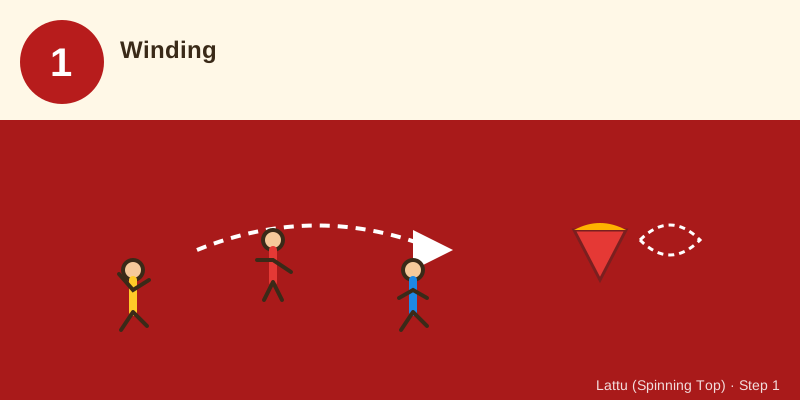
Step 1 – Lattu (Spinning Top) step 1: Winding - Hold the top in your throwing hand with the knot or button between your fingers, the tip pointing out.
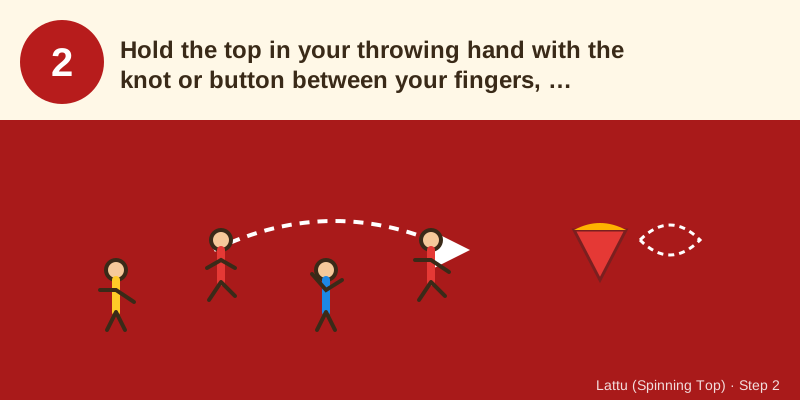
Step 2 – Lattu (Spinning Top) step 2: Hold the top in your throwing hand with the knot or button between your fingers, … - Throwing: raise your hand to shoulder height and throw down in front of you, pulling the string back sharply as the top leaves your hand. The top should land tip down and spin.
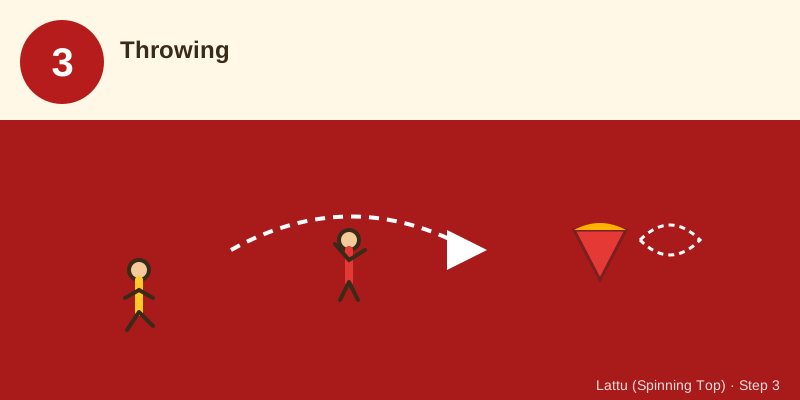
Step 3 – Lattu (Spinning Top) step 3: Throwing - Longest spin: all players throw at the same time; the top that spins longest wins the round.

Step 4 – Lattu (Spinning Top) step 4: Longest spin - Ring knock-out: one player spins a top inside the ring. Others throw their tops to knock it out. If a top stops inside the ring, it stays as a target. The last spinning top inside wins.

Step 5 – Lattu (Spinning Top) step 5: Ring knock-out - Palm pick-up: after the top lands, scoop it onto your palm with the string or by sliding your hand under it. Points for each successful pick-up.

Step 6 – Lattu (Spinning Top) step 6: Palm pick-up - Target spin: draw small circles; players try to land the top in a circle and keep it spinning.

Step 7 – Lattu (Spinning Top) step 7: Target spin - Turns rotate clockwise; each player gets an equal number of throws.

Step 8 – Lattu (Spinning Top) step 8: Turns rotate clockwise; each player gets an equal number of throws
Scoring and winning — अंक और जीत
Longest spin: one point to the winner of each round. Ring knock-out: one point for each top knocked out; the last top standing gets two points. Palm pick-up: one point per successful pick-up within 5 seconds. Target spin: 3 points for landing in the inner circle, 1 point for the outer.
Fouls and common disputes — फ़ाउल और झगड़े
- Throwing towards people — warning; second time out.
- Using a cracked top — disqualified for safety.
- Stepping into the ring while throwing — throw invalid.
- Touching another player's top deliberately — point to opponent.
A sample round, explained — एक उदाहरण
Four friends play ring knock-out. Raj spins his top in the centre. Ayesha throws hers and it clips Raj's top, which wobbles but keeps spinning. Tushar's throw misses, and his top dies inside the ring, so now there are two targets. Neha winds tight and throws hard; her top knocks Tushar's out of the ring and keeps spinning. Raj's top finally stops, and Neha wins the round.
Regional names across India — अलग-अलग राज्यों में नाम
| Region / language | Name used |
|---|---|
| Hindi belt | Lattu, Lattoo, Lattoo-baazi |
| Punjab | Lattoo, Latu |
| Maharashtra | Bhingri, Bhovra |
| Gujarat | Bhamardo |
| Bengal | Lattu |
| Tamil Nadu | Bambaram |
| Karnataka | Buguri |
| Andhra, Telangana | Bongaram |
| Kerala | Pambaram |
| Odisha | Bhaunri |
Variations to try — खेल के रूप
Twin tops
Two players throw together and count who spins longer.
Musical tops
Throw while a song plays; when it stops, tops must still be spinning.
String pick-up
Lift the spinning top using only the string loop.
Plastic battle tops
Modern tops for younger kids; similar rules but safer.
Troubleshooting your throw
If your top lands on its side, the most common cause is that it left your hand at an angle. Keep your palm facing down and release it straight down in front of you. If it lands tip-down but wobbles and dies, the string was probably loose or wound unevenly; rewind with tight, overlapping rows. If it flies away, you may be pulling the string upwards; pull backwards towards your body. Some players find an overhand throw easier, others an underhand "drop and pull." Experiment and stick to the one that feels natural. Practise ten throws a day for a week and you will see huge improvement.
A little physics of spinning
Why does a lattu stay upright while spinning but fall when it stops? A spinning object resists changes to the direction of its spin axis — the gyroscopic effect. The faster it spins, the more stable it is. As friction at the tip and air resistance slow it down, it begins to wobble (precession) and finally falls. Teachers can demonstrate this by spinning a top on a smooth floor and then on a rough one, and asking students to time the spins. Children love discovering that a simple wooden toy teaches the same principle used in bicycle wheels and gyroscopes.
How to run it in a school or housing society — स्कूल और सोसाइटी में कैसे खिलाएँ
Lattu is a calm, skill-based game good for hobby clubs or craft weeks. Pair it with a lesson on Channapatna toys or the science of rotation (gyroscopic stability). Use plastic tops for juniors, wooden tops for older students with supervision. For societies, run a "longest spin" contest during a fair.
Teaching tips for coaches and parents — सिखाने के टिप्स
Winding is the hardest part. Show slowly and let children practise winding without throwing. Then teach the throw from a low height. Encourage consistent winding (tight, even rows) and a sharp pull.
A ready-made 45-minute session plan for Lattu / Surr — 45 मिनट की योजना
Teachers, coaches and society volunteers often ask for a plan they can follow without preparation. Here is one built around Lattu / Surr, suitable for 1–8 and a space of roughly flat floor or hard mud 2 × 2 m. Adjust the timings to your group, but try to keep the structure, because it moves children from understanding to playing without long lectures.
- 0–5 minutes: gather and explain. Sit everyone in a circle. Show the diagram on this page (print it or hold up a phone). Explain only the three most important rules; the rest can be taught while playing.
- 5–10 minutes: warm-up. Light jogging, arm circles, ankle rolls and a few stretches. For board or small-space games, use finger and wrist warm-ups and a quick memory game instead.
- 10–18 minutes: skill drill. Practise the one key skill of the game in pairs or small groups (the teaching tips above suggest which). Short repetitions with lots of praise work better than one long attempt.
- 18–38 minutes: play. Play the game in short rounds. After every round, pause for thirty seconds and ask one question: "What worked? What was unfair?" Let children suggest small rule tweaks and vote on them.
- 38–45 minutes: cool down and reflect. Slow walking or breathing, water, and a quick round where each child says one thing they learned or one person who played fairly.
A session like this fits neatly into a school games period, a summer-camp slot or a Sunday morning in the society garden. Repeat it across a few weeks and you will see children start organising Lattu / Surr on their own, which is the real goal.
Making Lattu / Surr inclusive — सबको शामिल करें
Traditional games were always played by mixed groups: older and younger siblings, cousins visiting for the holidays, neighbours of every background. Keep that spirit alive. Give younger or less confident children a "helper" role first (scorer, umpire, equipment-in-charge) and then a playing role once they have watched a round. Pair a strong player with a beginner rather than letting captains pick teams in front of everyone, which can hurt feelings. For a child who uses a wheelchair or has limited mobility, shorten distances, allow seated or standing play where possible, and give them roles that matter to the result, such as caller, measurer or final judge. For children who find noise overwhelming, a quieter corner version or a smaller group helps. Small changes like these rarely spoil the game, and they teach every child that play belongs to everyone.
A note for parents: bringing Lattu / Surr home — माता-पिता के लिए
Many parents tell us the same story: their child spends hours on a phone game, but the moment a cousin or neighbour suggests Lattu / Surr, the phone is forgotten. Traditional games work because they are social, physical and a little unpredictable, and because they belong to the child's own world rather than to a screen. You do not need to be an expert to bring this game home. Start by playing once yourself, even badly; children love seeing a parent learn. Tell them how you or their grandparents played it, and what it was called in your town. Then step back and let them run it.
Keep the equipment in a visible place, such as a basket near the door, so that it is easy to grab. Invite one or two neighbourhood children for a regular weekly slot, perhaps a Saturday evening, and the habit will grow on its own. When disagreements happen, ask questions instead of giving verdicts: "What rule did you agree? Is that fair for the smaller kids?" Over a few weeks you will notice the children negotiating, adapting and including others, which are exactly the skills a good school tries to teach. Finally, take a photo or a short video of them playing and share it with the grandparents. Few things make an Indian dadi or nana happier than seeing a grandchild play the game they once played in the same way.
Safety tips — सुरक्षा
- Never throw towards people or pets.
- Use rounded tips; file sharp ones.
- Play on floors that will not crack.
- Keep a safe distance when others throw.
- Supervise young children with wooden tops.
Skills and benefits for children — बच्चों को फ़ायदे
Lattu builds hand-eye coordination, wrist strength, fine motor skills and patience. It also introduces basic physics (rotation, balance) and connects children with Indian craft traditions.
हिंदी में सारांश
लट्टू एक लकड़ी का घूमने वाला खिलौना है जिसकी नोक लोहे की होती है। डोरी से कसकर लपेटकर उसे ज़मीन पर फेंका जाता है और डोरी खींचने से लट्टू घूमने लगता है।
खेल: सबसे देर तक घूमना, गोले से दूसरे लट्टू बाहर निकालना, और घूमते लट्टू को हथेली पर उठाना। लोगों की तरफ़ कभी न फेंकें।
FAQ: Lattu (Spinning Top) Games – How to Spin & Play Surr/Bambaram — अक्सर पूछे जाने वाले सवाल
What is a lattu?
A wooden spinning top with a metal tip, spun using a string.
How do I wind a lattu?
Start at the tip, wrap tightly upward, and leave some string free.
Why does my lattu fall without spinning?
Usually the string is loose or the throw is too soft; wind tighter and pull sharply.
Is lattu safe for kids?
Yes with supervision; use rounded tips.
What is Bambaram?
The Tamil name for a spinning top.
Where are Channapatna toys from?
Channapatna in Karnataka, famous for lacquered wooden toys.
How long can a lattu spin?
A good throw can spin for 20–60 seconds or more.
What is palm pick-up?
Scooping the spinning top onto your hand.
Can I play lattu indoors?
Yes on a smooth floor, away from glass.
Do plastic tops work the same?
Mostly, but they are lighter and spin differently.
Related games

Kancha (Marbles) Rules – Indian Marble Games Explained
Flick the shooter, knock marbles out of the ring and learn the famous Indian "gucchi" pit version.
Gilli-Danda Rules (गिल्ली डंडा) – How to Play, Scoring & Diagram
India's original bat-and-ball game: flick the gilli, strike it far, and count your score in danda-lengths.
Carrom Rules (Home Rules) – Points, Queen Cover & Fouls
Flick the striker, pocket your coins, cover the queen — family carrom rules made clear.
Seven Stones Game Rules – School Version for PE Classes
A tidy, referee-friendly version of the stone-stack game designed for school periods and sports days.