
Aankh Micholi Rules – Indian Blind Man's Buff for Kids
 Aankh Micholi literally means "closing the eyes," and in many Indian homes it is the first game little children learn at a family gathering. One player is blindfolded, spun gently around, and then tries to catch any of the other players, who move quietly around, tease and dodge. When the blindfolded player catches someone, they have to guess who it is by touching their face, hair or clothes. Guess right, and the caught player takes the blindfold.
The game is known in English as blind man's buff. In India, the name aankh micholi is also used for a hide-and-seek style game where the seeker closes their eyes and counts; we cover that as a variation. This page explains a safe, structured version for homes, schools and birthday parties, with tips for keeping it fun for small children and challenging for older ones.

History and cultural note — इतिहास और परंपरा
Blindfold catching games are found across the world and are very old. In India, aankh micholi is part of family folklore, with countless songs and film scenes showing children or couples playing it. It is popular at weddings, festivals and summer holidays when cousins gather in grandparents' homes. The game needs no equipment besides a dupatta or handkerchief, which made it the perfect courtyard game in joint families.
Players and age group — खिलाड़ी और उम्र
Four to fifteen players. One "denner" (the one who is "it," sometimes called "chor" or "daam") is blindfolded at a time. Children from four years can play with help; ideal ages are five to twelve, but adults love it too.
Equipment you need — सामान
- A soft blindfold: dupatta, scarf or handkerchief folded so the denner cannot see.
- A cleared room or a soft lawn with a marked boundary (rope, chairs or chalk).
- Optional: a small bell or clapping signal for variations.
Ground and setup — मैदान की तैयारी
Clear the area of furniture with sharp edges, toys on the floor and anything breakable. Mark a boundary: for small children, a circle about 5–6 m wide is enough. Agree whether players may move once the game starts (in some versions they must freeze after the denner says "stop"). Choose the first denner by a counting-out rhyme like "Akkad bakkad bambe bo."
Step-by-step rules — खेल के नियम
- Blindfold the denner and check they cannot see. Spin them gently three times (not too fast!).

Step 1 – Aankh Micholi step 1: Blindfold the denner and check they cannot see - Other players move around inside the boundary, calling out or clapping softly to tease the denner.
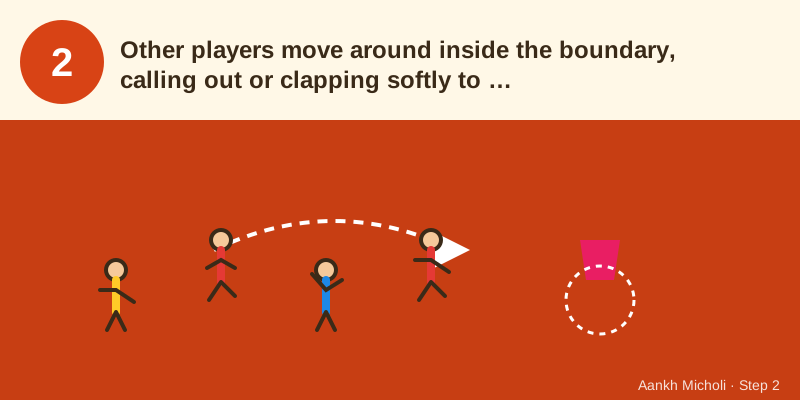
Step 2 – Aankh Micholi step 2: Other players move around inside the boundary, calling out or clapping softly to … - The denner walks (no running) with hands out in front, trying to touch someone.

Step 3 – Aankh Micholi step 3: The denner walks (no running) with hands out in front, trying to touch someone - Players may dodge and duck but must stay inside the boundary and may not hide behind furniture.

Step 4 – Aankh Micholi step 4: Players may dodge and duck but must stay inside the boundary and may not hide … - When the denner touches a player, the player must stand still.
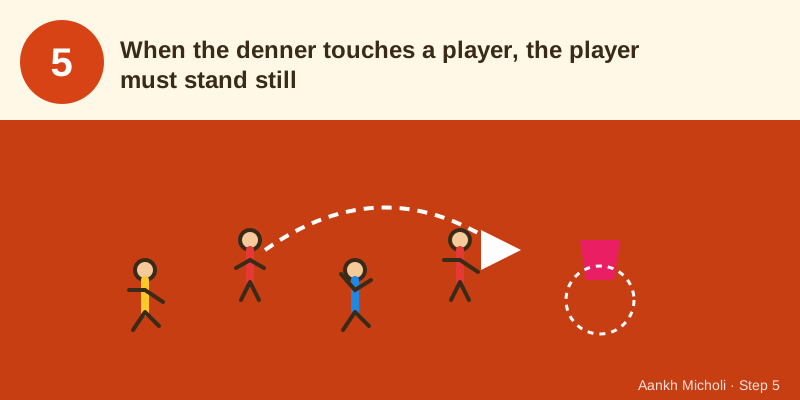
Step 5 – Aankh Micholi step 5: When the denner touches a player, the player must stand still - The denner may feel the player's hair, face shape, clothes and height to guess who it is. In some homes, the denner gets one guess; in others, three.

Step 6 – Aankh Micholi step 6: The denner may feel the player's hair, face shape, clothes and height to guess who … - If the guess is correct, the caught player becomes the new denner.

Step 7 – Aankh Micholi step 7: If the guess is correct, the caught player becomes the new denner - If incorrect, the player is released and the game continues.

Step 8 – Aankh Micholi step 8: If incorrect, the player is released and the game continues - Anyone stepping out of the boundary becomes the new denner.

Step 9 – Aankh Micholi step 9: Anyone stepping out of the boundary becomes the new denner
Scoring and winning — अंक और जीत
Aankh micholi is usually not scored; the fun is in being caught and guessing. For older children, give one point for each correct guess and minus one for each time someone steps outside. The player with the most points after everyone has been denner once wins.
Fouls and common disputes — फ़ाउल और झगड़े
- Peeking from the blindfold — the denner has to restart the count.
- Running — players or denner who run are given a warning; repeat runners sit out a round.
- Pushing or tripping the denner — out.
- Hiding behind furniture or leaving the area — becomes denner.
A sample round, explained — एक उदाहरण
At a family gathering, Anaya is blindfolded and spun. Her cousins circle around, giggling. "Main yahan hoon!" calls Raghav from behind. She turns and steps towards him, but he ducks under her arm. She hears a dupatta rustle and touches Simran. Simran freezes. Anaya feels long hair and a bangle: "Simran!" Correct — Simran takes the blindfold.
Regional names across India — अलग-अलग राज्यों में नाम
| Region / language | Name used |
|---|---|
| Hindi belt | Aankh Micholi, Aankh Michauli |
| Punjab | Akh Macholi |
| Bengal | Kanamachi (কানামাছি) |
| Maharashtra | Aandhali Koshimbir |
| Gujarat | Aankh Micholi |
| Tamil Nadu | Kannamoochi |
| Karnataka | Kannu Muchale |
| Kerala | Kannupotti Kali |
Variations to try — खेल के रूप
Kanamachi (Bengal)
Players chant "Kanamachi bhonbhon" around the denner, who tries to catch them.
Clap and find
Players must clap every five seconds, helping the denner locate them. Great for little kids.
Freeze version
When the denner says "Stop!", everyone freezes and the denner walks to find someone.
Hide-and-seek aankh micholi
The seeker closes eyes and counts while others hide; also called chhupan-chhupai.
Animal sounds
Each caught player must make an animal sound, and the denner guesses the person from the sound.
Counting-out rhymes for choosing the denner
Choosing who will be "it" is a mini-ritual in Indian games, and counting-out rhymes make it fair and fun. The best known is "Akkad bakkad bambe bo, assi nabbe poore sau…" Players stand in a circle and one person points at each player for each word; whoever is pointed at on the last word is out of selection or becomes the denner, depending on local custom. Another popular option is "Ink pink ponk," and many families use "Ittak mittak" or regional rhymes. Bengali children may use "Ikir mikir chamchikir." A simple non-rhyme method is "Pugam-pugai" (also called "Chidi udd" in some areas): everyone puts their hands together and turns them palm up or down on a count, and the odd one out is chosen.
Rhymes are not just a selection tool. They teach rhythm, counting and a sense of fairness, and they are a lovely piece of oral culture worth passing on. Teachers can make a "rhyme book" with children collecting counting-out rhymes from their grandparents in different languages, a great project for a traditional games week.
Making the game work for very young children
For three- and four-year-olds, a full blindfold can be scary. Start with "eyes closed" instead, with the child covering their eyes with their own hands, and keep the circle small. Let players stand still and say "here!" when the denner comes close. Celebrate every catch with cheers rather than focusing on guessing correctly. As children get comfortable, move to a soft blindfold and add the guessing part. Always end the session before anyone gets tired or overexcited, which is when bumps happen.
How to run it in a school or housing society — स्कूल और सोसाइटी में कैसे खिलाएँ
Aankh micholi works in classrooms if desks are pushed aside, or in a hall. Use a large mat area, small groups of eight, and a teacher spotter. It is perfect for nursery and primary classes, and for icebreakers at the start of the year (children learn each other's names by guessing).
Teaching tips for coaches and parents — सिखाने के टिप्स
Explain "walking only" clearly. Practise walking with eyes closed and hands forward for a few seconds before blindfolding anyone. Encourage players to give helpful sound clues to younger denners.
A ready-made 45-minute session plan for Aankh Micholi — 45 मिनट की योजना
Teachers, coaches and society volunteers often ask for a plan they can follow without preparation. Here is one built around Aankh Micholi, suitable for 4–15 and a space of roughly cleared room or small lawn. Adjust the timings to your group, but try to keep the structure, because it moves children from understanding to playing without long lectures.
- 0–5 minutes: gather and explain. Sit everyone in a circle. Show the diagram on this page (print it or hold up a phone). Explain only the three most important rules; the rest can be taught while playing.
- 5–10 minutes: warm-up. Light jogging, arm circles, ankle rolls and a few stretches. For board or small-space games, use finger and wrist warm-ups and a quick memory game instead.
- 10–18 minutes: skill drill. Practise the one key skill of the game in pairs or small groups (the teaching tips above suggest which). Short repetitions with lots of praise work better than one long attempt.
- 18–38 minutes: play. Play the game in short rounds. After every round, pause for thirty seconds and ask one question: "What worked? What was unfair?" Let children suggest small rule tweaks and vote on them.
- 38–45 minutes: cool down and reflect. Slow walking or breathing, water, and a quick round where each child says one thing they learned or one person who played fairly.
A session like this fits neatly into a school games period, a summer-camp slot or a Sunday morning in the society garden. Repeat it across a few weeks and you will see children start organising Aankh Micholi on their own, which is the real goal.
Making Aankh Micholi inclusive — सबको शामिल करें
Traditional games were always played by mixed groups: older and younger siblings, cousins visiting for the holidays, neighbours of every background. Keep that spirit alive. Give younger or less confident children a "helper" role first (scorer, umpire, equipment-in-charge) and then a playing role once they have watched a round. Pair a strong player with a beginner rather than letting captains pick teams in front of everyone, which can hurt feelings. For a child who uses a wheelchair or has limited mobility, shorten distances, allow seated or standing play where possible, and give them roles that matter to the result, such as caller, measurer or final judge. For children who find noise overwhelming, a quieter corner version or a smaller group helps. Small changes like these rarely spoil the game, and they teach every child that play belongs to everyone.
A note for parents: bringing Aankh Micholi home — माता-पिता के लिए
Many parents tell us the same story: their child spends hours on a phone game, but the moment a cousin or neighbour suggests Aankh Micholi, the phone is forgotten. Traditional games work because they are social, physical and a little unpredictable, and because they belong to the child's own world rather than to a screen. You do not need to be an expert to bring this game home. Start by playing once yourself, even badly; children love seeing a parent learn. Tell them how you or their grandparents played it, and what it was called in your town. Then step back and let them run it.
Keep the equipment in a visible place, such as a basket near the door, so that it is easy to grab. Invite one or two neighbourhood children for a regular weekly slot, perhaps a Saturday evening, and the habit will grow on its own. When disagreements happen, ask questions instead of giving verdicts: "What rule did you agree? Is that fair for the smaller kids?" Over a few weeks you will notice the children negotiating, adapting and including others, which are exactly the skills a good school tries to teach. Finally, take a photo or a short video of them playing and share it with the grandparents. Few things make an Indian dadi or nana happier than seeing a grandchild play the game they once played in the same way.
Safety tips — सुरक्षा
- No running, ever.
- Use a soft blindfold; check it is not tight around the eyes or neck.
- Clear sharp corners and breakables.
- An adult spotter for under-6s.
- Do not spin the denner too fast or too many times.
- Keep away from stairs, doors and kitchens.
Skills and benefits for children — बच्चों को फ़ायदे
Aankh micholi builds spatial awareness, listening skills, trust and social bonding. Guessing by touch encourages children to notice details about one another.
हिंदी में सारांश
आँख मिचौली में एक बच्चे की आँखों पर पट्टी बाँधी जाती है। बाकी बच्चे उसके आसपास घूमते हैं और उसे चिढ़ाते हैं। जिसे वह पकड़ लेता है, उसे छूकर पहचानना होता है। सही पहचान हुई तो वह अगला "दाम" बनता है।
दौड़ना मना है, जगह साफ़ रखें और छोटे बच्चों के साथ एक बड़ा ज़रूर रहे।
FAQ: Aankh Micholi Rules – Indian Blind Man's Buff for Kids — अक्सर पूछे जाने वाले सवाल
What is aankh micholi?
A blindfold catching and guessing game, like blind man's buff.
Is aankh micholi the same as hide-and-seek?
In some homes, the name is also used for hide-and-seek, but the classic version is blindfold catching.
How many players are needed?
Four or more.
What do I use as a blindfold?
A soft scarf, dupatta or handkerchief.
Can it be played indoors?
Yes, in a cleared room.
What age is suitable?
Four years and above.
How do I make it easier for small kids?
Use the clap-and-find variation.
What is Kanamachi?
The Bengali name for aankh micholi.
How many guesses does the denner get?
Usually one, sometimes three.
Is running allowed?
No, for safety it is walking only.
Related games

Four Corners Game Rules – Chaar Kone Indoor & Outdoor Fun
Run to a corner, wait for the call, hope your corner survives — a quick, no-equipment classroom favourite.
Vish Amrit Game Rules – Freeze Tag with Poison & Nectar
Touched with "vish" you freeze; touched with "amrit" you're free — the Indian twist on freeze tag.
Dog and the Bone Game Rules – Snatch the Hanky (Rumal Jhapatta)
Two teams, one "bone," a caller shouts a number — snatch it and race home before you are tagged.

Stapoo (Hopscotch India) Rules – Kith-Kith, Ekkat-Dukkat & More
Toss the gitti, hop the boxes, win a "ghar" — India's favourite chalk game for courtyards and school corridors.