
Stapoo (Hopscotch India) Rules – Kith-Kith, Ekkat-Dukkat & More
Walk past any Indian building compound in the evening and you will probably find a chalk grid on the floor with a little flat stone lying in one box. That is stapoo, India's version of hopscotch. Girls and boys hop through the boxes on one foot, turn at the top and hop back, picking up the stone on the way. It looks simple, but stapoo demands balance, aim and a lot of patience, and older children make it fiendishly hard with "ghar" (house) rules.
In Delhi and Punjab it is Stapu or Stapoo; in Bengal it is Ekka-Dokka; in Maharashtra Langdi Pata or Tikri; in Andhra and Telangana Tokkudu Billa; in Tamil Nadu Pandi or Nondi; and in many Hindi-speaking homes it is Ikhat-Dukhat or Kith-Kith. This page explains the grid most commonly drawn in India, the core rules, the ghar system that makes the game interesting, common fouls, and plenty of variations.
History and cultural note — इतिहास और परंपरा
Hopping-grid games are found worldwide, and children in Indian towns and villages have long drawn them in mud with sticks or on floors with chalk, charcoal or a bit of broken brick. The flat stone, usually a smooth piece of tile or slate called a gitti, tikri or billa, is carefully chosen and often kept as a treasured item. Some children carry their "lucky" gitti for years.
What makes Indian stapoo special is the variety of grid shapes and the rich local language around the game: "chowka" (box), "ghar" (house), "asmaan" or "aram" (resting zone), "line kati" (touched the line, out). In many regions the game is linked to girls' play, but it is genuinely for everyone, and many PE teachers use it for balance training.
Players and age group — खिलाड़ी और उम्र
Two to six players take turns. One player plays at a time while others watch for fouls, which keeps everyone involved. Children from five years can play the basic version; older children enjoy ghar rules and harder throws. Adults are surprisingly bad at stapoo, which makes it a great family game.
Equipment you need — सामान
- Chalk, a piece of brick or a stick to draw the grid (on mud).
- One flat stone, tile piece or a small beanbag per player (the gitti).
- Optional: a tape measure for consistent boxes in schools.
Ground and setup — मैदान की तैयारी
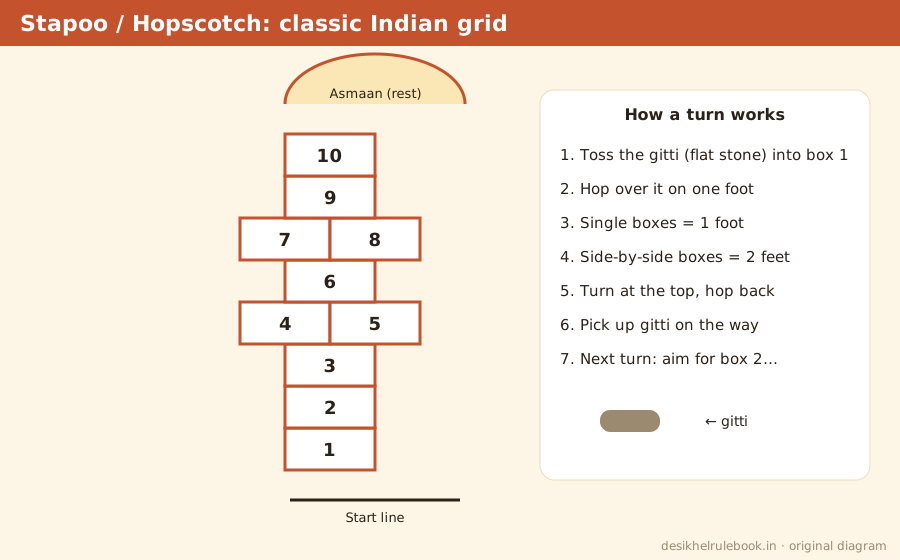
Draw a grid on a flat surface. A typical Indian layout has ten boxes about 40 × 40 cm each: three single boxes in a column (1, 2, 3), then a pair side by side (4 and 5), then a single (6), then another pair (7 and 8), then two singles (9 and 10), topped by a semicircle called "asmaan" or the rest area. The exact layout varies — see the diagram for one common pattern. Draw a start line about 30 cm before box 1.
Each player chooses a distinctive gitti. Decide the order by a quick lagging throw: everybody tosses their gitti at box 10; closest goes first.
Step-by-step rules — खेल के नियम
- Stand behind the start line and toss your gitti into box 1. It must land fully inside the box without touching any line.
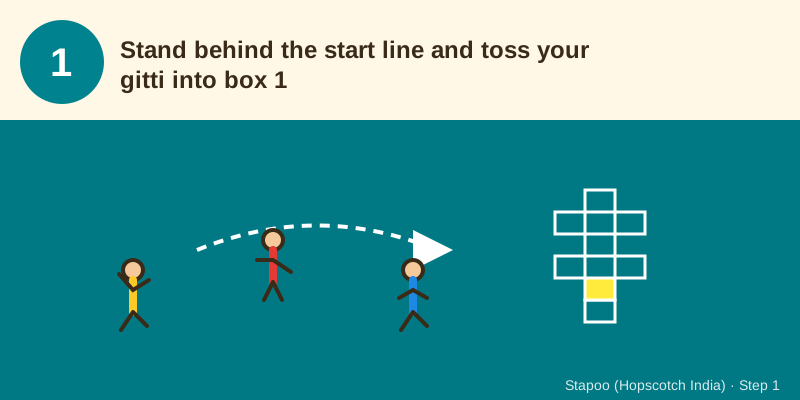
Step 1 – Stapoo (Hopscotch India) step 1: Stand behind the start line and toss your gitti into box 1 - Hop over box 1 (never step in the box with the gitti) on one foot. Single boxes take one foot; side-by-side boxes take two feet, one in each.
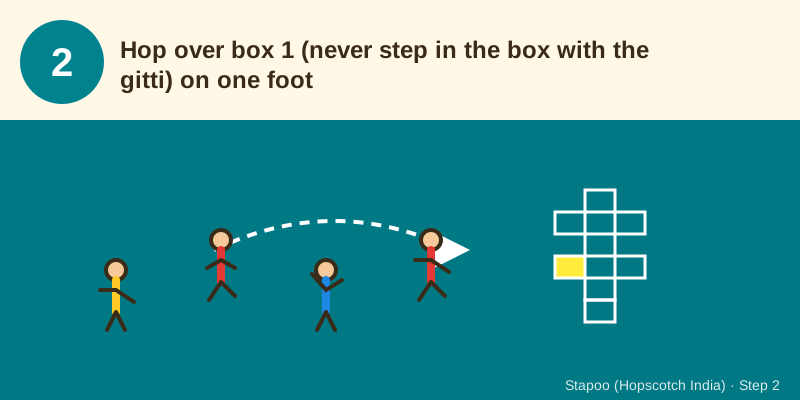
Step 2 – Stapoo (Hopscotch India) step 2: Hop over box 1 (never step in the box with the gitti) on one foot - Hop through all the boxes to the top. In the asmaan or rest area you may put both feet down and turn around.
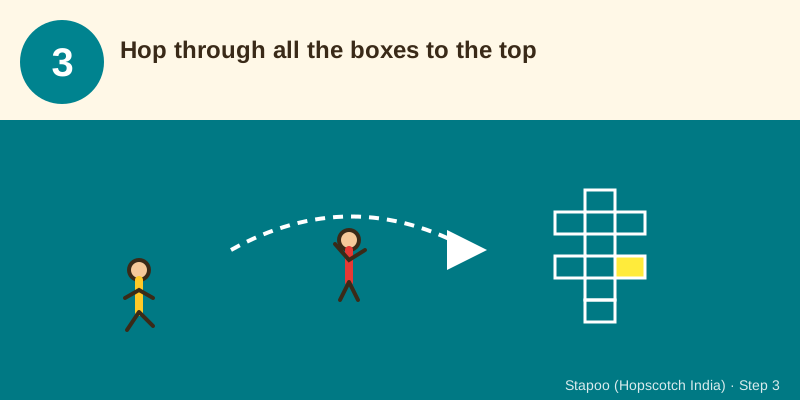
Step 3 – Stapoo (Hopscotch India) step 3: Hop through all the boxes to the top - Hop back the same way. When you reach the box before your gitti, balance on one foot, bend down and pick up the gitti, then hop into that box and out over the start line.
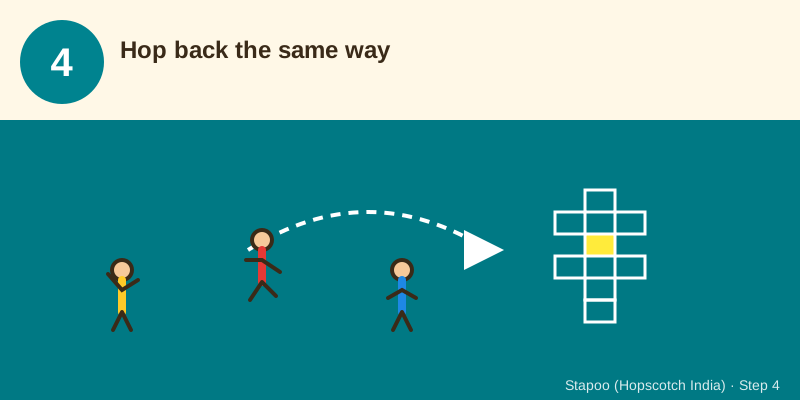
Step 4 – Stapoo (Hopscotch India) step 4: Hop back the same way - If successful, on your next turn throw the gitti into box 2, and so on up to box 10.
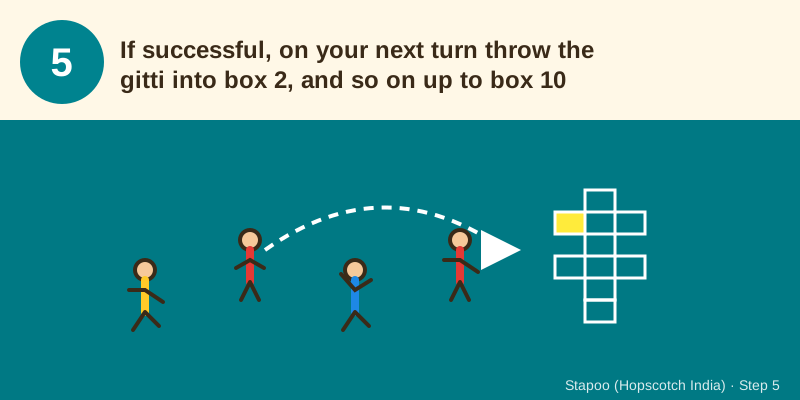
Step 5 – Stapoo (Hopscotch India) step 5: If successful, on your next turn throw the gitti into box 2, and so on up to box 10 - Your turn ends (out) if: your gitti lands on a line or in the wrong box; you step on a line; you put a second foot down in a single box; you lose balance and touch the ground with a hand; or you hop into the box containing the gitti.
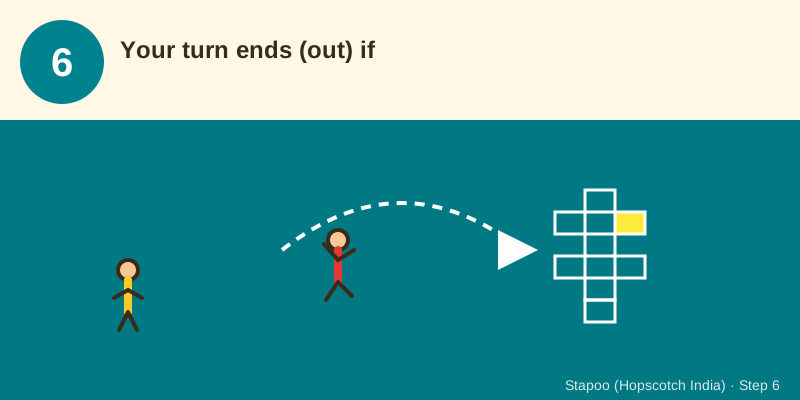
Step 6 – Stapoo (Hopscotch India) step 6: Your turn ends (out) if - When out, leave your gitti where the turn ended (in many rules) or pick it up, and the next player goes. On your next turn, continue from the box you failed.
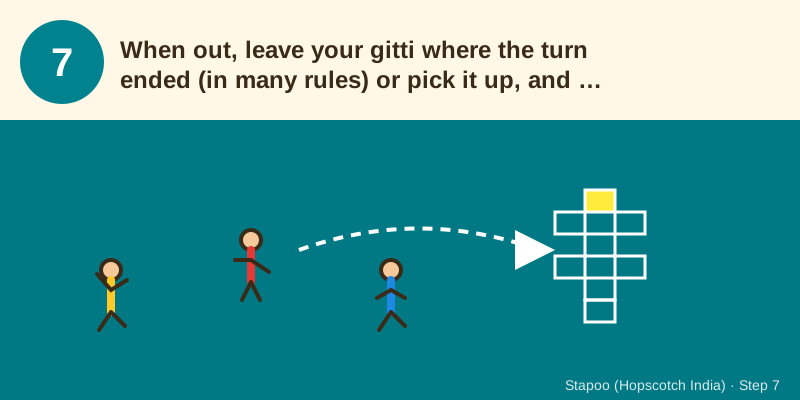
Step 7 – Stapoo (Hopscotch India) step 7: When out, leave your gitti where the turn ended (in many rules) or pick it up, and … - Ghar (house): after completing all boxes, stand with your back to the grid and throw the gitti over your shoulder. The box it lands in becomes your ghar; write your initial in it. Others must hop over your ghar, while you may rest both feet in it.
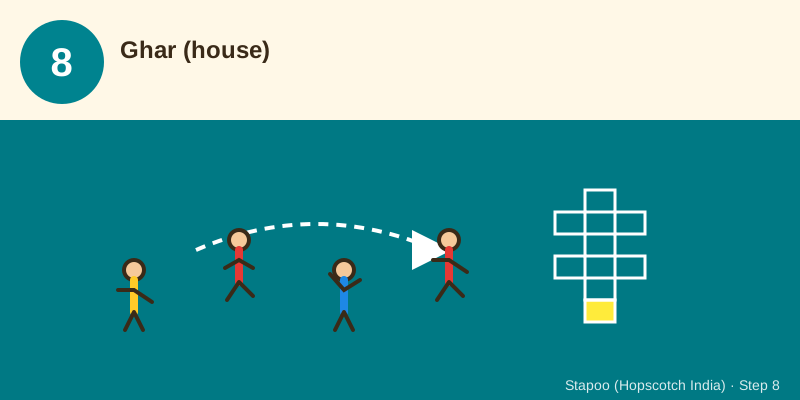
Step 8 – Stapoo (Hopscotch India) step 8: Ghar (house) - The game continues until no more boxes can be claimed or everyone agrees to stop.
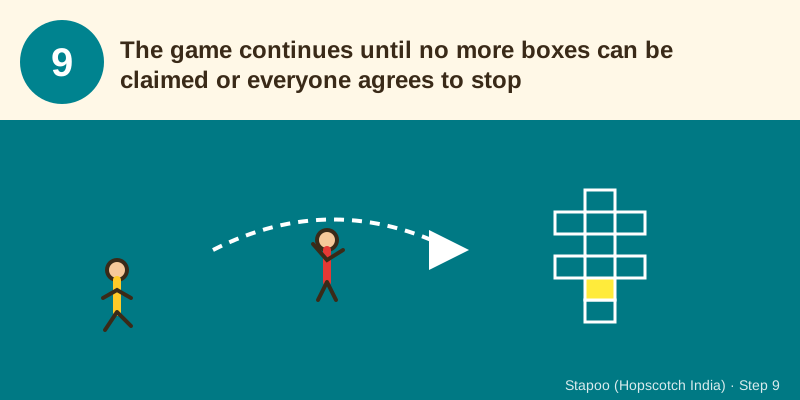
Step 9 – Stapoo (Hopscotch India) step 9: The game continues until no more boxes can be claimed or everyone agrees to stop
Scoring and winning — अंक और जीत
In the basic game, the first player to complete all boxes (1 to 10) wins. In the ghar game, the player who owns the most boxes at the end wins. Ghar rules make the game harder for opponents, because they must hop over more boxes, sometimes two in a row, which takes strength and balance. A common kind rule: no one may own both boxes of a pair, so the grid never becomes impossible.
Fouls and common disputes — फ़ाउल और झगड़े
- Touching a line with a foot — out ("line kati").
- Gitti on the line — out on the throw.
- Putting the second foot down in a single box — out.
- Hopping into the box with your gitti — out.
- Touching the ground with hands when picking up the gitti — out (in strict rules; allow it for under-7s).
- Hopping into someone else's ghar — out.
A sample round, explained — एक उदाहरण
Tara and Nisha play. Tara throws her gitti into box 1 cleanly. She hops over box 1 into 2 and 3, lands with two feet in 4 and 5, one foot in 6, two in 7 and 8, one in 9 and 10, rests in the asmaan and turns. On the way back, at box 2 she balances on one foot, bends, picks up the gitti from box 1 and hops out. Success.
Next turn, she throws into box 2, but it bounces on the line between 2 and 3: out. Nisha now plays. Later, Tara finishes all ten boxes, throws her gitti over her shoulder and it lands in box 6. That is now her ghar; she writes "T" in it. From now on Nisha must hop from 5 directly to 7 — a long jump on one foot — which makes the game much more challenging.
Regional names across India — अलग-अलग राज्यों में नाम
| Region / language | Name used |
|---|---|
| Delhi, Punjab, Haryana | Stapu, Stapoo, Ikkal-Dukkal |
| UP, Bihar, MP | Kith-Kith, Ikhat-Dukhat, Chippi |
| Rajasthan | Tikkdi, Langdi Taang |
| Maharashtra | Langdi Pata, Tikri |
| Gujarat | Chhi, Chhippi |
| Bengal | Ekka-Dokka |
| Odisha | Kit-kit |
| Andhra, Telangana | Tokkudu Billa |
| Tamil Nadu | Pandi, Nondi |
| Karnataka | Kunte Bille |
| Kerala | Kakkakali |
Variations to try — खेल के रूप
Aeroplane grid
The classic Western-style grid with wings; easy for small kids.
Spiral stapoo (snail)
A spiral divided into boxes; hop to the centre and back. Very hard.
Kick-the-gitti
Instead of picking up, kick the gitti box by box with the hopping foot (a Maharashtra and Andhra style).
Eyes-closed final
After completing boxes, walk the grid with eyes closed, asking "Ameer?" and others answer "Haan" or "Na" if you step on a line.
Beanbag version
For indoor halls, use a small beanbag that does not bounce.
Drawing a good stapoo grid
A well-drawn grid prevents half the arguments. Use boxes of roughly the same size, about 40 cm for children under ten and 50 cm for older children. Draw lines thick enough to see but not so thick that a foot touching the edge becomes a dispute; around 3 cm is right. Number the boxes clearly. If you are using chalk on a society floor, a quick tip is to tie a piece of string to the chalk and use it as a ruler to keep lines straight. For mud, drag a stick and then press the line down with your heel so it does not blur.
For schools that want a permanent grid, use road-marking paint or exterior enamel in a light colour, and paint the box numbers in Hindi and English. Several schools paint two different grids side by side, one easier and one harder, so that younger and older children can play at the same time without arguing over space.
How to run it in a school or housing society — स्कूल और सोसाइटी में कैसे खिलाएँ
Stapoo is a favourite for school corridors and covered areas. Paint permanent grids (many schools now do this) or tape them with masking tape. Give each group of four children one grid. Teachers can attach maths to it: write multiplication or Hindi letters in boxes and children must say them as they hop.
In societies, draw grids on the podium or parking (only in a closed, traffic-free area). Stapoo suits evenings when younger children want something calmer than running games.
Teaching tips for coaches and parents — सिखाने के टिप्स
For beginners, practise one-foot balance (count to ten on each foot) and hopping on the spot. Next, practise throwing the gitti into a box from the start line. Then put the two together. Encourage children to switch hopping feet so both legs get stronger.
A ready-made 45-minute session plan for Stapoo / Hopscotch — 45 मिनट की योजना
Teachers, coaches and society volunteers often ask for a plan they can follow without preparation. Here is one built around Stapoo / Hopscotch, suitable for 2–6 and a space of roughly 1.5 × 4 m of floor. Adjust the timings to your group, but try to keep the structure, because it moves children from understanding to playing without long lectures.
- 0–5 minutes: gather and explain. Sit everyone in a circle. Show the diagram on this page (print it or hold up a phone). Explain only the three most important rules; the rest can be taught while playing.
- 5–10 minutes: warm-up. Light jogging, arm circles, ankle rolls and a few stretches. For board or small-space games, use finger and wrist warm-ups and a quick memory game instead.
- 10–18 minutes: skill drill. Practise the one key skill of the game in pairs or small groups (the teaching tips above suggest which). Short repetitions with lots of praise work better than one long attempt.
- 18–38 minutes: play. Play the game in short rounds. After every round, pause for thirty seconds and ask one question: "What worked? What was unfair?" Let children suggest small rule tweaks and vote on them.
- 38–45 minutes: cool down and reflect. Slow walking or breathing, water, and a quick round where each child says one thing they learned or one person who played fairly.
A session like this fits neatly into a school games period, a summer-camp slot or a Sunday morning in the society garden. Repeat it across a few weeks and you will see children start organising Stapoo / Hopscotch on their own, which is the real goal.
Making Stapoo / Hopscotch inclusive — सबको शामिल करें
Traditional games were always played by mixed groups: older and younger siblings, cousins visiting for the holidays, neighbours of every background. Keep that spirit alive. Give younger or less confident children a "helper" role first (scorer, umpire, equipment-in-charge) and then a playing role once they have watched a round. Pair a strong player with a beginner rather than letting captains pick teams in front of everyone, which can hurt feelings. For a child who uses a wheelchair or has limited mobility, shorten distances, allow seated or standing play where possible, and give them roles that matter to the result, such as caller, measurer or final judge. For children who find noise overwhelming, a quieter corner version or a smaller group helps. Small changes like these rarely spoil the game, and they teach every child that play belongs to everyone.
A note for parents: bringing Stapoo / Hopscotch home — माता-पिता के लिए
Many parents tell us the same story: their child spends hours on a phone game, but the moment a cousin or neighbour suggests Stapoo / Hopscotch, the phone is forgotten. Traditional games work because they are social, physical and a little unpredictable, and because they belong to the child's own world rather than to a screen. You do not need to be an expert to bring this game home. Start by playing once yourself, even badly; children love seeing a parent learn. Tell them how you or their grandparents played it, and what it was called in your town. Then step back and let them run it.
Keep the equipment in a visible place, such as a basket near the door, so that it is easy to grab. Invite one or two neighbourhood children for a regular weekly slot, perhaps a Saturday evening, and the habit will grow on its own. When disagreements happen, ask questions instead of giving verdicts: "What rule did you agree? Is that fair for the smaller kids?" Over a few weeks you will notice the children negotiating, adapting and including others, which are exactly the skills a good school tries to teach. Finally, take a photo or a short video of them playing and share it with the grandparents. Few things make an Indian dadi or nana happier than seeing a grandchild play the game they once played in the same way.
Safety tips — सुरक्षा
- Play on dry, non-slippery surfaces.
- Keep grids away from traffic, stairs and parked cars.
- Wear proper shoes or play barefoot on clean ground; avoid slippers.
- Use smooth stones or beanbags, not sharp tiles.
- Avoid playing in afternoon heat on hot concrete.
Skills and benefits for children — बच्चों को फ़ायदे
Stapoo builds balance, leg strength, coordination, counting and aiming. The ghar system adds strategy and fairness discussions. It is also wonderfully low-cost: a piece of chalk and a stone.
हिंदी में सारांश
स्टापू (इखट-दुखट, किथ-किथ) में ज़मीन पर खाने बनाए जाते हैं। खिलाड़ी गिट्टी को खाने में फेंकता है और एक पैर पर कूदते हुए सारे खाने पार करके लौटता है, रास्ते में गिट्टी उठाता है।
लाइन पर पैर पड़ा, गिट्टी लाइन पर गिरी, या दूसरा पैर ज़मीन पर रखा — तो आउट। सभी खाने पूरे करने के बाद पीछे की ओर गिट्टी फेंककर "घर" बनाया जाता है।
FAQ: Stapoo (Hopscotch India) Rules – Kith-Kith, Ekkat-Dukkat & More — अक्सर पूछे जाने वाले सवाल
Is stapoo the same as hopscotch?
Yes, stapoo is the Indian name for hopscotch, with local grid shapes and rules.
What is a gitti?
The flat stone or tile thrown into the boxes.
What is a ghar in stapoo?
A box claimed by a player after completing all boxes; others must hop over it.
Can I put both feet down?
Only in side-by-side boxes, the rest area, and your own ghar.
What age is good for stapoo?
Five years and older.
What if the gitti lands on a line?
Your turn ends.
How many boxes are there?
Commonly eight to ten, but layouts vary.
Can stapoo be played indoors?
Yes, with masking tape and a beanbag.
What is Ekka-Dokka?
The Bengali name for stapoo/hopscotch.
Does stapoo help children?
Yes, it improves balance, leg strength and concentration.
Related games
Langdi Game Rules – Hop-and-Chase Tag (लंगड़ी)
The chaser can only hop on one leg — catch the runners before your leg gives up!
Four Corners Game Rules – Chaar Kone Indoor & Outdoor Fun
Run to a corner, wait for the call, hope your corner survives — a quick, no-equipment classroom favourite.
Seven Stones Game Rules – School Version for PE Classes
A tidy, referee-friendly version of the stone-stack game designed for school periods and sports days.
Vish Amrit Game Rules – Freeze Tag with Poison & Nectar
Touched with "vish" you freeze; touched with "amrit" you're free — the Indian twist on freeze tag.