
Vish Amrit Game Rules – Freeze Tag with Poison & Nectar
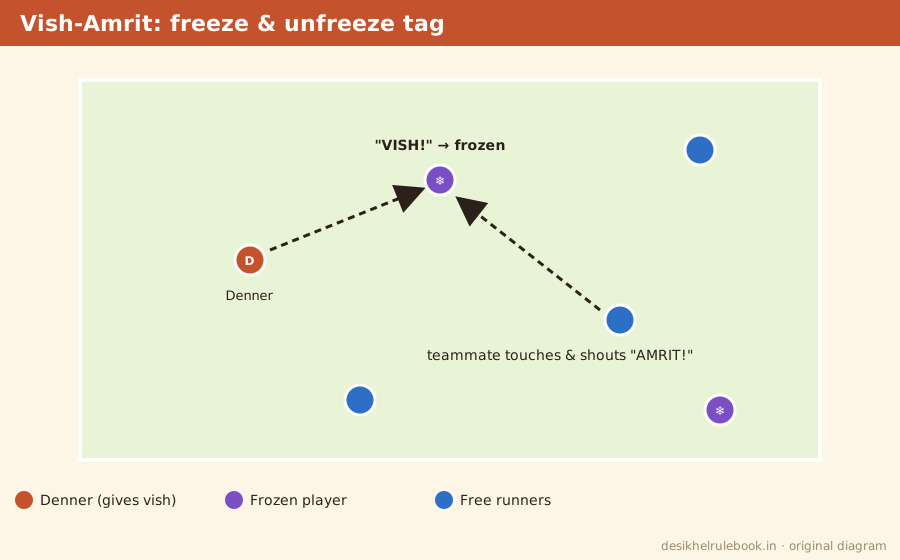
 Vish Amrit is the Indian version of freeze tag, and its name comes from Indian mythology: vish means poison and amrit means the nectar of immortality. The denner (the one who is "it") chases players and touches them with "vish," freezing them on the spot. Other players can touch the frozen player and shout "amrit" to unfreeze them. The denner wins by freezing everyone; the players win by keeping at least one person free until time runs out.
It is one of the most popular chasing games in Indian schools and colonies, especially in North and West India. This page explains the rules, how to choose a denner, freeze and unfreeze rules, boundaries, scoring, variations such as Pakdam-Pakdai and Chor-Sipahi, and safety advice.
History and cultural note — इतिहास और परंपरा
The game draws on the ancient story of the Samudra Manthan (churning of the ocean), in which both poison (halahal) and nectar (amrit) emerged. Children turned this mythic duality into a playful tag game. While tag games exist worldwide, Vish Amrit is distinctly Indian in its names and storytelling, and it is often taught by older siblings or neighbours rather than in formal PE.
Players and age group — खिलाड़ी और उम्र
Five to thirty players. One or two denners for small groups; three or four denners for large groups. Ages five and up.
Equipment you need — सामान
- No equipment needed.
- Chalk or cones to mark the boundary.
- Optional: a bandana or ribbon to mark denners.
Ground and setup — मैदान की तैयारी
Choose a play area with clear boundaries — a playground, lawn or courtyard. Remove obstacles. Choose the denner using a counting rhyme. If you have more than 15 players, choose multiple denners.
Step-by-step rules — खेल के नियम
- The denner chases players and tags them, shouting "Vish!"
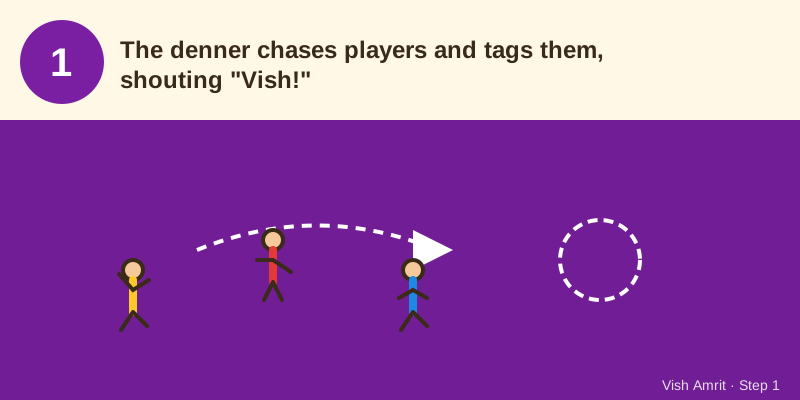
Step 1 – Vish Amrit step 1: The denner chases players and tags them, shouting "Vish!" - A tagged player freezes immediately, standing still with arms out or crossed.
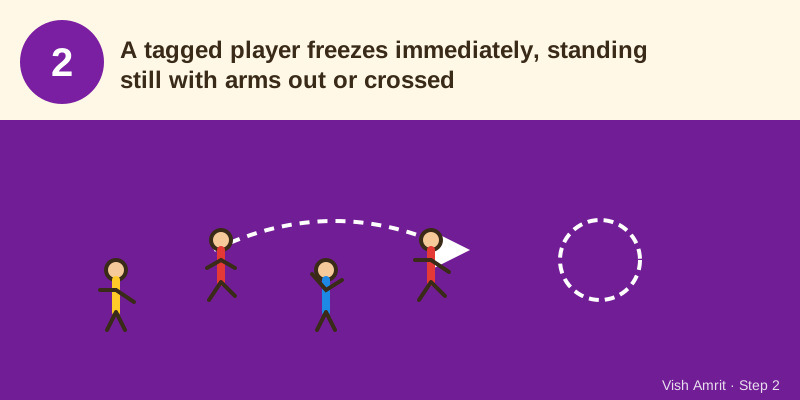
Step 2 – Vish Amrit step 2: A tagged player freezes immediately, standing still with arms out or crossed - Free players can unfreeze a frozen player by touching them and shouting "Amrit!"
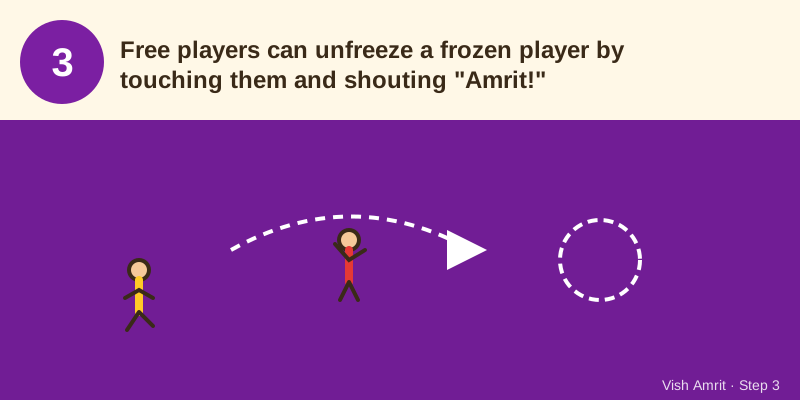
Step 3 – Vish Amrit step 3: Free players can unfreeze a frozen player by touching them and shouting "Amrit!" - Frozen players cannot move until unfrozen.

Step 4 – Vish Amrit step 4: Frozen players cannot move until unfrozen - If all players are frozen, the denner wins and a new denner is chosen.
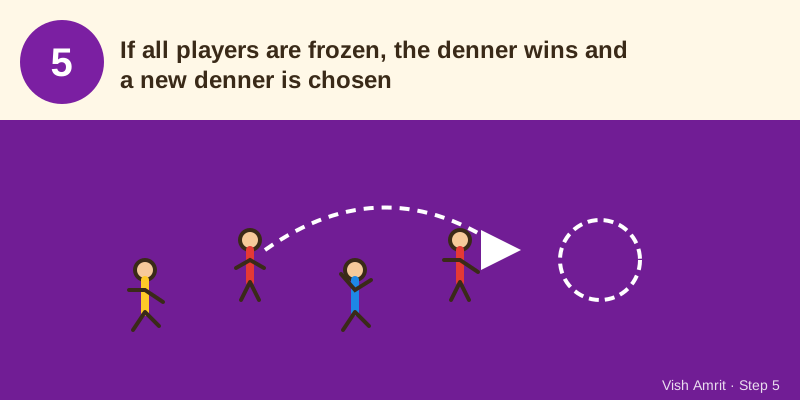
Step 5 – Vish Amrit step 5: If all players are frozen, the denner wins and a new denner is chosen - If a time limit (e.g., 5 minutes) ends with at least one player free, the players win.
Step 6 – Vish Amrit step 6: If a time limit (e - Players must stay inside the boundary; stepping out means frozen.
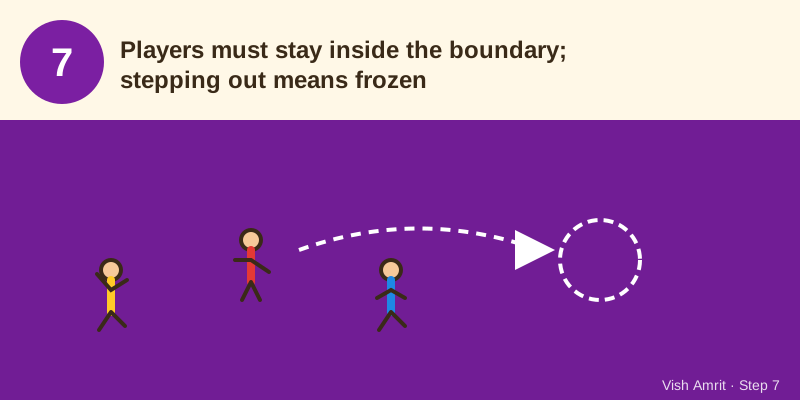
Step 7 – Vish Amrit step 7: Players must stay inside the boundary; stepping out means frozen - Denners cannot "guard" a frozen player for too long (agree on a 5-second rule).
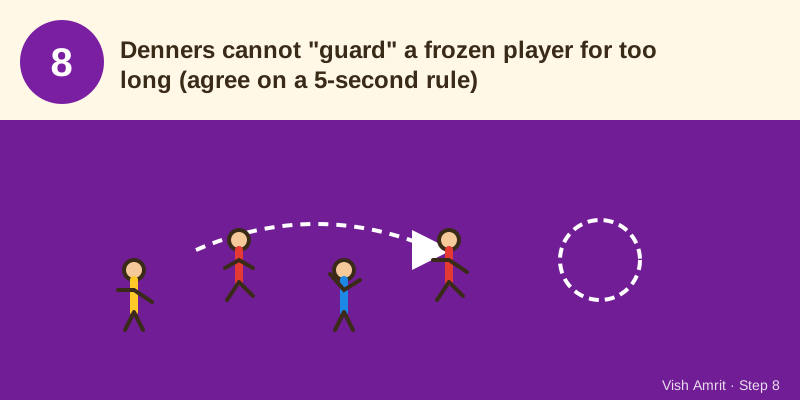
Step 8 – Vish Amrit step 8: Denners cannot "guard" a frozen player for too long (agree on a 5-second rule)
Scoring and winning — अंक और जीत
Vish Amrit is usually not scored. For tournaments, count how many players are frozen at the end of a time limit or how long it takes to freeze everyone. Rotate denners so everyone gets a turn.
Fouls and common disputes — फ़ाउल और झगड़े
- Unfreezing without saying "Amrit" — not valid.
- Moving while frozen — becomes the next denner or remains frozen longer.
- Denner guarding a frozen player continuously — not allowed beyond the agreed time.
- Pushing or rough tagging — warning.
A sample round, explained — एक उदाहरण
In a playground, Arjun is the denner. He tags Riya: "Vish!" Riya freezes. Neha sneaks behind and touches Riya: "Amrit!" Riya is free. Arjun turns and tags Neha. The game continues until Arjun freezes everyone. Then Riya becomes the next denner.
Regional names across India — अलग-अलग राज्यों में नाम
| Region / language | Name used |
|---|---|
| North India | Vish Amrit, Vish-Amrut |
| Maharashtra | Vish Amrut |
| Gujarat | Vish Amrut |
| Hindi belt | Pakdam-Pakdai (simple tag) |
| South India | Freeze tag variants |
Variations to try — खेल के रूप
Pakdam-Pakdai
Simple tag: tagged player becomes the new denner.
Chor-Sipahi
Teams of "chor" (thieves) and "sipahi" (police); police catch thieves and bring them to "jail."
Colour freeze
Frozen players can be unfrozen only by touching a specific colour.
Bridge freeze
Frozen players stand with legs apart; unfreeze by crawling through.
Mythology behind the names
The story of the Samudra Manthan tells how the devas and asuras churned the ocean of milk using Mount Mandara as the churning rod and the serpent Vasuki as the rope. Many treasures emerged, including the deadly halahal poison and the pot of amrit. Lord Shiva drank the poison to protect the world, and his throat turned blue (hence Neelkanth), while the amrit gave immortality. Children may not know every detail, but naming a tag game after poison and nectar adds drama and makes the game memorable. Teachers can use the game to introduce the story in a fun way.
Pakdam-Pakdai and Chor-Sipahi: close cousins
If you want a simpler version, play Pakdam-Pakdai: the denner tags someone and that person becomes the new denner. No freezing, just constant swapping. Chor-Sipahi adds roles: one team are police (sipahi), the other thieves (chor). The police catch thieves and take them to a "jail" area; thieves can be freed if a free teammate touches them in jail. This variant teaches teamwork and strategy. All three games share the same chasing energy, so kids can switch between them depending on group size and mood.
Strategies for denners and runners
Denners should not chase one person for too long; instead, tag quickly and move to the next. They can also position themselves near frozen players to prevent easy unfreezing (respecting the five-second rule). Runners should move in groups to protect frozen teammates and should avoid corners. A fast runner can act as the "amrit hero," constantly freeing others. Discussing these roles helps children think tactically and keeps the game fair.
Running Vish Amrit with a big group
With thirty or more children, a single denner never catches everyone and the game becomes tiring. Use one denner for every six or seven players, and give denners a coloured ribbon or bandana so everyone can see them. Set a timer for three minutes per round; if at least one player is still free when the timer ends, the players win, otherwise the denners win. Rotate denners every round, choosing those who were frozen first, so that everyone gets a turn at chasing. For younger children, introduce a "safe zone" such as a tree or a chalk circle where players can rest for five seconds, which reduces crowding and keeps the game fair. Teachers often end PE warm-ups with two quick rounds of Vish Amrit because it raises heart rates quickly and brings shy children into the game naturally.
How to run it in a school or housing society — स्कूल और सोसाइटी में कैसे खिलाएँ
Vish Amrit is perfect for PE warm-ups or recess. For big classes, use multiple denners and shorter rounds. Teach the unfreeze call clearly.
Teaching tips for coaches and parents — सिखाने के टिप्स
Explain freeze posture. Teach safe tagging (light touch). Encourage teamwork: players should help unfreeze others.
A ready-made 45-minute session plan for Vish-Amrit — 45 मिनट की योजना
Teachers, coaches and society volunteers often ask for a plan they can follow without preparation. Here is one built around Vish-Amrit, suitable for 5–30 and a space of roughly playground or lawn. Adjust the timings to your group, but try to keep the structure, because it moves children from understanding to playing without long lectures.
- 0–5 minutes: gather and explain. Sit everyone in a circle. Show the diagram on this page (print it or hold up a phone). Explain only the three most important rules; the rest can be taught while playing.
- 5–10 minutes: warm-up. Light jogging, arm circles, ankle rolls and a few stretches. For board or small-space games, use finger and wrist warm-ups and a quick memory game instead.
- 10–18 minutes: skill drill. Practise the one key skill of the game in pairs or small groups (the teaching tips above suggest which). Short repetitions with lots of praise work better than one long attempt.
- 18–38 minutes: play. Play the game in short rounds. After every round, pause for thirty seconds and ask one question: "What worked? What was unfair?" Let children suggest small rule tweaks and vote on them.
- 38–45 minutes: cool down and reflect. Slow walking or breathing, water, and a quick round where each child says one thing they learned or one person who played fairly.
A session like this fits neatly into a school games period, a summer-camp slot or a Sunday morning in the society garden. Repeat it across a few weeks and you will see children start organising Vish-Amrit on their own, which is the real goal.
Making Vish-Amrit inclusive — सबको शामिल करें
Traditional games were always played by mixed groups: older and younger siblings, cousins visiting for the holidays, neighbours of every background. Keep that spirit alive. Give younger or less confident children a "helper" role first (scorer, umpire, equipment-in-charge) and then a playing role once they have watched a round. Pair a strong player with a beginner rather than letting captains pick teams in front of everyone, which can hurt feelings. For a child who uses a wheelchair or has limited mobility, shorten distances, allow seated or standing play where possible, and give them roles that matter to the result, such as caller, measurer or final judge. For children who find noise overwhelming, a quieter corner version or a smaller group helps. Small changes like these rarely spoil the game, and they teach every child that play belongs to everyone.
A note for parents: bringing Vish-Amrit home — माता-पिता के लिए
Many parents tell us the same story: their child spends hours on a phone game, but the moment a cousin or neighbour suggests Vish-Amrit, the phone is forgotten. Traditional games work because they are social, physical and a little unpredictable, and because they belong to the child's own world rather than to a screen. You do not need to be an expert to bring this game home. Start by playing once yourself, even badly; children love seeing a parent learn. Tell them how you or their grandparents played it, and what it was called in your town. Then step back and let them run it.
Keep the equipment in a visible place, such as a basket near the door, so that it is easy to grab. Invite one or two neighbourhood children for a regular weekly slot, perhaps a Saturday evening, and the habit will grow on its own. When disagreements happen, ask questions instead of giving verdicts: "What rule did you agree? Is that fair for the smaller kids?" Over a few weeks you will notice the children negotiating, adapting and including others, which are exactly the skills a good school tries to teach. Finally, take a photo or a short video of them playing and share it with the grandparents. Few things make an Indian dadi or nana happier than seeing a grandchild play the game they once played in the same way.
Safety tips — सुरक्षा
- Clear the area of obstacles.
- Light touches only; no pushing.
- Short rounds in hot weather.
- Stay inside boundaries.
Skills and benefits for children — बच्चों को फ़ायदे
Speed, agility, teamwork, quick decisions and empathy (helping teammates).
हिंदी में सारांश
विष-अमृत एक पकड़म-पकड़ाई जैसा खेल है। दाम वाला खिलाड़ी किसी को छूकर "विष!" कहता है तो वह जम जाता है। दूसरा खिलाड़ी उसे छूकर "अमृत!" कहे तो वह फिर से आज़ाद हो जाता है।
अगर सब जम जाएँ तो दाम जीतता है। धक्का न दें और मैदान की सीमा में रहें।
FAQ: Vish Amrit Game Rules – Freeze Tag with Poison & Nectar — अक्सर पूछे जाने वाले सवाल
What does Vish Amrit mean?
Vish means poison and Amrit means nectar.
How do you unfreeze someone?
Touch them and say "Amrit."
How many denners should there be?
One for small groups, more for large groups.
Is it the same as freeze tag?
Yes, it is the Indian version.
What is Pakdam-Pakdai?
A simple tag game where tagged players become the denner.
What is Chor-Sipahi?
A team chase game of thieves and police.
Can frozen players move?
No, they must stay still.
What is the 5-second rule?
Denners cannot guard frozen players beyond 5 seconds.
What age is it for?
Five and above.
Can it be played indoors?
Only in a large hall with soft flooring.
Related games
Langdi Game Rules – Hop-and-Chase Tag (लंगड़ी)
The chaser can only hop on one leg — catch the runners before your leg gives up!

Kho-Kho Playground Rules – Simple Guide for Kids & Schools
Sit, chase, shout "Kho!" — the fast relay-chase game every Indian school knows, explained for the playground.

Four Corners Game Rules – Chaar Kone Indoor & Outdoor Fun
Run to a corner, wait for the call, hope your corner survives — a quick, no-equipment classroom favourite.

Aankh Micholi Rules – Indian Blind Man's Buff for Kids
Blindfolded and spinning, the "denner" must catch and guess who is who — a gentle classic for family gatherings.