
Chaupar & Pachisi Rules – India's Royal Board Game
Long before Ludo boxes appeared in Indian homes, families gathered around a cloth board shaped like a plus sign and played Pachisi or Chaupar. The board was often embroidered, the pieces were carved wood, and the "dice" were cowrie shells (kaudi) or long, four-sided bone or brass dice called pasa. It is a game of luck mixed with real strategy: choosing which piece to move, when to capture, and when to wait safely in a castle square.
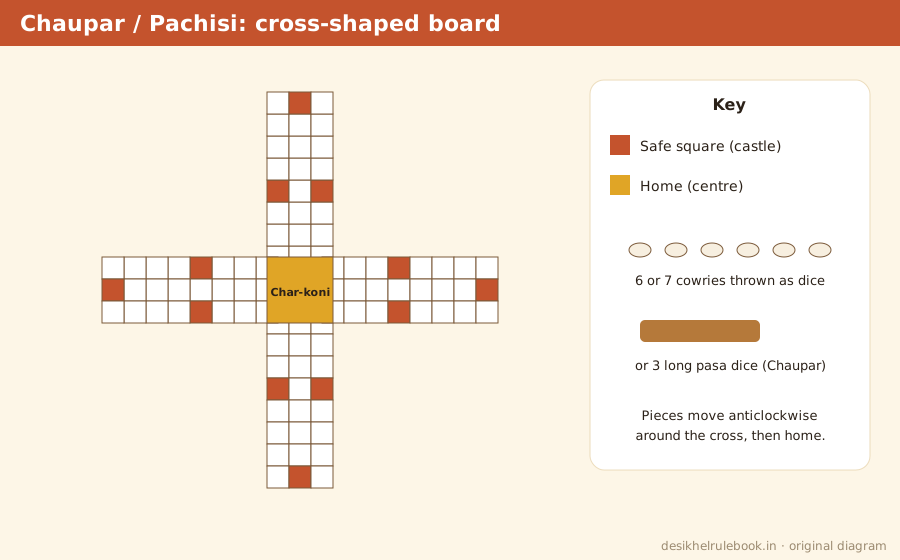
Pachisi and Chaupar are close cousins. Both use the same cross-shaped board. Pachisi is usually played with six or seven cowrie shells, and the name comes from "pachis," twenty-five, the highest throw. Chaupar (Chausar) is usually played with three long dice and allows a little more choice. This page explains the board, the throws, movement, capture, safe squares and a common set of family rules, so you can start playing tonight with a home-made board.
History and cultural note — इतिहास और परंपरा
The game is strongly associated with India's royal and courtly culture. A famous story tells of Mughal emperor Akbar playing Pachisi on a giant board laid out in a palace courtyard at Fatehpur Sikri, using people as pieces; the paved courtyard board is still shown to visitors there. Chaupar or Chausar also appears in the Mahabharata, where the dice game between Yudhishthira and Shakuni changes the fate of the Pandavas; that game is often described as a form of chausar. Whatever the precise history, cross-and-circle board games have deep roots in India, and Pachisi later inspired the Western game "Parcheesi" and the British "Ludo," which simplified the rules and replaced shells with a cube die.
Many Indian families still own old cloth chaupar boards, often brought out during Diwali, Holi or long summer afternoons. Grandparents tend to be fiercely competitive, which only adds to the fun.
Players and age group — खिलाड़ी और उम्र
Four players in two partnerships is the classic format: partners sit opposite each other (yellow & black vs red & green, for example). Two players can also play, each controlling two colours. Ages eight and up can learn quickly; younger children can be "shell throwers" on a parent's team. A full game can take an hour or more, which makes it ideal for holidays and family evenings.
Equipment you need — सामान
- A cross-shaped board: four arms, each with three columns of eight squares (96 squares in total), plus a central home called the Char-koni.
- Four sets of four pieces (16 in total), usually cone-shaped, in four colours.
- Six or seven cowrie shells (Pachisi) or three long four-sided dice marked 1, 2, 5, 6 (Chaupar).
- Optional: a cloth bag to keep pieces, and paper to note captures.
No board? Draw it on chart paper with a ruler: three columns of eight squares on each arm, a large square in the centre, and mark the safe "castle" squares with a cross. Cowries are easy to find in pooja shops; if not, use six coins and count "heads" as open mouths.
Ground and setup — मैदान की तैयारी
Each player's pieces start in the central home (in Pachisi) or just off the board (in some family rules). The playing path runs down the middle column of your own arm from the centre, then anticlockwise around the outer columns of all four arms, and finally back up the middle column of your own arm to home.
The marked squares (castles) are usually the fourth square from the end on each outer column and the end square of each middle column: 12 castles in total. A piece sitting on a castle cannot be captured by opponents.
Step-by-step rules — खेल के नियम
- Throwing cowries (Pachisi): throw six cowries. Count how many land with the open side (mouth) up. Values in a common system: 0 mouths up = 25 (pachisi); 1 = 10 (dus); 2 = 2 (do); 3 = 3 (teen); 4 = 4 (chaar); 5 = 5 (paanch); 6 = 6 (chhah). Throws of 6, 10 or 25 earn an extra throw; these are called "grace" throws.
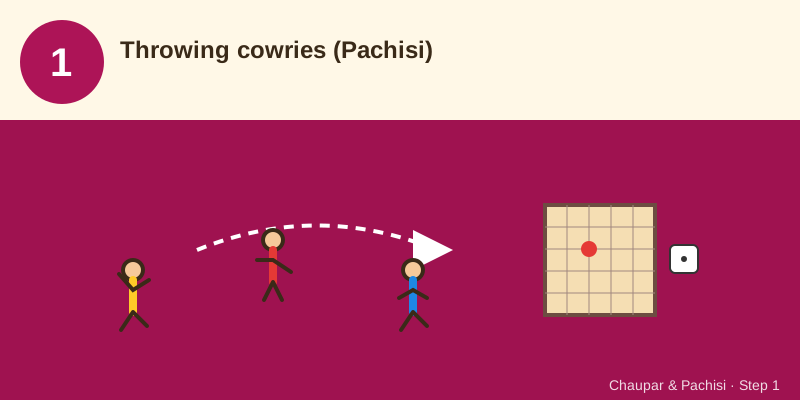
Step 1 – Chaupar & Pachisi step 1: Throwing cowries (Pachisi) - Throwing long dice (Chaupar): throw three long dice; each shows 1, 2, 5 or 6. You may use each die for a different piece or combine them for one.
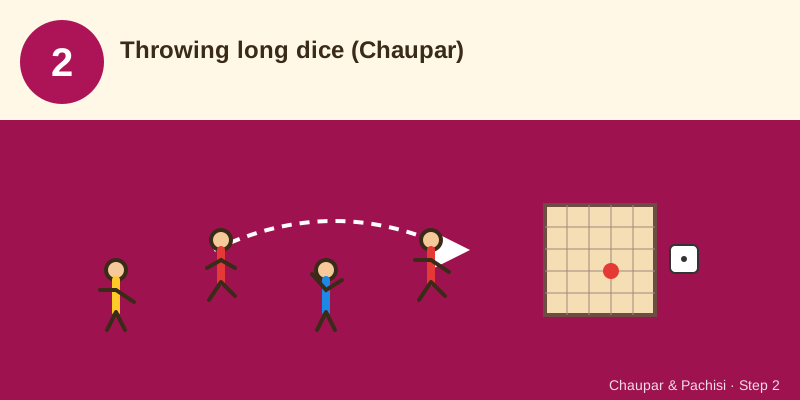
Step 2 – Chaupar & Pachisi step 2: Throwing long dice (Chaupar) - Entering: in many rules, a piece needs a grace throw (6, 10 or 25) to enter the board. Some families allow entering on any throw.
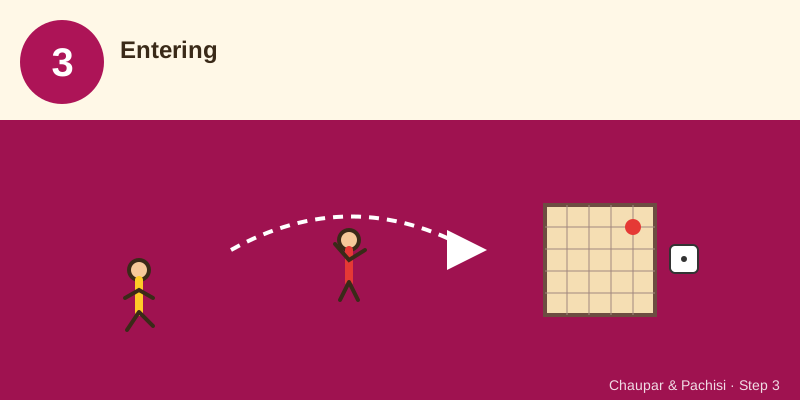
Step 3 – Chaupar & Pachisi step 3: Entering - Moving: move a piece forward the number thrown. Pieces always move anticlockwise. You may split multiple throws among different pieces.
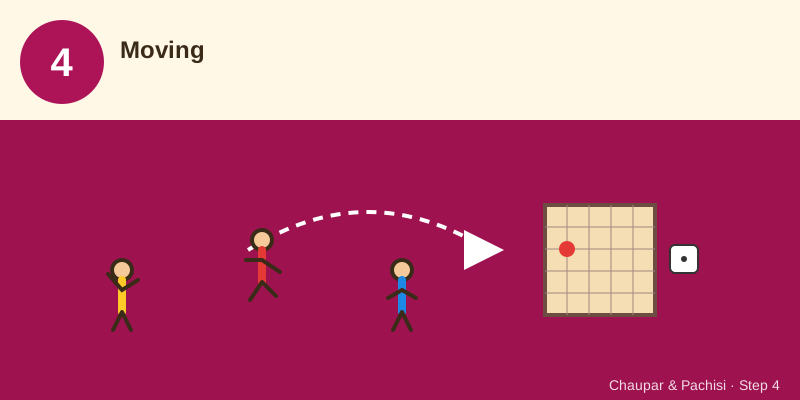
Step 4 – Chaupar & Pachisi step 4: Moving - Capturing: if you land exactly on a square occupied by an opponent's piece (not on a castle), that piece is captured and goes back to the start. Capturing usually grants an extra throw.
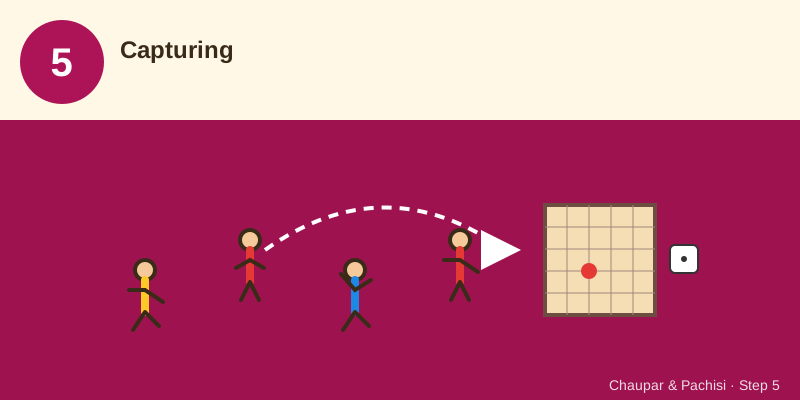
Step 5 – Chaupar & Pachisi step 5: Capturing - Safe castles: a piece on a castle is safe. Opponents cannot land there on top of it. Your partner may share a castle with you.

Step 6 – Chaupar & Pachisi step 6: Safe castles - Blocking: two of your own pieces on the same square form a block; opponents cannot pass in some rules.
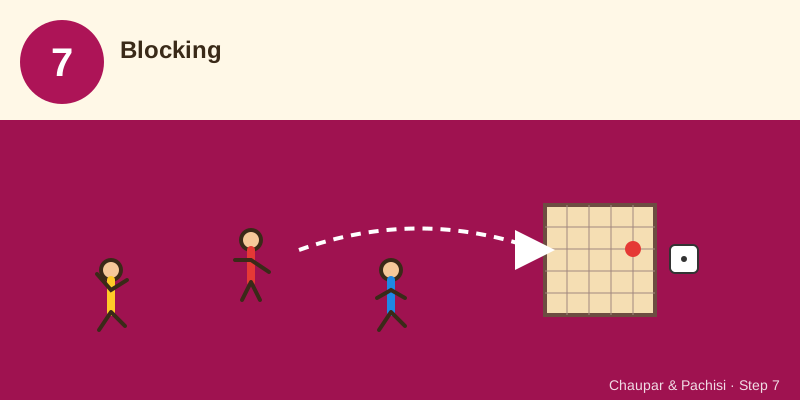
Step 7 – Chaupar & Pachisi step 7: Blocking - Home: after completing the full circuit, pieces return up their own middle column to the central home. An exact throw is often needed to enter home.
Step 8 – Chaupar & Pachisi step 8: Home - Partnership win: the first partnership to bring all eight pieces home wins.
Step 9 – Chaupar & Pachisi step 9: Partnership win
Scoring and winning — अंक और जीत
Pachisi is won, not scored: the team that brings all their pieces home first wins. However, family games often keep a tally across several games, with one point for a win and an extra point if the losing team has fewer than two pieces home. Some families score captures too, as bragging rights.
Strategy tip: grace throws (6, 10, 25) are precious. Use the big 25 throw to move a piece quickly past danger, and smaller throws to slip pieces onto castles.
Fouls and common disputes — फ़ाउल और झगड़े
- Moving a piece clockwise — move is cancelled.
- Landing on a castle already occupied by an opponent — not allowed; choose another move.
- Counting the starting square as one — common beginner mistake; you count the next square as one.
- Throwing cowries outside the board area or with a hand cupped over them — re-throw.
- Not using a throw you were able to use — in strict rules the throw is forfeited.
A sample round, explained — एक उदाहरण
Riddhi (yellow) and her grandfather (black) play against her cousins. Riddhi throws six cowries: two mouths up, which is 2. She cannot enter yet because her family rule needs a grace throw. Next turn she throws no mouths up: 25! She enters a piece and moves it 25 squares, and because 25 is a grace throw she throws again: 6. She brings a second piece in.
Later, her cousin's red piece is 3 squares ahead of her yellow piece, not on a castle. Riddhi throws a 3 and captures it, sending it back home and earning an extra throw. Her grandfather smiles: "Ab dhyan se, castle pe baitho." On the extra throw she gets a 4 and moves to a castle square, safe from revenge.
Regional names across India — अलग-अलग राज्यों में नाम
| Region / language | Name used |
|---|---|
| North India | Chaupar, Chausar, Pachisi |
| Rajasthan | Chopad |
| Maharashtra | Saripat, Chausar |
| Gujarat | Chopat |
| Tamil Nadu | Dayakattam (related cross game) |
| Kerala | Pakida (related) |
| Karnataka | Pagade |
| Bengal | Pasha |
Variations to try — खेल के रूप
Pachisi (cowries)
Six or seven cowries; values 2–6, 10 and 25; grace throws of 6, 10, 25.
Chaupar (long dice)
Three long dice with 1, 2, 5, 6; more choice and speed.
Simple family version
Use a single cube die; 6 lets a piece enter; any capture sends a piece home. Great for kids.
Two-player version
Each player controls two opposite colours, effectively playing both partners.
How to run it in a school or housing society — स्कूल और सोसाइटी में कैसे खिलाएँ
Chaupar works well as a rainy-day activity in school or as part of a heritage week. Let students draw their own boards on chart paper, which teaches geometry and counting squares. Use buttons as pieces and coins or cowries as dice. Introduce it with the story of Akbar's courtyard board and the Mahabharata dice game; history teachers love the connection.
In societies, host a "Chaupar evening" during Diwali. Senior residents often know the rules and can teach children. Set up tables with boards and have a simple knockout tournament of partnerships.
Teaching tips for coaches and parents — सिखाने के टिप्स
Start with the simple single-die family version, then introduce cowries once children understand movement. Use a cheat sheet listing cowrie values. Encourage children to think aloud about choices: "Which piece is safest to move?" This builds strategic thinking.
A ready-made 45-minute session plan for Chaupar / Pachisi — 45 मिनट की योजना
Teachers, coaches and society volunteers often ask for a plan they can follow without preparation. Here is one built around Chaupar / Pachisi, suitable for 2 or 4 (4 in partnerships is classic) and a space of roughly table or floor mat. Adjust the timings to your group, but try to keep the structure, because it moves children from understanding to playing without long lectures.
- 0–5 minutes: gather and explain. Sit everyone in a circle. Show the diagram on this page (print it or hold up a phone). Explain only the three most important rules; the rest can be taught while playing.
- 5–10 minutes: warm-up. Light jogging, arm circles, ankle rolls and a few stretches. For board or small-space games, use finger and wrist warm-ups and a quick memory game instead.
- 10–18 minutes: skill drill. Practise the one key skill of the game in pairs or small groups (the teaching tips above suggest which). Short repetitions with lots of praise work better than one long attempt.
- 18–38 minutes: play. Play the game in short rounds. After every round, pause for thirty seconds and ask one question: "What worked? What was unfair?" Let children suggest small rule tweaks and vote on them.
- 38–45 minutes: cool down and reflect. Slow walking or breathing, water, and a quick round where each child says one thing they learned or one person who played fairly.
A session like this fits neatly into a school games period, a summer-camp slot or a Sunday morning in the society garden. Repeat it across a few weeks and you will see children start organising Chaupar / Pachisi on their own, which is the real goal.
Making Chaupar / Pachisi inclusive — सबको शामिल करें
Traditional games were always played by mixed groups: older and younger siblings, cousins visiting for the holidays, neighbours of every background. Keep that spirit alive. Give younger or less confident children a "helper" role first (scorer, umpire, equipment-in-charge) and then a playing role once they have watched a round. Pair a strong player with a beginner rather than letting captains pick teams in front of everyone, which can hurt feelings. For a child who uses a wheelchair or has limited mobility, shorten distances, allow seated or standing play where possible, and give them roles that matter to the result, such as caller, measurer or final judge. For children who find noise overwhelming, a quieter corner version or a smaller group helps. Small changes like these rarely spoil the game, and they teach every child that play belongs to everyone.
A note for parents: bringing Chaupar / Pachisi home — माता-पिता के लिए
Many parents tell us the same story: their child spends hours on a phone game, but the moment a cousin or neighbour suggests Chaupar / Pachisi, the phone is forgotten. Traditional games work because they are social, physical and a little unpredictable, and because they belong to the child's own world rather than to a screen. You do not need to be an expert to bring this game home. Start by playing once yourself, even badly; children love seeing a parent learn. Tell them how you or their grandparents played it, and what it was called in your town. Then step back and let them run it.
Keep the equipment in a visible place, such as a basket near the door, so that it is easy to grab. Invite one or two neighbourhood children for a regular weekly slot, perhaps a Saturday evening, and the habit will grow on its own. When disagreements happen, ask questions instead of giving verdicts: "What rule did you agree? Is that fair for the smaller kids?" Over a few weeks you will notice the children negotiating, adapting and including others, which are exactly the skills a good school tries to teach. Finally, take a photo or a short video of them playing and share it with the grandparents. Few things make an Indian dadi or nana happier than seeing a grandchild play the game they once played in the same way.
Safety tips — सुरक्षा
- Cowries and small pieces are choking hazards for toddlers.
- Play on a stable table to avoid pieces rolling off.
- Long games: take breaks to stretch and drink water.
Skills and benefits for children — बच्चों को फ़ायदे
Pachisi builds counting, probability intuition, planning and patience. Partnerships teach cooperation; the long game teaches resilience when luck turns. It also connects children to Indian history and family stories.
हिंदी में सारांश
चौपड़ और पचीसी पुराना भारतीय खेल है, जिसका बोर्ड "+" आकार का होता है। पचीसी में कौड़ियाँ फेंकी जाती हैं: कोई भी कौड़ी सीधी न गिरे तो 25 (पचीस) अंक मिलते हैं। चौपड़ में लंबे पासे होते हैं।
गोटियाँ उल्टी घड़ी की दिशा में चलती हैं। विरोधी की गोटी पर पहुँचकर उसे मारा जा सकता है, लेकिन "किले" वाले खानों पर गोटी सुरक्षित रहती है। सबसे पहले सभी गोटियाँ घर लाने वाली टीम जीतती है।
FAQ: Chaupar & Pachisi Rules – India's Royal Board Game — अक्सर पूछे जाने वाले सवाल
Is Pachisi the same as Ludo?
Ludo is a simplified version of Pachisi with a cube die and a smaller board.
What does Pachisi mean?
It comes from "pachis," meaning twenty-five, the highest cowrie throw.
How many cowries are used?
Six or seven in most versions.
What are castle squares?
Marked safe squares where pieces cannot be captured.
Can two people play?
Yes, each controls two colours.
Is Chaupar different from Pachisi?
Chaupar uses three long dice; Pachisi uses cowries. The board is the same.
Where can I see a giant Pachisi board?
At Fatehpur Sikri, the courtyard is traditionally associated with Akbar's human-sized game.
How long does a game take?
Usually 45–90 minutes.
What if I have no cowries?
Use coins (heads = mouth up) or a cube die with family rules.
Is Chaupar mentioned in the Mahabharata?
The famous dice game in the Mahabharata is often linked to chausar/chaupar.
Related games
Ludo Rules & Indian House Variants – Cutting, Safe Squares & More
Roll a six, open your goti, cut your cousin — and learn the house rules every Indian family argues about.

Snakes and Ladders Rules – Saap Seedhi & Moksha Patam Desi Variants
Climb ladders of virtue, slide down snakes of vice — the Indian origin and desi house rules of saap-seedhi.
Carrom Rules (Home Rules) – Points, Queen Cover & Fouls
Flick the striker, pocket your coins, cover the queen — family carrom rules made clear.

Kancha (Marbles) Rules – Indian Marble Games Explained
Flick the shooter, knock marbles out of the ring and learn the famous Indian "gucchi" pit version.