
Snakes and Ladders Rules – Saap Seedhi & Moksha Patam Desi Variants

Almost every Indian child has slid down a long snake from 98 to 7 and wailed in protest. Saap-Seedhi (snakes and ladders) is the perfect first board game: no strategy, just counting, luck and a big emotional ride. Yet this simple game has a surprisingly deep Indian history as Moksha Patam or Gyan Chaupar, a game designed to teach that good deeds raise us and bad deeds pull us down.
This page covers the standard rules, the Indian house variants families use (starting conditions, exact finish, bounce-back, cutting), team play, and ideas to turn the game into a values or maths lesson. A home-made board idea is included for rainy-day crafts.
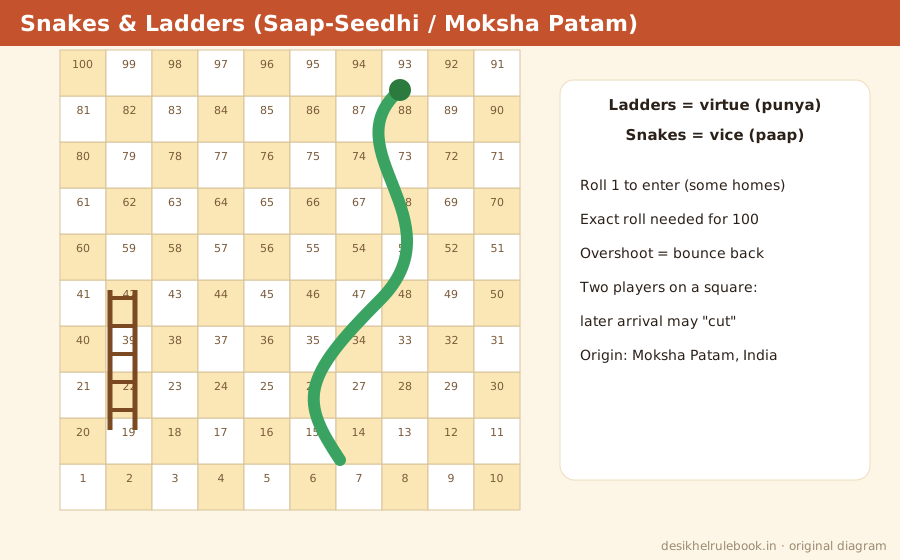
History and cultural note — इतिहास और परंपरा
Historians and game researchers trace snakes and ladders to Indian games such as Gyan Chaupar (game of knowledge) and Moksha Patam (ladder to liberation). Old boards, often painted on cloth, had squares labelled with virtues and vices: ladders started at squares like generosity, faith or humility, while snakes started at squares like anger, greed or theft. Players reached the final square representing moksha or liberation. Jain, Hindu and Sufi versions are known, each with different spiritual labels. In the colonial era, the game travelled to Britain and was simplified into "Snakes and Ladders," later "Chutes and Ladders" in America. Today, Indian printed boards often carry ludo on the reverse side.
Players and age group — खिलाड़ी और उम्र
Two to six players, each with one token. Ages four and up — it is excellent for teaching counting to small children. Adults can join without any advantage, which makes it a fair family game.
Equipment you need — सामान
- A board with 100 squares (10 × 10) numbered in a zig-zag (boustrophedon) pattern.
- Snakes and ladders printed or drawn on the board.
- One die.
- One token per player.
Ground and setup — मैदान की तैयारी
Place all tokens off the board, next to square 1. Decide the order by rolling the die; highest goes first.
Step-by-step rules — खेल के नियम
- Players take turns rolling the die and moving forward that many squares.

Step 1 – Snakes and Ladders step 1: Players take turns rolling the die and moving forward that many squares - If you land at the bottom of a ladder, climb to the top.
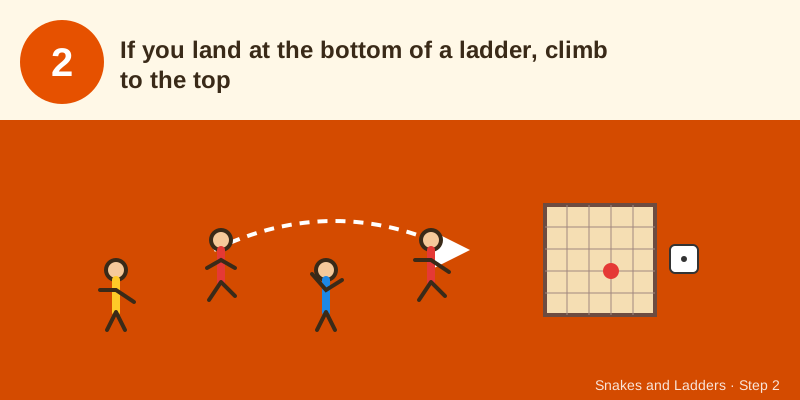
Step 2 – Snakes and Ladders step 2: If you land at the bottom of a ladder, climb to the top - If you land on a snake's head, slide down to its tail.
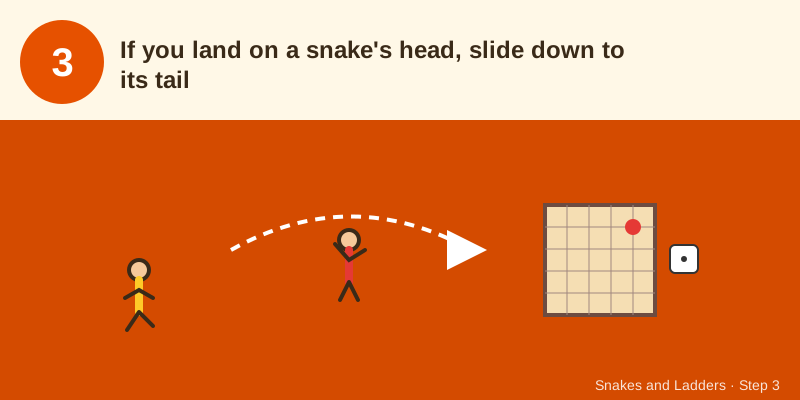
Step 3 – Snakes and Ladders step 3: If you land on a snake's head, slide down to its tail - Rolling a six gives an extra turn (common rule).

Step 4 – Snakes and Ladders step 4: Rolling a six gives an extra turn (common rule) - Three sixes in a row: in many homes, you go back to start or lose the turn.

Step 5 – Snakes and Ladders step 5: Three sixes in a row - You must land exactly on 100 to win (common rule). If your roll would take you beyond 100, you either do not move or bounce back the extra steps.

Step 6 – Snakes and Ladders step 6: You must land exactly on 100 to win (common rule) - The first player to reach 100 wins.

Step 7 – Snakes and Ladders step 7: The first player to reach 100 wins
Scoring and winning — अंक और जीत
Saap-seedhi usually has no points. For tournaments, give points by finishing order. For learning games, ask each player to add their rolls or name the square number aloud for a point.
Fouls and common disputes — फ़ाउल और झगड़े
- Moving the wrong number — undo.
- Skipping a snake by accident — must take it.
- Rolling the die off the board — re-roll.
- Arguing about house rules — settle them before playing.
A sample round, explained — एक उदाहरण
Anu, Ravi and Nanu play with "enter on 6" and "bounce-back" rules. Anu rolls a 6 and enters, then rolls a 3 to square 3. Ravi rolls a 1 but cannot enter. Nanu rolls 6, enters and gets another roll: 4, landing on a ladder to square 14. Later, Anu is on 97 and rolls a 5. She bounces back: 98, 99, 100, 99, 98 — and lands on a snake at 98. Everyone gasps as she slides to 7.
Regional names across India — अलग-अलग राज्यों में नाम
| Region / language | Name used |
|---|---|
| Hindi belt | Saap-Seedhi, Saanp-Seedhi |
| Tamil Nadu | Parama Padam |
| Telugu states | Vaikuntapali, Parama Padam |
| Karnataka | Haavu Eni |
| Bengal | Sap-Ludo, Sap-Siri |
| Maharashtra | Saap-Shidi |
| Traditional | Moksha Patam, Gyan Chaupar |
Variations to try — खेल के रूप
Moksha Patam values board
Label ladders with virtues and snakes with vices; discuss them as you play.
Maths ladder
Answer a sum before climbing.
Team saap-seedhi
Two players share a token; good for small kids.
Giant floor board
Draw a 10 × 10 grid on the floor; children are tokens.
Make your own Moksha Patam board
A home-made board is a wonderful rainy-day craft. Take a chart paper and draw a 10 × 10 grid with 6–7 cm squares. Number from bottom left, going right on the first row, then left on the second row, and so on to 100. Now ask children to choose five virtues and five vices in Hindi or English: daya (kindness), satya (truth), dhairya (patience), seva (service), mehnat (hard work); krodh (anger), lobh (greed), jhooth (lying), aalas (laziness), ahankaar (pride). Draw ladders starting at the virtue squares and snakes starting at the vice squares. Colour the snakes and ladders brightly. When playing, every time someone climbs or slides, the child reads the word aloud and the family shares one small example from daily life. It turns a luck game into a gentle values conversation, exactly as the old Indian boards intended.
Making it less frustrating for small children
Saap-seedhi can be heartbreaking for a four-year-old who slides from 97 to 4. A few gentle tweaks help: use a board with fewer long snakes, allow a "snake shield" token that cancels one snake per game, or play in teams so an adult shares the token. Praise good counting rather than winning. Explain beforehand that the game is about luck, and celebrate funny slides together. These small changes keep the game joyful and teach resilience instead of tears.
Probability for older children
Older children can explore probability: what is the chance of rolling a six? (One in six.) Why does a long snake near 100 matter so much? (Because players spend many turns near the end.) Ask them to track how many turns a game takes and compare boards with different snake placements. This simple data project shows how game design shapes outcomes — a nice bridge between play and maths.
Quick checklist before you start
Before the first round, run through a short checklist with the group. Is the space clear and safe for everyone, including younger children? Does everyone know the main rules, and have the house rules been agreed out loud? Is there a neutral person to settle disputes, such as an older child, a teacher or a parent? Is there water nearby, and does anyone need a break? Does every player have a role, even if it is scorer or judge for the first round? Taking one minute for this checklist saves many minutes of arguments later, and it teaches children to plan before they play — a small habit that helps them in every team activity they will ever join.
How to run it in a school or housing society — स्कूल और सोसाइटी में कैसे खिलाएँ
Teachers use saap-seedhi for counting, number recognition and values education. Draw a giant board in the playground with chalk for primary classes. In societies, organise a "giant saap-seedhi" on Children's Day.
Teaching tips for coaches and parents — सिखाने के टिप्स
For small kids, count steps aloud. Ask them to predict where they will land. Discuss the values on a Moksha Patam board: "Why does a snake start at anger?"
A ready-made 45-minute session plan for Saap-Seedhi — 45 मिनट की योजना
Teachers, coaches and society volunteers often ask for a plan they can follow without preparation. Here is one built around Saap-Seedhi, suitable for 2–6 and a space of roughly table or floor. Adjust the timings to your group, but try to keep the structure, because it moves children from understanding to playing without long lectures.
- 0–5 minutes: gather and explain. Sit everyone in a circle. Show the diagram on this page (print it or hold up a phone). Explain only the three most important rules; the rest can be taught while playing.
- 5–10 minutes: warm-up. Light jogging, arm circles, ankle rolls and a few stretches. For board or small-space games, use finger and wrist warm-ups and a quick memory game instead.
- 10–18 minutes: skill drill. Practise the one key skill of the game in pairs or small groups (the teaching tips above suggest which). Short repetitions with lots of praise work better than one long attempt.
- 18–38 minutes: play. Play the game in short rounds. After every round, pause for thirty seconds and ask one question: "What worked? What was unfair?" Let children suggest small rule tweaks and vote on them.
- 38–45 minutes: cool down and reflect. Slow walking or breathing, water, and a quick round where each child says one thing they learned or one person who played fairly.
A session like this fits neatly into a school games period, a summer-camp slot or a Sunday morning in the society garden. Repeat it across a few weeks and you will see children start organising Saap-Seedhi on their own, which is the real goal.
Making Saap-Seedhi inclusive — सबको शामिल करें
Traditional games were always played by mixed groups: older and younger siblings, cousins visiting for the holidays, neighbours of every background. Keep that spirit alive. Give younger or less confident children a "helper" role first (scorer, umpire, equipment-in-charge) and then a playing role once they have watched a round. Pair a strong player with a beginner rather than letting captains pick teams in front of everyone, which can hurt feelings. For a child who uses a wheelchair or has limited mobility, shorten distances, allow seated or standing play where possible, and give them roles that matter to the result, such as caller, measurer or final judge. For children who find noise overwhelming, a quieter corner version or a smaller group helps. Small changes like these rarely spoil the game, and they teach every child that play belongs to everyone.
A note for parents: bringing Saap-Seedhi home — माता-पिता के लिए
Many parents tell us the same story: their child spends hours on a phone game, but the moment a cousin or neighbour suggests Saap-Seedhi, the phone is forgotten. Traditional games work because they are social, physical and a little unpredictable, and because they belong to the child's own world rather than to a screen. You do not need to be an expert to bring this game home. Start by playing once yourself, even badly; children love seeing a parent learn. Tell them how you or their grandparents played it, and what it was called in your town. Then step back and let them run it.
Keep the equipment in a visible place, such as a basket near the door, so that it is easy to grab. Invite one or two neighbourhood children for a regular weekly slot, perhaps a Saturday evening, and the habit will grow on its own. When disagreements happen, ask questions instead of giving verdicts: "What rule did you agree? Is that fair for the smaller kids?" Over a few weeks you will notice the children negotiating, adapting and including others, which are exactly the skills a good school tries to teach. Finally, take a photo or a short video of them playing and share it with the grandparents. Few things make an Indian dadi or nana happier than seeing a grandchild play the game they once played in the same way.
Safety tips — सुरक्षा
- Small tokens can be choking hazards for toddlers.
- Keep play light; remind kids it is a luck game.
Skills and benefits for children — बच्चों को फ़ायदे
Counting, number sense, turn-taking, coping with disappointment and values discussion.
हिंदी में सारांश
साँप-सीढ़ी में पासा फेंककर आगे बढ़ते हैं। सीढ़ी मिली तो ऊपर, साँप के मुँह पर पहुँचे तो नीचे। 100 पर पहले पहुँचने वाला जीतता है।
यह खेल भारत के "मोक्ष पटम" और "ज्ञान चौपड़" से आया है, जिसमें सीढ़ियाँ अच्छे कर्म और साँप बुरे कर्म दिखाते थे। घर के नियम पहले तय करें — जैसे 6 पर शुरुआत, ठीक 100 पर पहुँचना।
FAQ: Snakes and Ladders Rules – Saap Seedhi & Moksha Patam Desi Variants — अक्सर पूछे जाने वाले सवाल
Is snakes and ladders Indian?
Yes, it is linked to Moksha Patam and Gyan Chaupar.
Do I need a 6 to start?
Only if your house rule says so.
What happens if I overshoot 100?
Depending on rules, you stay or bounce back.
What is Moksha Patam?
A traditional Indian version teaching virtues and vices.
What is Parama Padam?
The Tamil/Telugu name for the game.
How many players?
Two to six.
What age is it for?
Four and above.
Can I cut another player?
Only if you use the cutting house rule.
Why is the board zig-zag?
So the path continues smoothly from row to row.
Can we make a home-made board?
Yes, draw a 10 × 10 grid and add snakes and ladders.
Related games
Ludo Rules & Indian House Variants – Cutting, Safe Squares & More
Roll a six, open your goti, cut your cousin — and learn the house rules every Indian family argues about.
Chaupar & Pachisi Rules – India's Royal Board Game
The cross-shaped royal game played with cowrie shells or long dice — the ancestor of Ludo.
Carrom Rules (Home Rules) – Points, Queen Cover & Fouls
Flick the striker, pocket your coins, cover the queen — family carrom rules made clear.

Four Corners Game Rules – Chaar Kone Indoor & Outdoor Fun
Run to a corner, wait for the call, hope your corner survives — a quick, no-equipment classroom favourite.